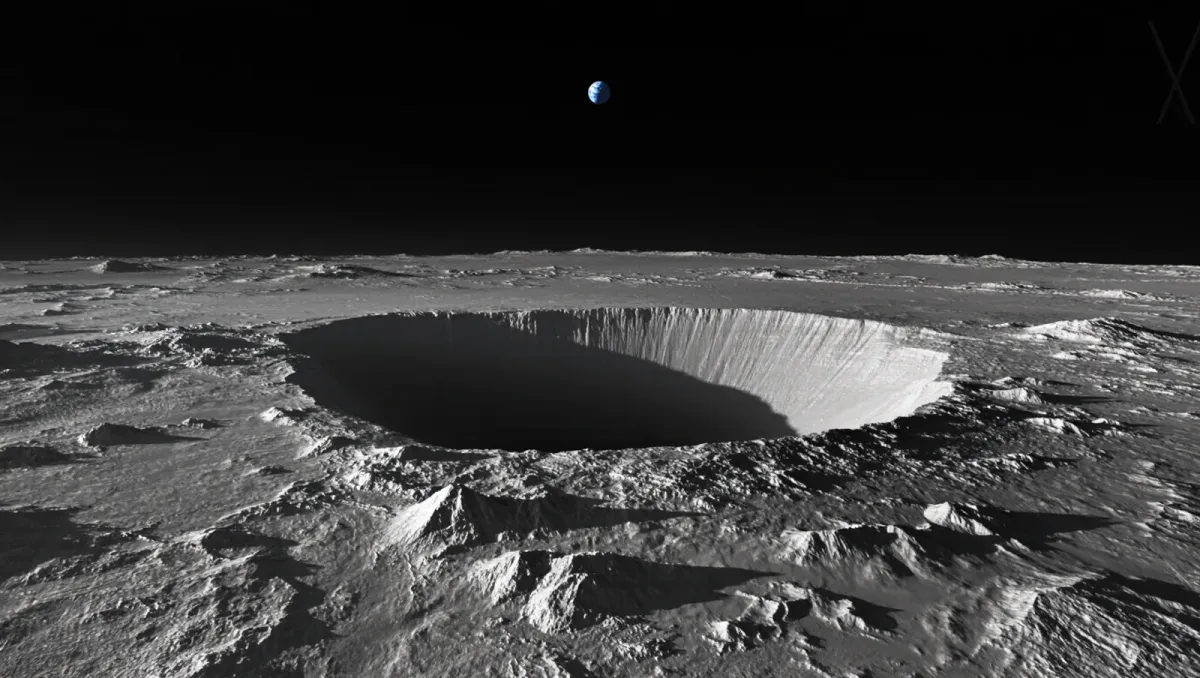
Lunar missions target the south pole because its permanently shadowed craters appear to hold deposits of water ice, along with other frozen gases, in places sunlight has not reached for billions of years. Data from India's Chandrayaan-1 orbiter in 2008 and NASA's LCROSS impact experiment in 2009 established that lunar hydrogen, most plausibly as ice, concentrates near the poles; since then a string of landers and orbiters has converged on the region. The ice matters twice over — as a scientific record of the solar system's water delivery, and as raw material no future surface mission would have to carry from Earth.
Why is there ice at the poles and not elsewhere?
The Moon's axis is tilted less than two degrees, so sunlight at the poles arrives at a grazing angle. Some crater floors near the poles have never seen the Sun; temperatures in these permanently shadowed regions sit near minus 220 degrees Celsius, cold enough that any water molecule arriving there — delivered by comets, asteroids, or solar-wind chemistry over eons — stays frozen rather than escaping to space. Instruments orbiting since the late 1990s have mapped hydrogen signatures consistent with ice concentrated in exactly these cold traps.
Estimates of how much ice exists vary widely between studies, because orbiters sense hydrogen from above rather than weighing the deposit. Modeling and orbital data agree on the where far better than the how much — a discrepancy that only surface missions can close.
How confident is the ice detection?
The evidence is layered and each layer is named. In 2009, NASA's LCROSS probe struck a permanently shadowed crater named Cabeus and flew a spacecraft through the ejecta plume, detecting water vapor and ice — a direct, though single-point, measurement. In 2018, a reanalysis of Chandrayaan-1 Moon Mineralogy Mapper data found exposed surface ice at polar cold traps. And from 2022 to 2024, NASA's ShadowCam camera aboard a Korean orbiter imaged shadowed crater interiors in detail, revealing terrain — and informally, obstacles — that earlier missions could only infer.
What remains unmeasured is distribution at the scale a lander or drill cares about: whether ice lies in thick layers, dispersed grains, or scattered lenses. That is the stated purpose of several missions now converging on the region.
Which missions are heading there?
The list as of early 2026, keeping to programs with firm surface ambitions:
- NASA's Artemis campaign plans crewed landings in the south polar region, with Artemis II, a crewed lunar flyby, and Artemis III, the first crewed landing of the campaign, in preparation; NASA has repeatedly revised these schedules, and target dates have moved multiple times.
- India's Chandrayaan-3 achieved the first landing in the south polar vicinity in August 2023, and India has announced follow-up south-pole missions including a planned sample return later in the decade.
- Russia's Luna-25 probe crashed during its south-pole landing attempt in August 2023.
- China's Chang'e program has orbited and sampled mid-latitude sites, with announced plans for south-pole landings and an international lunar research station later in the decade.
- U.S. commercial landers under NASA's CLPS program, including Intuitive Machines' flights in 2024 and 2025, have carried polar-relevant science toward the region, with mixed success that NASA reports in detail.
Not every attempt succeeds — landers have tipped over, missed their sites, or fallen silent — and the failures are as much a part of the record as the landings.
Why is landing at the pole technically harder?
Terrain and light. The same grazing sunlight that preserves ice means landers descend through long shadows and glaring horizontal glare, with navigation cameras struggling to judge surface relief in near-darkness. Terrain near the poles is ancient and battered, offering fewer smooth flood-basalt plains like the equatorial sites of the Apollo era. And the cold traps themselves are among the coldest places in the solar system measured by orbiters — hostile to batteries, seals, and moving parts, which is why mission concepts sample their edges before entering the deepest shadow.
What do the polar landers carry?
Science payloads follow from the questions. Some landers tote drills and spectrometers meant to taste the regolith's volatiles directly; others carry thermal probes to measure how heat flows through layers that sunlight has never warmed; orbiters contribute neutron and infrared spectrometers that map where hydrogen and surface frost sit. NASA's shadowed-crater imaging and terrain radar, and instruments delivered on early commercial flights, are explicitly billed as scouting: choosing where a future drill should sink its first core.
What science does the ice offer beyond resources?
The frozen layers are an archive. Volatiles trapped in polar cold traps record billions of years of delivery by comets and asteroids and of production by solar-wind chemistry; their layering and composition — water, carbon dioxide, ammonia, methane, and more detected in orbital data — bear on where Earth's own water came from, still an open question. Drilling and analyzing a core from a permanently shadowed region is, in this sense, a paleoclimate record for the inner solar system.
The resource case is more speculative and usually stated with hedges: water split into hydrogen and oxygen could, in principle, supply drinking water, breathable air, and rocket propellant, reducing what future missions must launch from Earth. Whether extracting it proves economical is untested, and no mission yet flown has refined polar ice into anything.
Who, if anyone, owns a landing site?
The 1967 Outer Space Treaty — ratified by more than 110 states including the United States, Russia, and China — forbids national appropriation of celestial territory. The U.S.-led Artemis Accords, with a growing list of signatories since 2020, add understandings about safety zones and resource extraction; China and Russia lead a parallel arrangement for a planned research station. Overlapping announcements, not overlapping flags, define the current situation — a governance question the science has not yet forced, but which surface presence at the pole gradually will.