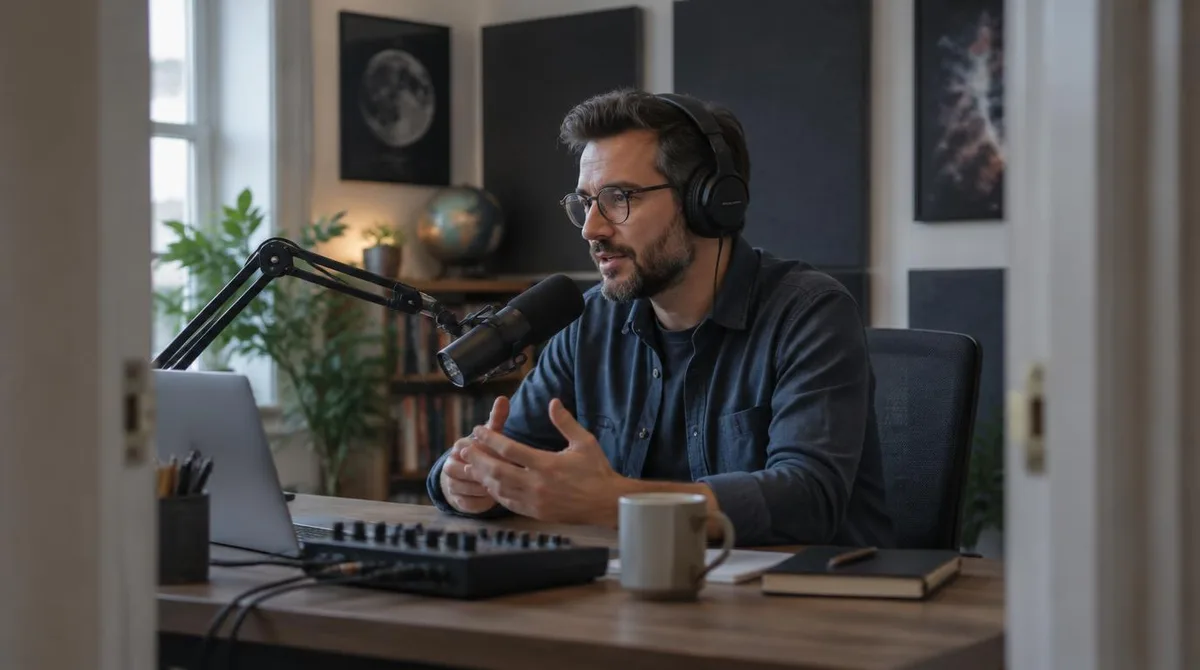
Science now reaches many ears before any screen. A 2019 analysis in Royal Society Open Science tracked science podcast series growing slowly from 2004 to 2010, then exponentially to 2018, with most series aimed at general audiences. That supply boom, plus record survey numbers behind it, hints that audio has become a main route into research.
The audience side has its own numbers. The Infinite Dial 2024 survey by Edison Research found 47 percent of Americans aged 12 and older had listened to a podcast in the past month, a record at the time. The magazine’s science news coverage follows how findings travel, and audio is now one of those roads.
The form rewards plain words. When an observatory announces it will photograph the entire sky over ten years, a host can slow down, define each term, and let the scale sink in, as this explainer of the Vera Rubin Observatory’s sky survey does for readers.
What counts as a science podcast?
In the 2019 study, Lewis MacKenzie of Durham University defined science podcasts as series covering the natural sciences: physics, chemistry, biology, geology, climate, and mathematics. The count included English-language feeds only, a limit that matters for any global claim. Most series were made for curious listeners, not peers; 77 percent targeted public audiences.
Where did the word and the boom come from?
The word itself is young. A Wikipedia entry updated in 2026 traces “podcasting” to Ben Hammersley, a Guardian columnist and BBC journalist, who coined it in February 2004 as a blend of “iPod” and “broadcast”. Early podcasters, among them Adam Curry, picked the term up within months.
Growth came in two phases, per the 2019 analysis: a linear crawl from 2004 to 2010, then an exponential climb to 2018. The study counted series; it could not test what drove the curve. Cheaper recording tools and phone listening plausibly played a part, but that reading stays an interpretation, not a measured cause.
How big is the audience now?
The 2024 Edison survey put weekly podcast listening at 34 percent of Americans 12 and older, with monthly listening at 47 percent. Online audio of any kind reached 76 percent monthly, an estimated 218 million people. Women drove much of the podcast gain: monthly listening rose from 39 to 45 percent.
A podcast episode works a bit like a friend walking a visitor through a museum wing. The host picks what to point at, and in what order, so the listener never faces a wall of 200 unlabeled paintings. Text can do the same job; audio just adds pace, pause, and a human voice.
Who hosts, and who pays?
The 2019 snapshot found scientists hosted 65 percent of series, with media professionals a distant second. Money was scarce: only 24 percent had any overt income, and 62 percent were tied to an organization. Affiliated series also produced more episodes, with a median of 24 against 16 for independent shows. The picture that emerges is a field run on effort more than revenue.
Where the evidence comes from
The 2019 study is a census-style count of series, not a survey of listeners, so it measures supply, not attention. It covered English feeds only, leaving other languages outside its frame. The Edison figures come from a long-running annual survey of Americans, a separate method aimed at behavior rather than content. Neither study can say why people press play.
Conclusion
The science podcast now works as a standard front door to research: built mostly by scientists, aimed mostly at the curious, and heard by a record share of Americans. The open questions concern impact rather than reach, and those need listener-side studies that follow what people retain. On supply, the record is already clear. Audio earned a seat at the table. This connects to our earlier piece, Science news for students: how a youth newsroom adapts research.