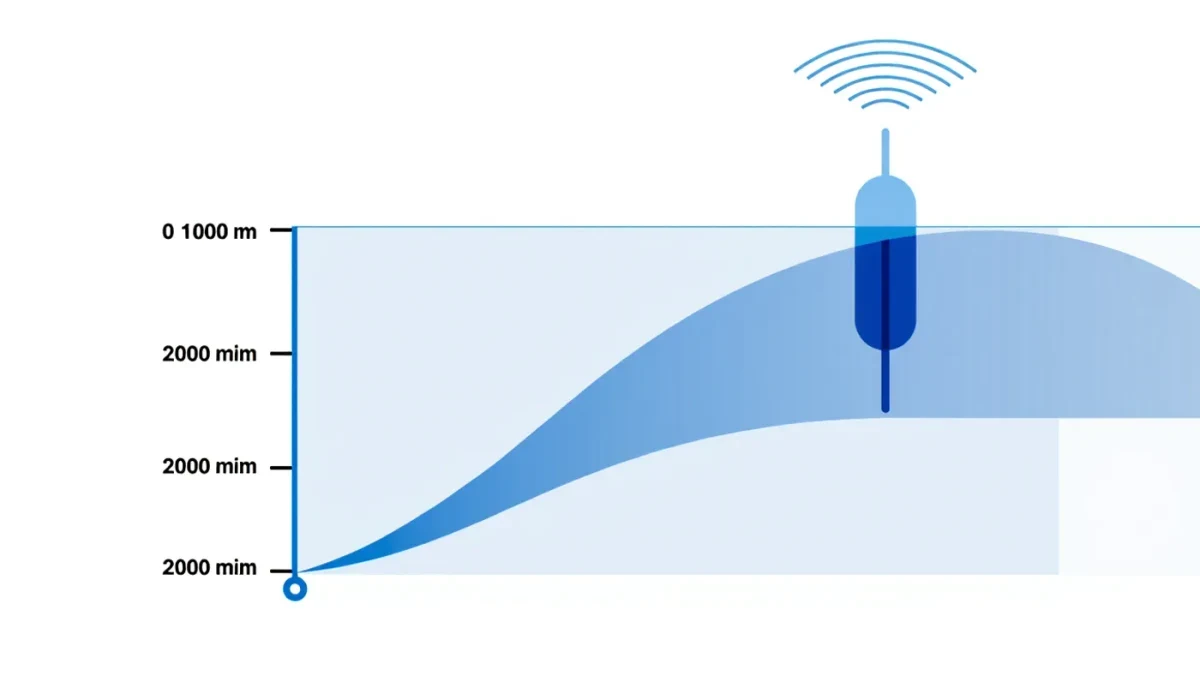
Ocean heat content deserves attention because the ocean absorbs roughly ninety percent of the excess energy that greenhouse gases trap in the climate system, according to assessments from the U.S. National Oceanic and Atmospheric Administration and international climate reports. Air temperature, the number most quoted in daily coverage, samples the thin share of the energy budget that sloshes year to year; the ocean is the reservoir. Its measured heat content, tracked since the early 2000s by the Argo array of autonomous floats and cross-checked by satellites, rose to record levels in 2023 and again in 2024 in NOAA's annual analyses — a steadier signal of planetary warming than any single hot summer.
How is heat in the ocean actually measured?
The core instrument is the Argo float: a meter-long cylinder that drifts at a parking depth of 1,000 meters, sinks to 2,000 meters every ten days, then rises over several hours, recording temperature and salinity as it goes. At the surface it transmits its profile to satellites and repeats the cycle for roughly four to six years before its batteries fail. The international Argo program, deployed from the early 2000s, sustains about 4,000 of these floats distributed over the ice-free deep ocean — the first time the ocean's interior was watched globally and continuously, after a twentieth century of sparse ship-based measurements along shipping lanes.
The record is extended three ways. Satellite altimeters measure sea-surface height, which rises partly because water expands as it warms; the expansion contribution, corrected for other effects, gives an independent heat estimate. A subset of deeper dives and separate Deep Argo prototypes probes below 2,000 meters, where older instruments on research cruises had already found warming. And analysis groups in the United States, China, and Europe reprocess the combined data with independent methods, publishing the differences openly.
Why is the ocean's share ninety percent?
Water's physics make it the system's storage medium. Seawater has roughly four times the heat capacity of dry air, and the ocean's circulating top layers mix warmth to depth on timescales of years to decades, while the atmosphere equilibrates in weeks. Add the comparative size — the ocean covers about seventy percent of the planet — and the accounting that climate assessments publish places about ninety percent of the energy imbalance in the sea, with most of the remainder going into melting ice and warming land, and a small fraction into the atmosphere.
The consequence is lag. Today's ocean contains heat committed by past emissions; heat taken up now will influence climate and sea level for decades regardless of near-term emissions changes. That is why ocean heat is called by some researchers a thermometer of committed warming, not of this year's weather.
What does the record show?
The multi-decade trend published by the analysis groups points the same direction with little ambiguity: ocean heat content in the upper 2,000 meters has increased steadily since systematic coverage began, and independent reconstructions of the sparser pre-Argo record extend the warming back to the mid-twentieth century. NOAA's 2024 assessment reported record global ocean heat, continuing the sequence of records set in preceding years; research published in 2025, using the latest reprocessed float data, described the upper-ocean warming as continuing to accelerate in that record, a finding consistent with — though somewhat stronger than — earlier estimates.
Regional structure matters as much as the global number: warming penetrates differently by basin, and the Southern Ocean around Antarctica has absorbed a disproportionate share, a result that emerges repeatedly from Argo-based studies and that researchers connect to the region's upwelling and mode-water formation.
How confident can these numbers be?
The uncertainties are known and quantified in each group's publications. Float coverage before the mid-2000s was thinner, and the deep ocean below 2,000 meters remains under-sampled by Argo itself — Deep Argo is a pilot-scale array, not a global one — so deep-ocean heat estimates lean on sparse historical cruise data and modeling. Sensor drift in early floats was a documented problem, corrected in reprocessing. And heat content is inferred from millions of point measurements of temperature and salinity converted through pressure-dependent calculations, with mapping choices that the independent groups handle differently — the reason they publish spread, not a single value.
What survives every methodological argument is the sign and rough magnitude of the trend: the ocean is gaining heat at a rate the analyses express in zettajoules per year — units of ten to the twenty-first power joules — with year-to-year fluctuations, such as those tied to El Niño and La Niña, superimposed on the climb rather than interrupting it.
What does a warmer ocean do?
Three consequences follow directly from measured physics. Thermal expansion raises sea level — the component of modern sea-level rise attributable to warming water is quantified in assessment reports alongside melting ice. Warmer surface water fuels more intense tropical cyclones, a relationship documented in attribution studies that frame it as intensity shifts, not storm counts. And warmer water holds less dissolved oxygen while stratification slows the mixing that ventilates the deep, with marine heatwaves — tracked as events since the 2010s — becoming more frequent in the satellite-and-float record.
The ocean's heat is measured by machines reporting from the middle of seas and from orbit, maintained by international programs on fixed budgets. The number they return changes slowly, which is exactly why researchers say it deserves more of the public's attention than the monthly temperature anomaly — the reservoir, not the splash.