NASA's Mars Sample Return program, run jointly with the European Space Agency, was rebuilt in 2024 after an independent review found its existing architecture could not be delivered on budget or schedule. The review, published in September 2023, estimated the plan then in force could cost up to 11 billion dollars and feared the launch might slip toward 2040. Through 2024, NASA solicited cheaper designs from industry and its own centers, and in early 2025 began restructuring the program around a simpler, less costly architecture — one that still aims to bring tubes of Martian rock, already collected by the Perseverance rover, back to Earth.
What was the original plan?
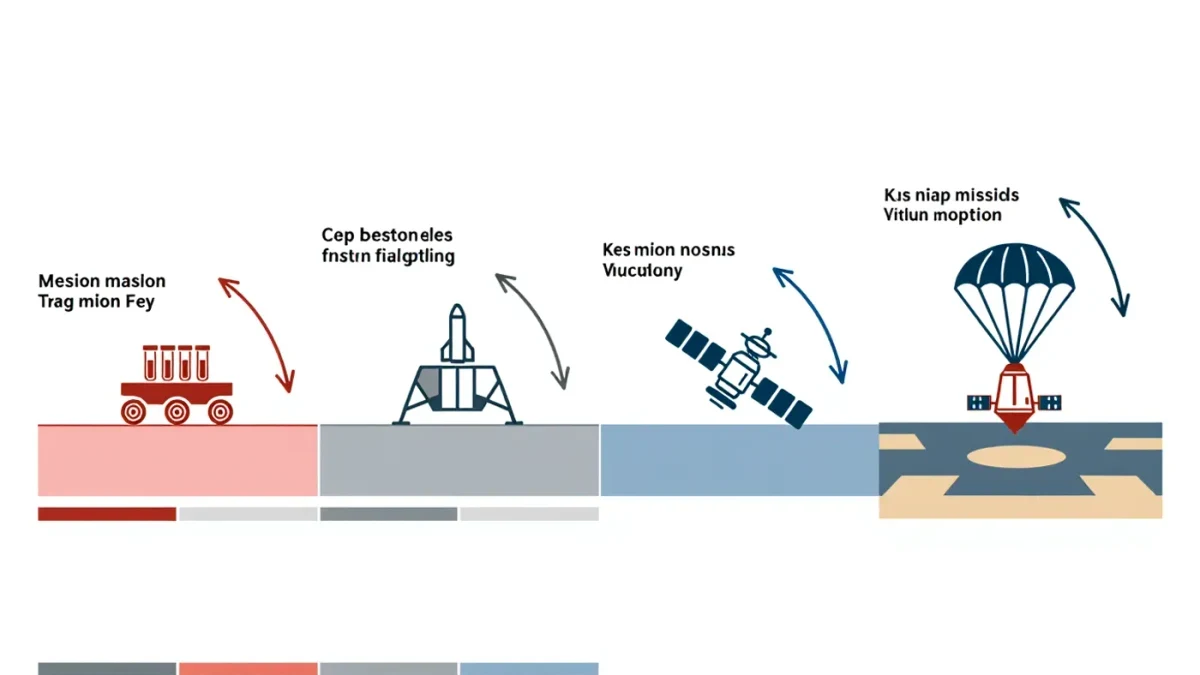
The architecture in trouble had three moving parts. Perseverance, which landed in Jezero Crater in February 2021, drills and seals finger-sized rock cores — as of 2024 more than two dozen sealed tubes had been filled, with sampling continuing. A NASA-built lander would deliver a small rocket, the Mars Ascent Vehicle, to loft those tubes into orbit, together with a fresh European rover to fetch them. An ESA-built Earth-return orbiter, to launch later this decade, would collect the orbiting cache and carry it home, dropping a capsule in the Utah desert in the 2030s.
It would have been the first round trip to another planet's surface, and the planetary-science community's top priority, repeatedly, since a 2011 decadal survey. The ambition survived the review; the configuration did not.
What went wrong?
Mass and money compounded. The September 2023 report of the Mars Sample Return Independent Review Board found the program's budget planning — roughly 4.4 billion dollars in annual phasing under flat overall agency budgets — unrealistic, with total lifecycle cost estimates between 8 and 11 billion dollars and near-term reserves thin. The lander's mass grew as designs matured; the ascent vehicle, which must burn solid propellant in Mars's thin atmosphere after sitting in deep cold, remained the schedule's long pole. The board wrote plainly that there was no credible alignment between the architecture, the schedule, and the budget profile.
NASA's response was staged. In April 2024 the agency asked NASA centers and industry for alternative architectures; in the same period, citing the impasse, it slowed spending on the program and, in late 2024, stood down parts of the existing design while requesting and evaluating proposals. Congressional criticism followed the budget fights, and mission timelines moved from the early 2030s toward a horizon the agency declined to guarantee.
What changed in the redesign?
According to NASA's 2025 announcements, the guiding rule is fewer spacecraft and fewer novel elements. Options the agency studied included eliminating the dedicated fetch rover — relying instead on Perseverance itself to deliver tubes to the landing site, with sample-transfer helicopters as a backup inspired by the Ingenuity aircraft that flew on Mars from 2021 to 2024 — and using a commercially provided lander and a smaller ascent vehicle. The European orbiter, already in an advanced phase, remains part of the concept.
A reformulated architecture selected in 2025 centers on a single lander carrying the ascent rocket, with the tubes loaded by Perseverance directly, and mission studies pointing to a launch later this decade and a return in the 2030s. NASA's own framing of the numbers has shifted with the reviews, and the agency has been careful to present schedules as planning targets rather than commitments.
How do we know the samples are worth this trouble?
The case rests on what rovers cannot do. Instruments aboard a rover weigh kilograms and run on solar or nuclear power measured in watts; laboratory instruments on Earth weigh tons and can consume a building's electricity. Returned samples can be reanalyzed for decades with methods not yet invented — the Apollo rocks, collected between 1969 and 1972, still generate papers.
Perseverance's cache was chosen with that in mind: Jezero Crater held a river delta, and the sampled rocks include sediments and altered igneous formations that record whether water persisted and what chemistry it supported. In-lab measurement of isotopes, organics, and mineral textures at sensitivities rovers cannot approach is the stated scientific payoff; claims about detecting life are not what the program promises, only the capability to look with adequate tools.
What happens to the science if it never flies?
The community has a stated fallback, and it is not resignation. Perseverance continues to collect and to deposit cached tubes at a depot site in Jezero, so the scientific material accumulates regardless of launch dates. And the mission's scientific questions can be partially addressed by in-situ instruments — the rover's own organic and mineralogy detectors, and analyses by other orbiters and landers — though at sensitivities many orders of magnitude below terrestrial laboratories. The 2023 review board framed the trade bluntly: a cheaper, later return beats an unaffordable one, but decades of delay would push definitive answers onto the next generation of scientists and instruments.
What are the remaining risks?
Three stand out. Schedule risk: each redesign year pushes the return toward the late 2030s, and the 2023 board's warning about 2040 was not withdrawn. Budget risk: the program competes inside a NASA science portfolio that must also fund other flagship missions. And planetary-protection risk, a quiet one: the campaign must not forward-contaminate Mars with Earth microbes on the way in, or return unsterilized Martian material without containing it on the way out — the backward half of that obligation is why the returned capsule's handling facility, itself a major unbuilt cost, appears in every architecture.
As of spring 2026, the revised mission remains in formulation rather than construction, with NASA directing funds to the selected architecture and Europe's orbiter proceeding on its own line. The tubes on Mars, meanwhile, sit sealed in Jezero — the easy part, observers note, is done.