NASA's Psyche spacecraft, launched from Kennedy Space Center on a Falcon Heavy rocket on October 13, 2023, is bound for the asteroid 16 Psyche, a roughly 220-kilometer object orbiting the Sun in the main belt between Mars and Jupiter. Telescopic evidence suggests its surface is unusually rich in metal, and one leading hypothesis is that Psyche is the exposed core of a protoplanet whose rocky exterior was stripped away by ancient collisions. The spacecraft is scheduled to perform a gravity-assist flyby of Mars in 2026 and to arrive at its target in 2029.
What makes 16 Psyche worth a dedicated mission?
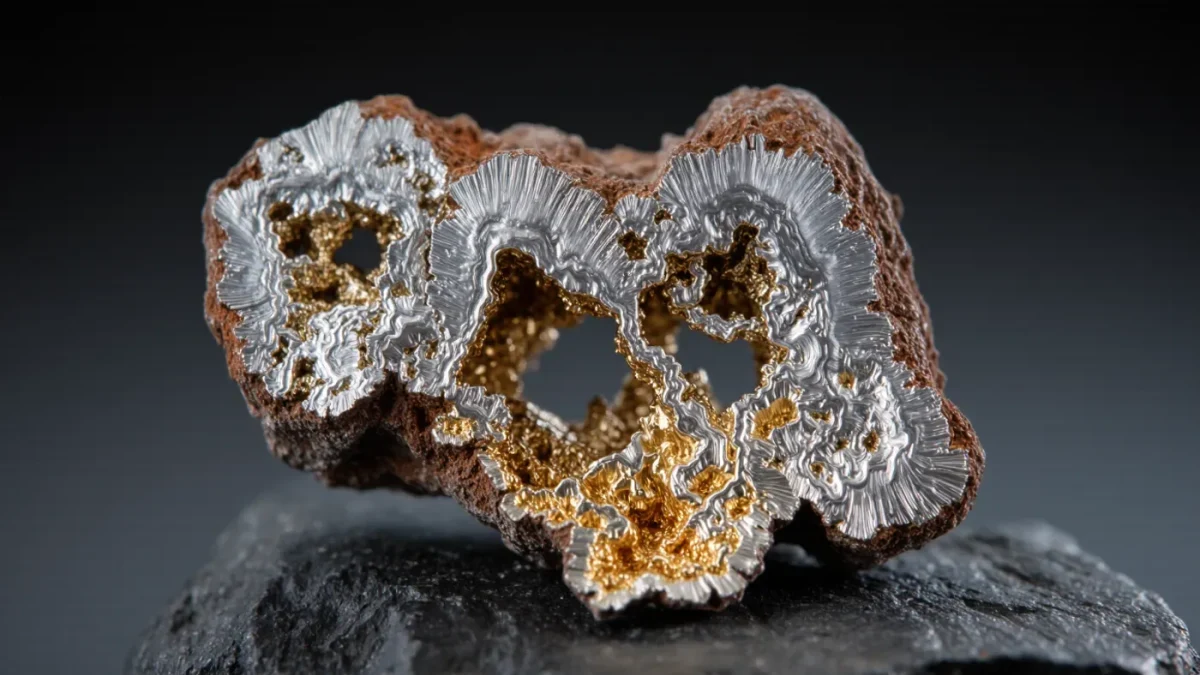
Psyche stands out by what its light reflects. Its spectrum matches iron meteorites far better than it matches ordinary rock, its density — estimated from perturbations it exerts on smaller asteroids — is high for a main-belt object, and radar observations bounce back strongly, consistent with a metal-rich surface. Taken together, these clues suggest a body that is a substantial fraction metal.
Why that matters is accessibility. Planetary scientists have never seen a planetary core up close; Earth's own core sits about 3,000 kilometers beneath our feet and is studied only indirectly, through seismology and magnetics. If Psyche is a bare or partially bare core — the leftover interior of a body that formed, differentiated into crust, mantle, and metal center, and then lost its outer layers — it offers a natural window onto the same materials and processes that sit under every rocky planet. science news coverage.
What are the alternative explanations?
The mission's own scientists are careful to note that the exposed-core story is a hypothesis, not a settled fact. Radar and density data are also consistent with a metal-rich rubble pile — fragments of shattered metal re-accumulated into a porous body — or with a layered world of metal and rock mixed at finer scale than telescopes can distinguish. A 2022 reanalysis of light-curve data revived an older argument that Psyche's surface may be less dense and less iron-dominated than simple core models predict.
Distinguishing among these options is precisely what the spacecraft's instruments are designed to do, and mission briefings frame the alternatives openly rather than promising to confirm the headline version.
What instruments does the spacecraft carry?
Psyche flies a suite aimed at composition and internal structure rather than photography alone. A multispectral imager will map surface composition and look for differences between metal, silicate, and possible volcanic terrain. A gamma-ray and neutron spectrometer, the kind used on Mars rovers, will measure elemental abundance in the top meter of the surface. A magnetometer will test the most telling prediction: a former core, frozen while a dynamo operated, could retain remnant magnetization in its metal. And a radio-science experiment using the spacecraft's X-band antenna will track tiny shifts in the signal, revealing the asteroid's gravity field and, from it, constraints on how mass is distributed inside.
Two technology demonstrations ride along: a laser communications terminal called Deep Space Optical Communications, which in late 2023 returned data from tens of millions of kilometers away at rates well beyond conventional radio — a first for deep space — and, on the ground, new techniques for interpreting the gravity data.
How do we know where the spacecraft is and that it will arrive?
Trajectory verification for a mission like this is routine engineering, checked continuously. After launch, the spacecraft executed its planned deep-space maneuvers; NASA reported in 2024 that cruise and instrument checkouts were proceeding, with the imager capturing calibration views and the optical-communication experiment completing its primary demonstration phase by mid-2024. The Mars flyby planned for 2026 bends the trajectory toward the asteroid and saves propellant, an application of gravity assists used since the 1970s and calculable to high precision.
Arrival is scheduled for August 2029, followed by roughly two years of orbital mapping at gradually lower altitudes, from an initial orbit hundreds of kilometers up down to close passes that the team will plan only after the shape and gravity of the body are known.
Is anyone going to mine it?
Notions of Psyche as a priceless metal lode circulate widely, and the mission materials push back on them. Media-friendly estimates of the asteroid's hypothetical metal value have no practical meaning: no market exists for asteroid iron, retrieval would cost vastly more than smelting on Earth, and the mission carries no sampling or return hardware. Psyche's value is informational — a close look at material that may be a planet's heart, at a moment when no drill could reach our own.
Why did this mission take so long to fly?
Psyche's route to the pad was not straight. NASA selected it in 2017 as a Discovery-class mission, the agency's line of mid-cost planetary projects, with launch planned for 2022. Software and testing problems with the spacecraft's flight platform pushed the launch out by a year, and NASA's own independent review of the delay, reported in 2022, attributed it to institutional workforce and testing shortfalls rather than to the science payload. The mission then flew on the rescheduled 2023 window — a reminder, mission managers noted at the time, that schedule failures in planetary science usually trace to engineering institutions, not to instruments.
What would confirm the core hypothesis?
Three observations would carry most of the weight. Remnant magnetization detected by the magnetometer would indicate the metal cooled in a magnetic field generated while the body was molten. A high bulk density with the gravity signature of a mostly solid interior would favor a core-like object over rubble. And imaging of what may be solidified metal flows or ferrovolcanic features — terrain types suggested in pre-arrival studies — would show the body's interior once reached the surface as liquid metal. Any of these could also come back negative, and that, too, would sharpen the picture of how planetesimals assembled in the early solar system.