The next generation of gravity-wave detectors will open lower frequencies — ripples with periods of minutes to hours that ground instruments like LIGO physically cannot register. The space-based LISA mission, formally adopted by the European Space Agency in January 2024 and planned for launch around 2035, will trail Earth around the Sun with three spacecraft forming laser arms 2.5 million kilometers long. On the ground, the planned Einstein Telescope in Europe and Cosmic Explorer in the United States would succeed today's observatories in the 2030s, extending reach deeper into the universe. Each machine hears a different band, the way different radio bands carry different stations.
Why can't LIGO just get better?
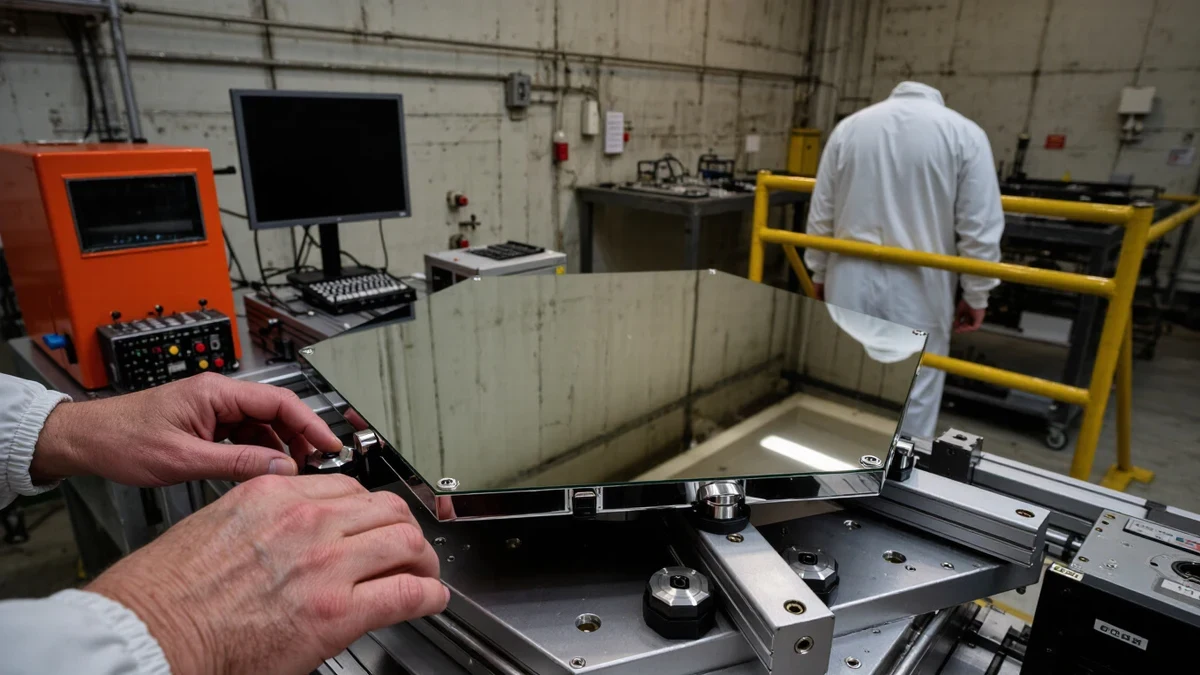
LIGO's two U.S. detectors, joined by Virgo in Italy and later by KAGRA in Japan, detect passing waves by monitoring laser beams along four-kilometer arms. A wave momentarily lengthens one arm and shortens the other by less than a proton's width; that is the measured signal of black hole mergers since the first detection in September 2015. The sensitivity is extraordinary — and bounded by physics at both ends.
Below roughly 10 hertz, ground detectors drown: seismic ground motion, the rumble of human activity, and even the slow sway of the suspension itself mask any longer-period signal. No feasible Earthbound isolation fixes that. The ceiling comes from shot noise in the laser light itself, which more mirror and more power can lower but not remove. To hear slower waves, the arms must leave the planet.
How will LISA work?
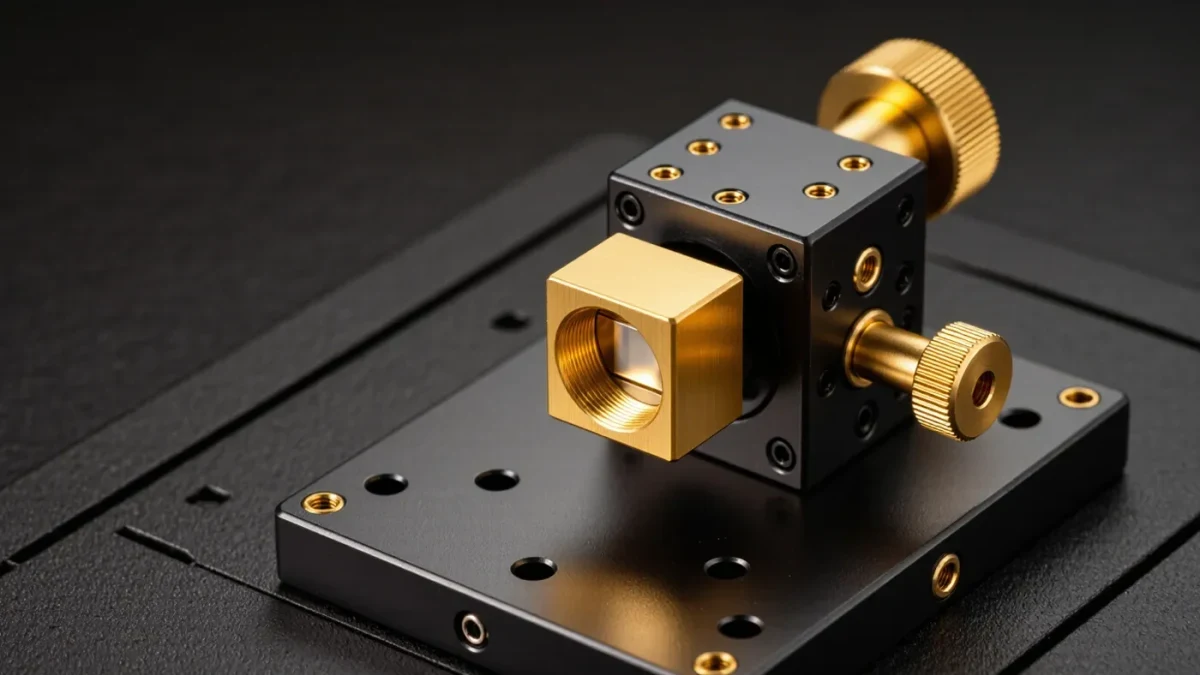
LISA's three spacecraft will fly in a triangle, 2.5 million kilometers on a side, following Earth along its orbit at a distance of tens of millions of kilometers from the planet. Each craft carries free-floating gold-and-platinum test masses, protected inside the spacecraft like coffee sealed in a cup on a bumpy road; lasers between craft measure the distances between these inertial masses, and a passing gravity wave changes those distances by fractions of a nanometer across millions of kilometers.
The scheme has flown in miniature. LISA Pathfinder, an ESA technology demonstrator, operated from 2016 to 2017 and showed the test masses could be kept almost perfectly undisturbed, beating requirements. LISA's adoption in January 2024 moved it from study to committed build, with NASA as a junior partner; the industrial phase began in 2024-2025, and launch is planned around 2035 on an Ariane 6.
What will LISA hear that is new?
The low-frequency band contains different sources, and mission publications list them concretely.
- Supermassive black hole mergers: pairs of millions-to-billions-solar-mass black holes, which collide too slowly for ground detectors to register. LISA could observe such mergers across most of the observable universe.
- Slow inspirals: stellar-mass black hole and neutron star pairs years before they merge, tracing complete orbital histories rather than the final seconds LIGO records.
- Extreme mass-ratio inspirals: small black holes spiraling into giant ones, mapping spacetime around the giant in detail — a precision test of general relativity's predictions.
- A confusion foreground: millions of compact binary stars in our galaxy, individually unresolved, together forming a background noise scientists must model — and can also use.
- Perhaps a cosmological background from the early universe, though this is uncertain and mission materials hedge accordingly.
What is hard about measuring nothing moving?
The engineering paradox of LISA is instructive. The spacecraft around the test masses do not hold them; they fly formations that shield them, firing microthrusters so gently that solar radiation pressure itself becomes a steering input. Lasers must remain phase-locked across millions of kilometers at power levels far below a household bulb, with the returning beam too weak to reflect cleanly — so the far craft measures the phase and re-emits an amplified copy, a scheme the mission literature describes without embarrassment as one of the harder parts. Each of these elements was demonstrated separately by Pathfinder and by interplanetary laser ranging; assembling them at full scale is the 2030s task.
What about the ground successors?
Two projects define the Earthbound future. The Einstein Telescope, a European collaboration, plans a triangular detector with ten-kilometer arms buried a few hundred meters underground to hush seismic noise, with sites under evaluation in Italy, the Netherlands, and Germany; the project entered European research-infrastructure roadmaps and, in 2024-2025, site-selection procedures. Cosmic Explorer, the U.S. concept, envisages L-shaped detectors with arms of 40 kilometers — ten times LIGO's — on new sites, with a horizon study published and a funding case being built through 2024 and 2025.
Both would extend the reach of the current network by roughly a factor of ten in distance, which in survey terms means sampling the black hole population of the early universe — and, as their teams emphasize, upgrading capabilities for multi-messenger astronomy, where gravitational and electromagnetic observatories watch the same event.
How do we know any of this is measurable?
The current detectors supply the existence proof. Since 2015, the global network has logged on the order of a hundred confirmed black hole and neutron star mergers through its observing runs, including the 2017 neutron star merger that was observed in gamma rays and optical light, tying gravity waves to conventional astronomy. LISA Pathfinder demonstrated the free-fall requirement in flight. What remains unproven is sensitivity at the new bands' faint edges: LISA's final performance depends on picometer-level laser metrology across millions of kilometers, which no mission has yet operated at full scale, and both ground successors await construction funding decisions — the kind of caveat review boards phrase carefully and this article repeats.
By design, then, the 2030s should run space and ground detectors simultaneously: a baseline of ten-plus years of coincidence data, listening to different bands of the same sky, with each detection carrying a frequency tag that tells physicists what kind of event produced it.