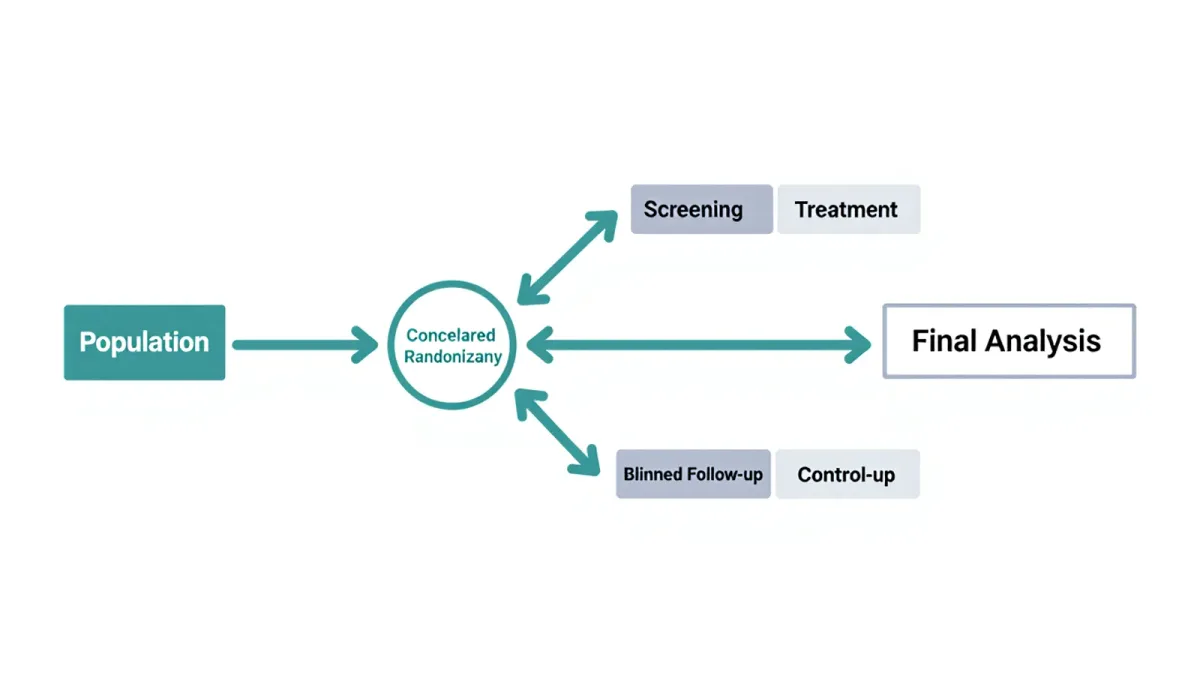
A clinical trial arm is a predefined group of participants who all follow the same assigned strategy, such as one drug dose, one device, or standard care. The SPRINT trial, funded by the United States National Institutes of Health and published in The New England Journal of Medicine in 2015, split 9,361 adults into two arms to compare intensive versus standard blood pressure control. One arm, alone, proves nothing; the comparison between arms is the result.
This article explains how research studies are designed and reported.
What is a trial arm, exactly?
An arm is one branch of a trial protocol. Every participant enrolled in the study is assigned to exactly one arm, and each arm specifies what that group receives, for how long, and what is measured along the way. In a simple two-arm design, one group gets the intervention under study and the other gets a comparator, which may be a placebo, an existing treatment, or no intervention beyond routine care.
Arms are fixed before the trial starts. The protocol, a document written in advance, defines who is eligible, how assignment happens, what dose is given, and which outcomes count as primary. That pre-commitment matters, because it prevents researchers from redefining success after the data arrive. Multi-arm trials extend the same logic: a three-arm study might compare a new drug against a placebo and against an established therapy, all under one protocol and one timeline.
Why do researchers randomize participants between arms?
Randomization uses chance to decide who goes into which arm, and its purpose is defensive: it protects the comparison from systematic imbalance. People who volunteer for a new treatment tend to differ from those who do not, in health, motivation, and access to care. If the healthiest patients end up in one arm, that arm will look better regardless of what the treatment does.
Assigning participants by a random sequence, like a computer-generated list, distributes both known and unknown differences roughly evenly across arms. Age, disease severity, and factors no one has thought to measure all get averaged out in expectation. Before the 1962 Kefauver-Harris amendments to United States law required adequate and well-controlled studies for drug approval, such comparisons were far from routine. Randomization is now the default, though it is never perfect in small samples, where chance imbalances can still occur.
What makes a control group meaningful?
A control group gives the trial its yardstick, and the choice of control quietly shapes what the trial can claim. A placebo control, an inert match of the real treatment in look and feel, accounts for the placebo response, a well-documented effect in which expectation alone shifts reported outcomes. Anesthesiologist Henry Beecher, writing in JAMA in 1955, famously estimated that placebos relieved symptoms in a substantial share of patients across a range of conditions.
An active comparator control tests the new treatment against the current standard rather than against nothing, which is usually the more honest clinical question. A sham control, used with surgery and devices, mimics the procedure without its active component. Each control answers a different question, so a trial with a weak comparator can produce an impressive but hollow result.
| Arm type | What the group receives | Question it helps answer |
|---|---|---|
| Experimental | The intervention under study | Does the treatment work under the protocol? |
| Placebo control | An inert match of the treatment | Does the treatment beat expectation alone? |
| Active comparator | An established standard treatment | Is the new treatment better or safer than current care? |
| Dose-ranging | Different doses of the same drug | Which dose balances benefit and harm? |
| Sham | A procedure imitation without the active step | Is the effect specific to the procedure itself? |
How does blinding keep an arm honest?
Blinding withholds the assignment from the people who could be influenced by it. In a double-blind trial, neither participants nor treating staff know who receives the active treatment, so expectation cannot steer reported symptoms or bedside decisions. Outcome assessors and statisticians can also be blinded, which matters most when the outcome involves judgment, such as rating symptom severity.
Blinding is harder in some designs than others. Surgery trials with sham controls are ethically delicate, and lifestyle interventions can rarely be blinded at all. When blinding is impossible, trials lean on objective outcomes, such as death or a laboratory measurement, which are harder to sway with belief.
Are there alternatives to parallel arms?
Yes. In a crossover trial, each participant passes through every arm in sequence, separated by a washout period, so each person serves as their own control. That design needs far fewer participants, which is why the 1948 Medical Research Council trial of streptomycin in tuberculosis, with just over one hundred patients, remains a landmark of controlled design. Crossover trials fail, however, when treatment effects carry over or when the condition itself changes quickly over time.
Cluster randomized trials assign whole groups, such as clinics or villages, to each arm because individual assignment is impractical. Adaptive designs let a trial drop an arm or reweight assignment midstream according to preset rules, though each added flexibility must be specified in advance to keep the statistics valid.
How do we know what a trial arm really showed?
SPRINT illustrates the anatomy. More than 9,000 adults at least 50 years old with high cardiovascular risk were randomized to a systolic blood pressure target below 120 or below 140 and followed for a median of roughly three years. The intensive arm experienced fewer primary cardiovascular events, and the trial was stopped early on the advice of its monitoring board. The design also carried costs worth noting: the intensive group had more serious adverse events, including low blood pressure and fainting, and the trial excluded certain groups, such as people with diabetes, so the result does not automatically extend to them.
That is the general pattern. Reading any trial means reading its arms: who was in each, what each received, how assignment was made, and whether anyone could tell the difference. Since 2000, trial registrations such as ClinicalTrials.gov, run by the United States National Library of Medicine, have made it possible to check a published report against its registered plan.
What should a reader check first?
A practical reading order: find the arms, then the control, then the primary outcome as registered, then the losses to follow-up. If participants dropped out unevenly across arms, the comparison is at risk. If the published outcome differs from the registered one, the result deserves skepticism. The arm structure is not administrative detail; it is the argument.