An observational study is strong when its design anticipates confounding and neutralizes it as far as possible, measures exposure before outcome, and defines a comparison group that answers a real question. The cautionary classic is hormone therapy: observational studies through the 1990s associated it with lower heart disease risk, but the Women's Health Initiative randomized trials, with more than 16,000 women in the hormone arm analyses, found no such protection when the therapy was actually assigned, and the trial's 2002 hormone results prompted a halt. The observational finding had measured who chooses therapy, not what therapy does.
What separates a weak observational study from a strong one?
Three properties do most of the separating. First, exposure measurement: strong studies measure the exposure before outcomes occur, repeatedly where possible, rather than asking participants to remember decades later. Second, comparison quality: strong studies build a comparison group that differs minimally except in exposure, using design tools such as restriction, matching, or new-user cohorts. Weak studies compare whoever happens to be in the data, and inherit every difference that comes with.
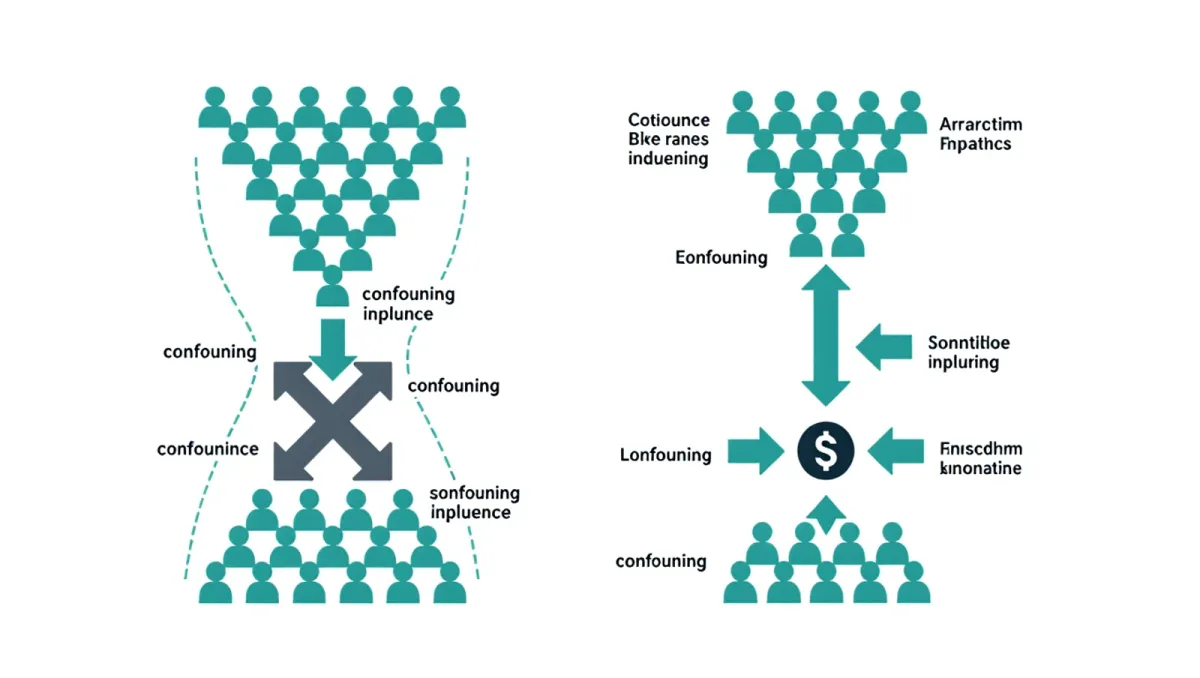
Third, confounding control. A confounder is a prior cause of both exposure and outcome, and adjusting for measured confounders, by stratification, regression, matching or weighting, is the observational study's main defensive craft. The unmeasured ones remain, and the best studies say so plainly, using sensitivity analyses to ask how large an unmeasured confounder would need to be to erase the finding.
What are the main observational designs, and what is each good for?
The family is larger than the cohort. Case-control studies begin with cases, people who have the outcome, and compare their prior exposures with controls who do not; they are efficient for rare diseases but vulnerable to recall bias when exposure is self-reported. Cross-sectional studies measure exposure and outcome at one moment, which cannot establish order. Cohort studies follow people forward and support cleanest timing, at the cost of size and years.
Nested and specialized variants refine the trade. Case-crossover designs compare each person's exposure during hazard windows with their own baseline periods, removing fixed personal confounders. Self-controlled and within-person designs apply the same logic more broadly. Each design answers a slightly different causal question, and matching design to question is itself a marker of strength.
| Design | Timing | Best for | Chief vulnerability |
|---|---|---|---|
| Cohort | Exposure first, outcome later | Common exposures, long follow-up | Loss to follow-up, unmeasured confounding |
| Case-control | Outcome first, exposure reconstructed | Rare outcomes | Recall bias, control selection |
| Cross-sectional | Simultaneous | Prevalence, hypothesis generation | No time order; weak for cause |
| Case-crossover | Within-person windows | Transient exposures, acute outcomes | Time trends misread as effects |
How do strong studies handle confounding?
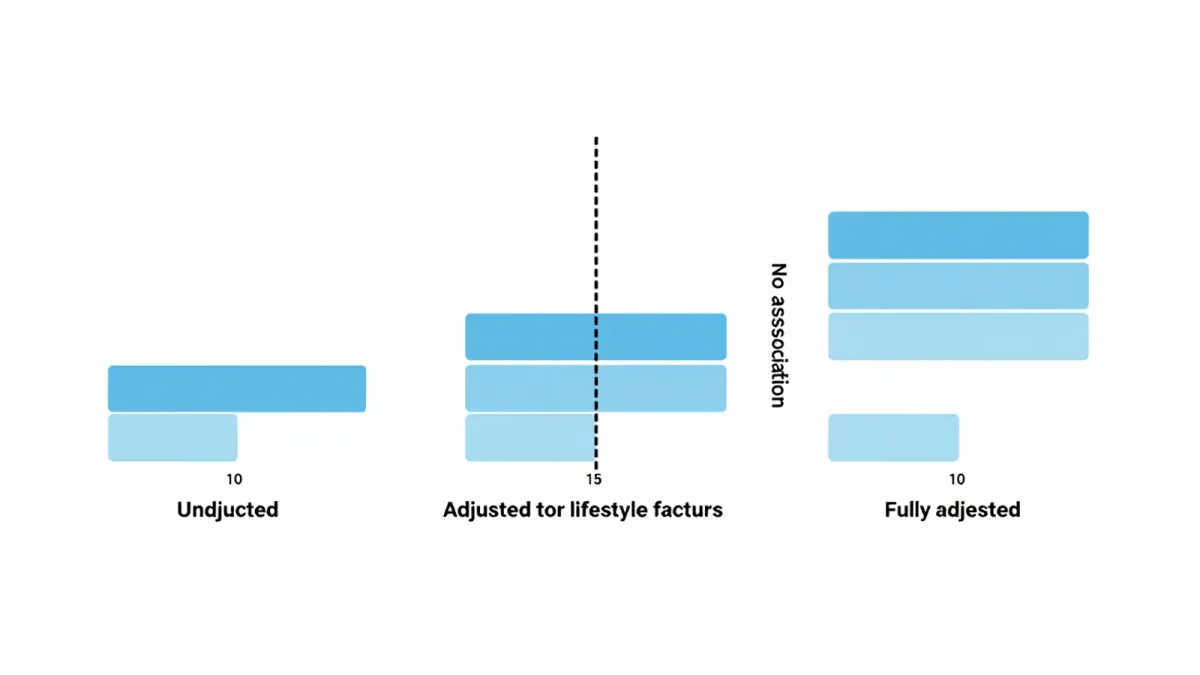
Layered. Design comes first: restrict to a narrow population, match controls on major confounders, anchor everyone to a common starting point, such as first prescription. Statistical adjustment comes second, using regression or propensity methods that balance measured characteristics between exposure groups. Diagnostics come third: balance tables showing whether adjustment actually equalized the groups, negative controls, exposures or outcomes that should show no effect, and quantitative sensitivity to unmeasured confounding.
The strongest studies triangulate across methods and designs, asking whether cohort, case-control and within-person approaches converge. Agreement across designs with different weaknesses is far more persuasive than one immaculate model, because the confounders that fool one design rarely fool all.
Why did hormone therapy observational results get it wrong?
Because the exposed group differed from the start. Women who sought hormone therapy in the 1980s and 1990s were on average thinner, wealthier, more physically active and better monitored than women who did not, a pattern researchers call the healthy-user effect. Statistical adjustment for measured variables shrank the apparent benefit but could not remove it, since the underlying differences in health behavior were only partly recorded. Random assignment erased the self-selection, and the apparent cardiovascular benefit vanished.
The episode is taught not to disgrace observation but to calibrate it: when an observational finding rests on a comparison between self-selected groups, the healthy-user effect and its shadow, the sick-quitter effect, belong at the top of the limitation list.
How do we know an observational finding deserves confidence?
A checklist a reader can apply in a few minutes: Was exposure measured before outcome, ideally in records rather than memory? Is the comparison group defined, or merely whoever remained? Are the confounders listed, adjusted, and shown to be balanced afterward? Is there a sensitivity analysis for unmeasured confounding? Do other designs, populations and time periods agree? Is the association large, dose-responsive, and biologically plausible with established mechanism?
No single item settles anything; together they separate the studies that later hold up from the ones that quietly dissolve. The 2002 hormone-therapy reversal remains the standing reminder that confidence in an observational result should track design strength, not sample size or p-value alone.
Can observational evidence ever support causal claims?
Carefully, and with corroboration. When an exposure cannot ethically be randomized, as with smoking, causation is established by convergence: large effects, dose-response, temporality, consistency across designs and populations, mechanism, and, where they exist, natural experiments. That is how the causal case against tobacco was built from observational evidence, and it remains the template. The claim is earned by pattern, not by any single study, and honest write-ups phrase results as associations supported by, rather than effects proven.
A final marker of strength is transparency about the design's limits. Strong reports publish the list of confounders considered, show the balance achieved after adjustment, and discuss the plausible direction of any remaining bias, whether it would inflate or shrink the estimate. Weak reports list limitations once, in a sentence, and leave readers to guess which findings those limits actually touch. The habit of naming the direction of possible error, not merely admitting that error exists, separates studies written to be checked from studies written to be cited.