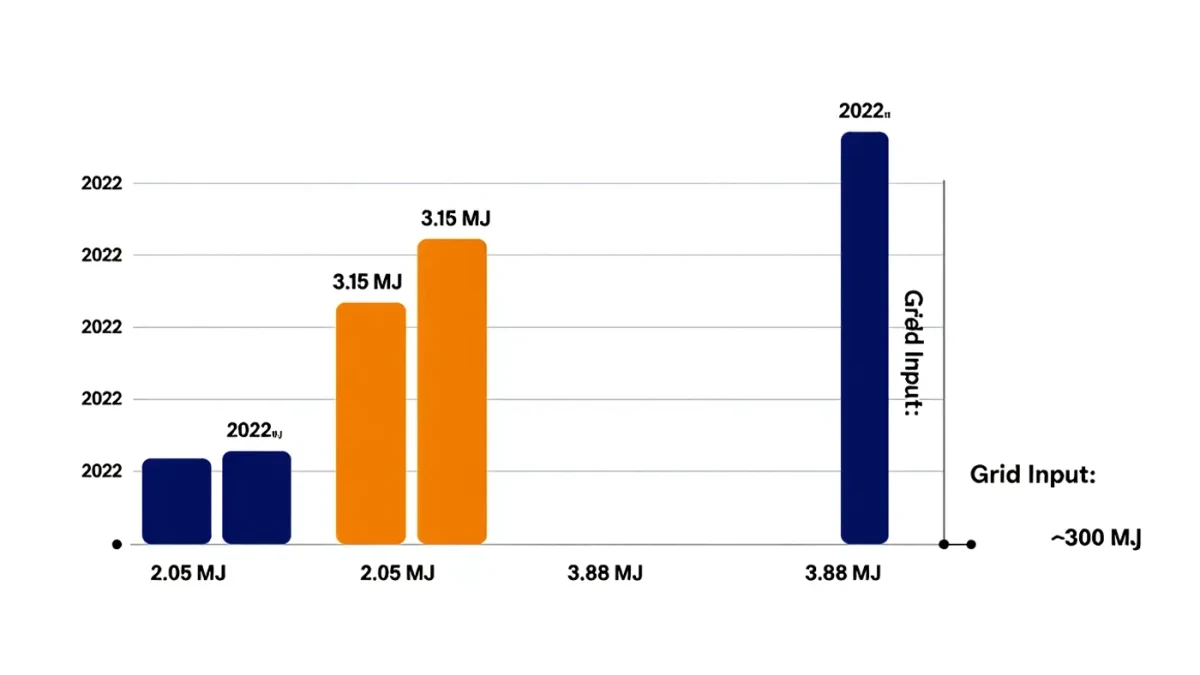
Fusion's net-gain milestone is hard to repeat because the achievement balanced on a knife edge. At the U.S. National Ignition Facility in December 2022, 2.05 megajoules of laser energy went into a pea-sized fuel pellet and about 3.15 megajoules came out — the first time a controlled fusion reaction released more energy than the laser delivered to it. Repeating that requires nanometer-perfect targets, exquisitely tuned laser pulses, and plasma behavior that varies shot to shot. The facility did repeat it in 2023, several times. Turning any of it into a power plant is another matter entirely.
What actually happened at the National Ignition Facility?
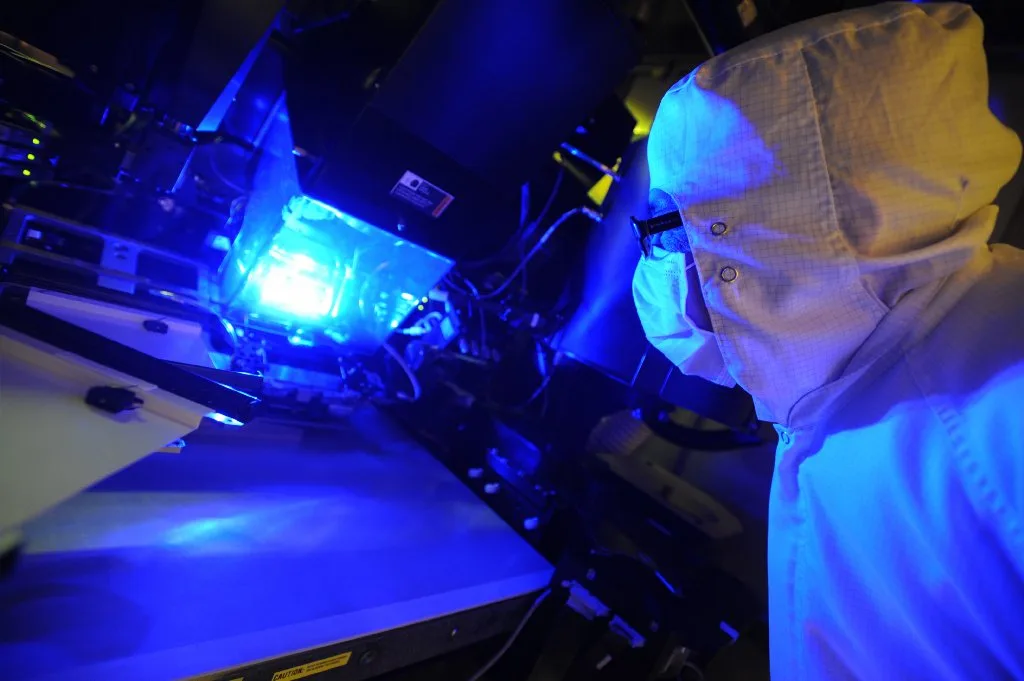
The facility, at Lawrence Livermore National Laboratory in California, uses a approach called inertial confinement fusion. Its 192 lasers converge on a small cylindrical container, called a hohlraum, holding a peppercorn-sized capsule of frozen hydrogen isotopes — deuterium and tritium. The laser light heats the hohlraum's walls until they blaze X-rays, which blast the capsule's surface outward, driving the capsule's contents inward at enormous speed in an implosion. If the compression is symmetric enough, the center reaches the temperature and density at which hydrogen nuclei fuse.
The December 5, 2022 shot crossed a threshold physicists call ignition: the fusion output exceeded the laser energy delivered to the target. The result was announced by the laboratory and covered worldwide; the physics was reported in 2023 in the journal Physical Review Letters and companion papers. In July 2023, the facility repeated the feat with a higher yield of about 3.88 megajoules, and further successful shots followed, with the laboratory reporting a growing tally of ignited experiments by 2024 and 2025.
Why can't every shot succeed?
Because the implosion multiplies every flaw. The capsule must remain spherical to within fractions of a percent while its contents compress to densities exceeding the center of the Sun — think of squeezing an inflated balloon to the size of a pea without wrinkling it anywhere. Fill-tube marks a few micrometers wide, pores in the capsule's diamond-like coating, small asymmetries in the X-ray bath: each seeds a jet of mixing that lets the fuel's heat escape. The fuel is burning for well under a nanosecond, so there is no time for feedback or correction. The December 2022 shot succeeded partly because its laser energy slightly exceeded prior attempts — a bigger push masking imperfections that had doomed earlier ones.
Physicists describe the difference between success and failure as a margin of a few hundred kilojoules, set against manufacturing tolerances of nanometers. That narrowness is not a sign of fraud or luck; it is the signature of operating near a physical threshold. But it is also why yield has varied by megajoules between otherwise similar shots.
Isn't the gain of 1.5 a small number?
Smaller than it sounds, for two reasons. First, the comparison uses only the light that reached the target. Producing those 2.05 megajoules of laser light drew around 300 megajoules of electricity from the grid — the lasers are inefficient, historically about one percent end to end. Counted at the wall plug, the December 2022 shot consumed roughly a hundred times more energy than the fusion released. Second, a power plant must do what no laser facility does: repeat its best shot around the clock, several times a second, capture the released energy as heat, generate electricity, and breed its own tritium fuel. NIF fires, at best, a few shots per day, each destroying the target.
How do we know the result was real?
The measurements were extensive and the claim careful. Instruments recorded neutron counts, neutron velocities, X-ray output, and the kinetic energy of escaping debris, several of which independently indicate fusion yield; the results passed internal review, peer review at Physical Review Letters, and scrutiny at international conferences. Other laboratories — notably the Omega laser at the University of Rochester, at smaller scale — have studied ignition physics for years, and the magnetic-confinement community measures progress with different yardsticks entirely. Within its stated terms, the Livermore result has withstood examination.
What would repetition at scale require?
A plant-relevant program needs targets by the hundreds of thousands per year, made more precisely and far more cheaply than today's bespoke capsules; lasers that are far more efficient, such as the diode-pumped designs researchers have proposed; and chambers that can absorb repeated explosions while extracting heat and tritium. Each requirement is an engineering field of its own. A comparison of the two main paths shows the contrast:
| Path | How it confines plasma | Best 2020s result |
|---|---|---|
| Inertial (NIF-style) | Implosion driven by lasers | Target gain of about 1.5, sporadic shots |
| Magnetic (tokamaks) | Magnetic fields in a torus | 69 megajoules over five seconds, UK JET, 2024 |
Neither path has produced net electricity. The U.S. Department of Energy, which funds NIF, launched a series of milestone-based public-private programs in 2023 aimed at bridging the gap between ignition physics and pilot plants, with timelines in the 2030s that many outside experts consider optimistic.
Is the milestone still meaningful?
Yes, but precisely. Ignition removed a physics question — can a laboratory reach fusion gain at all? — and replaced it with engineering questions that are harder, duller, and more numerous. Repetition is the current frontier: the facility's own reporting shows yields creeping upward shot after shot, with setbacks between. That is what the beginning of an engineering discipline looks like. It is not yet what a power grid looks like.