Innovation means the practical implementation of an idea that creates or improves a product, service, or process in a way that delivers value. That is the working definition used across the research literature, and it carries two tests at once: the thing must be new, and it must actually work in the world. A compound that never leaves the vial, an app nobody opens, a factory process that never ships — those are ideas, not innovations.
The word gets stretched in marketing, which is why the definition matters. Surveys of academic writing have found dozens of competing definitions — Wikipedia's entry on innovation notes that one 2009 survey counted around 60 definitions in scientific papers, and a 2014 survey found more than 40 — but nearly all of them share the same core: newness, improvement, and spread. Strip away the buzzword and what remains is a process, not a label.
This piece unpacks what that process involves, how it differs from invention and creativity, and how to tell a real innovation from a recycled adjective. For more in this coverage area, the publication's innovation section tracks technologies moving from lab to use.
What does innovation actually mean, in one sentence?
Innovation is a new or changed entity — a product, service, process, or business model — that realizes or redistributes value. That phrasing comes from the international standard ISO 56000:2020, which defines innovation as "a new or changed entity, realizing or redistributing value." The definition is deliberately broad. It covers a new drug, a cheaper way to fill a capsule, and a subscription model that changes who pays for a service.
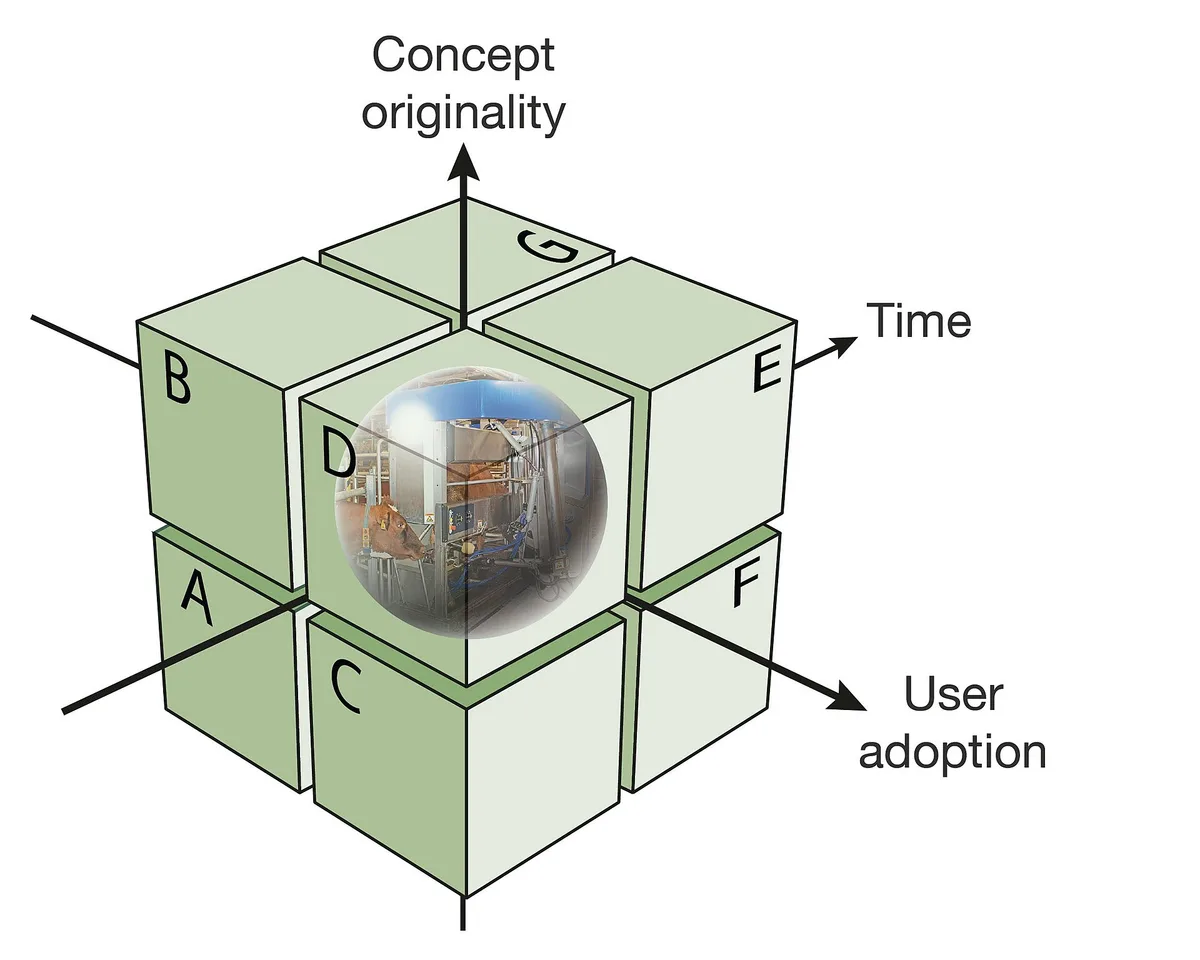
Two dimensions run through most definitions. The first is degree of novelty: is something new to the firm, to the market, to the industry, or to the world? A retailer adopting a supply-chain tool its competitors already use is innovating at the firm level, even if nothing is new to the industry. The second dimension is kind: is the change in a product, or in the process that makes it? We covered a connected angle in A brain implant let one ALS patient talk for two years at home.
Economist Everett Rogers offered a definition that captures how adoption works on the ground: an innovation is "an idea, practice, or object that is perceived as new by an individual or other unit of adoption." Perception counts. If users experience something as new, it can function as an innovation even when the underlying idea has circulated for years.
How is innovation different from invention?
Invention creates something that did not exist. Innovation puts it to work. The two are related but not the same: innovation is more likely to involve the practical implementation of an invention to make a meaningful impact in a market or society — and, importantly, not every innovation requires a new invention at all.
Think of a lab that synthesizes a new molecule. The synthesis is the invention. The innovation arrives later, if the molecule survives formulation, testing, regulation, manufacturing, and distribution, and reaches people who benefit from it. Many innovations skip the invention step entirely: repackaging an existing ingredient at a workable percentage, or reorganizing a production line, changes value without inventing anything.
The economist Joseph Schumpeter, writing in the early twentieth century, described the economic effect of this process as creative destruction — new products and methods displacing old ones. The concept of innovation as a field of study took shape largely after the Second World War, building on his work.
How is innovation different from creativity?
Creativity produces novel and useful ideas. Innovation implements them. Organizational researchers Teresa Amabile and Michael Pratt drew this line explicitly in 2016: creativity is "the production of novel and useful ideas by an individual or small group of individuals working together," while innovation is "the successful implementation of creative ideas within an organization."
The distinction explains a familiar workplace frustration. A team can brim with ideas and still produce nothing, because generating ideas and carrying them through adoption, promotion, and practical implementation are different activities with different skills. Peter Drucker, the management writer, put innovation at the center of entrepreneurship for exactly this reason: it is the means, he wrote, by which the entrepreneur creates new wealth-producing resources or endows existing ones with enhanced potential.
What does the innovation process look like?
Business schools tend to describe the process in stages, and the versions agree more than they differ. According to Harvard Division of Continuing Education's explainer on innovation, instructor Ben Little describes three "zones": understanding the problem, exploring solutions, and implementation. At the start, he notes, a problem "doesn't quite have shape yet" and needs exploration. In the middle zone, the advice is to keep multiple good ideas alive as long as possible, because exploring more than one option preserves the chance to end up somewhere better. The final zone is about making the idea real and sustainable — the right features, the right design, the right operations.
A parallel method, design thinking, follows a similar arc: clarify the problem, brainstorm and research solutions, build early prototypes and test them, then launch — with collaboration with the end user throughout, to check that the solution actually meets a need.
What this means for a reader evaluating a claim: genuine innovation stories describe the process and the value delivered. Buzzword versions describe only the adjective.
How do you spot buzzword recycling?
The fastest test is to ask what changed and who benefited. A claim that something is innovative, without a new or changed entity and a value outcome, is decoration. A few checks help:
- Is anything actually new? New to whom — the company, the market, the world? A reformulated product with an old ingredient list at a new percentage may qualify. A renamed ingredient usually does not.
- Did value move? The ISO definition hinges on realizing or redistributing value. If no customer, patient, or process is better off, the novelty is inert.
- Is there implementation? Processes matter. Innovation involves problem identification, introduction of new ideas, promotion of them, and practical implementation — not a press release.
Constraint can be a legitimate source of the new. The literature on frugal innovation examines how limits on cost and resources shape invention, a topic this publication covers in Frugal innovation: how constraint shapes low-cost invention. Scarcity forces the process questions — what problem, whose need, what value — that buzzwords skip.
Why does the definition matter in science and business?
Because it sets the bar for evidence. In science, an innovation claim implies demonstrated use, not just a demonstration. A battery chemistry that works in a lab coin cell is not yet an innovation for drivers; the gap between those states is where most technologies stall. In business, the definition separates companies that deliver value in new ways from companies that describe themselves as if they did. Harvard's explainer points to Netflix, which moved from DVD-by-mail to streaming and later invested in original content, against Blockbuster, which it describes as having failed to meet changing customer behavior and gone out of business in 2010.
The definition also carries a caution. Scholars in the neo-Schumpeterian tradition argue that innovation is not a neutral or apolitical process; its direction depends on the political and societal context in which it happens. Critics such as Shannon Walsh have argued that innovation today is best understood as innovation under capital, pointing to practices like planned obsolescence. Whatever one makes of that argument, it usefully reminds readers that "innovative" is not automatically "good."
The takeaway
Innovation is a process with an outcome, not a mood. The evidence it requires is specific: something new or changed, implemented, and delivering value someone can name. When a product page, a pitch, or a headline offers the word without any of those parts, the honest reading is that the innovation has not happened yet — and may never. When all three parts are present, the word earns its place. That is the meaning worth carrying, and the one worth checking for.