Direct air capture costs so much because the carbon dioxide it hunts is extraordinarily dilute. CO2 makes up roughly 420 parts per million of the atmosphere — about one molecule in 2,400 — so a machine must process enormous volumes of air to harvest each ton. Published cost estimates for current plants run from several hundred to roughly a thousand dollars per ton of CO2, far above the price most carbon markets pay. The physics of separating a rare gas, not any single engineering flaw, sets that floor.
What is direct air capture, mechanically?
A direct air capture plant is a collection of giant air contactors — structures resembling industrial cooling towers — that draw air over materials that bind CO2. Two designs dominate. Liquid-solvent systems pass air through a hydroxide solution that absorbs CO2, then release it in a kiln heated to around nine hundred degrees Celsius. Solid-sorbent systems use amine-coated filters that grab CO2 at ambient temperature and release it when heated to roughly one hundred degrees. In both, the released gas is compressed into a stream pure enough for underground storage or, occasionally, industrial use. Climeworks, a Swiss company, opened its largest solid-sorbent plant, named Mammoth, in Iceland in May 2024, with a nameplate capacity of 36,000 tons per year.
Where does the money actually go?
The energy bill comes first. Separating CO2 from air and concentrating it is thermodynamically uphill work; theory sets a minimum energy cost, and real plants pay several times that minimum. Heat is the dominant input for sorbent regeneration, and electricity runs the fans and compressors. If the energy itself is fossil, captured CO2 can be outmatched by the plant's own emissions — which is why projects cluster where geothermal or hydro power is available, as in Iceland.
Capital cost comes second. Fans, contactors, sorbent materials, and compressors are custom industrial equipment, and the few existing plants are effectively one-off constructions. Sorbent degrades over hundreds of cycles and must be replaced. Add financing, and a small plant capturing tens of thousands of tons per year carries costs that only scale can dilute — and the whole world's fleet, as of the mid-2020s, captures on the order of a million tons per year, compared with tens of billions of tons emitted annually.
How do the numbers compare with other climate tools?
Unfavorably today, by design constraints. Avoiding a ton of emissions — renewable electricity replacing coal, insulation replacing heat loss — usually costs less than capturing a ton after the fact. Nature-based approaches such as reforestation store carbon at lower cost per ton but face questions of permanence and land. Where capture holds an advantage is in the hard cases: emissions from aviation, agriculture, and industry that cannot easily be eliminated, and eventually net removal to offset historical emissions. Those roles, in most pathways assessed by the Intergovernmental Panel on Climate Change, are large in the second half of the century — conditional on costs falling dramatically.
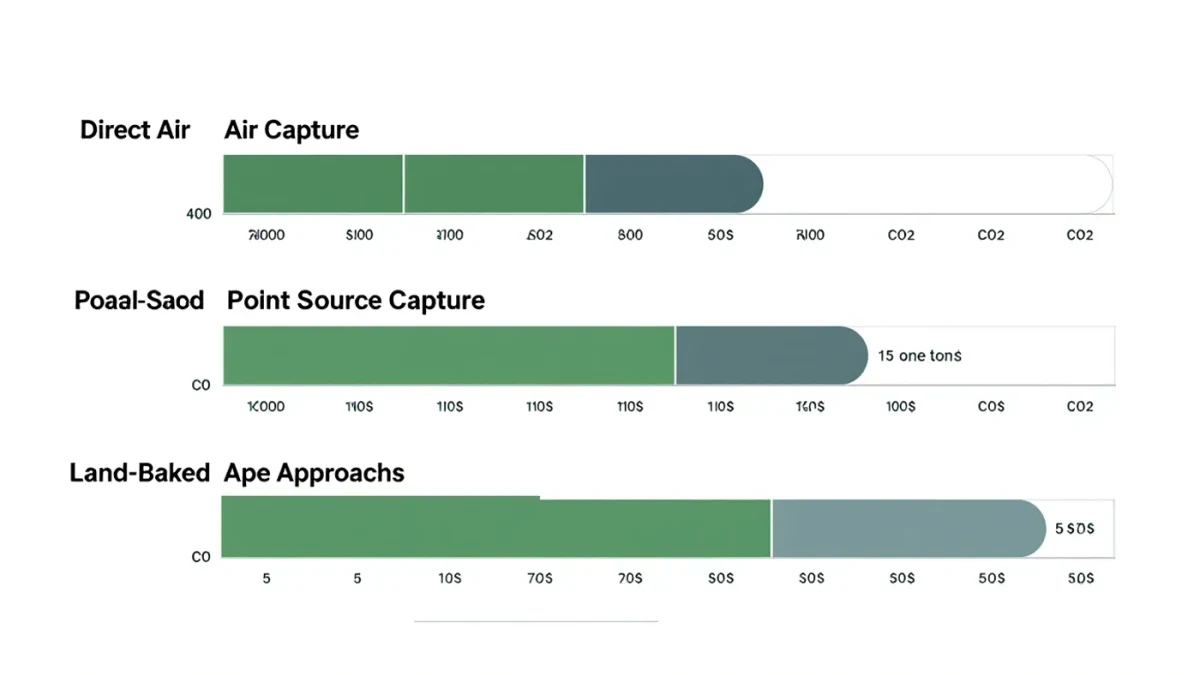
| Approach | Rough cost per ton CO2 | Main constraint |
|---|---|---|
| Direct air capture | Several hundred to ~1,000 dollars | Energy and capital cost |
| Point-source capture | Roughly 15–120 dollars | Only works at concentrated sources |
| Reforestation and land management | Roughly 5–50 dollars | Permanence, land competition |
How do we know the cost estimates are honest?
Partly because independent analysts and auditors publish them. Engineering firms such as Carbon Engineering and its partners have published design studies; researchers — including analyses in journals such as Joule and reports by the U.S. Department of Energy — have estimated costs from first principles and pilot data; and the actual operators, Climeworks among them, have publicly stated per-ton subscription prices in the hundreds of dollars, with a stated aim of a few hundred dollars by 2030. Skeptics counter that early quotes exclude financing or assume optimistic lifetimes. Both things can be true: today's merchant prices are real, and future projections are targets, not results. The honest summary is a range, falling, but falling slowly and from a high starting point.
Is the technology improving?
Incrementally, and with public help. The U.S. Department of Energy announced in 2023 a program of regional direct air capture hubs funded at 3.5 billion dollars, aiming to drive costs down through scale; similar support exists in Europe and the United Kingdom. Sorbent chemistries are improving in laboratories, and second-generation plant designs target lower regeneration temperatures, which widens the choice of energy sources. Learning-curve logic — costs falling as cumulative capacity doubles — applies, but the curve has barely begun: the industry's total capacity would fit within a single large factory's capture needs.
What happens to the captured carbon?
Two fates dominate. Storage means injecting compressed CO2 into deep rock formations, as the Icelandic operator's partner does — the gas reacts with basalt and mineralizes within years, a permanence few other removal methods match. Utilization means selling the gas for greenhouses, carbonated drinks, or synthetic fuels; it earns revenue but rarely keeps the carbon out of the air for long, and analysts caution against counting short-lived uses as removal. Monitoring and verification by independent registries add a modest but real cost per ton, one that grows with public scrutiny.
Does the cost argument make it a distraction?
The criticism is made seriously: some researchers argue that cheap-sounding promises of future removal delay emissions cuts today, a moral-hazard concern aired in peer-reviewed commentary since at least 2021. Defenders answer that hard-to-abate sectors need a removal option regardless. Both positions can coexist. The measurable facts are that costs are currently high, that no plausible projection makes removal cheaper than avoidance this decade, and that every credible climate pathway pairing limited warming with continued industry relies on removals growing to relevance later. The bill for dilute carbon is ultimately thermodynamic. The task of the next two decades is to reduce everything wrapped around it.