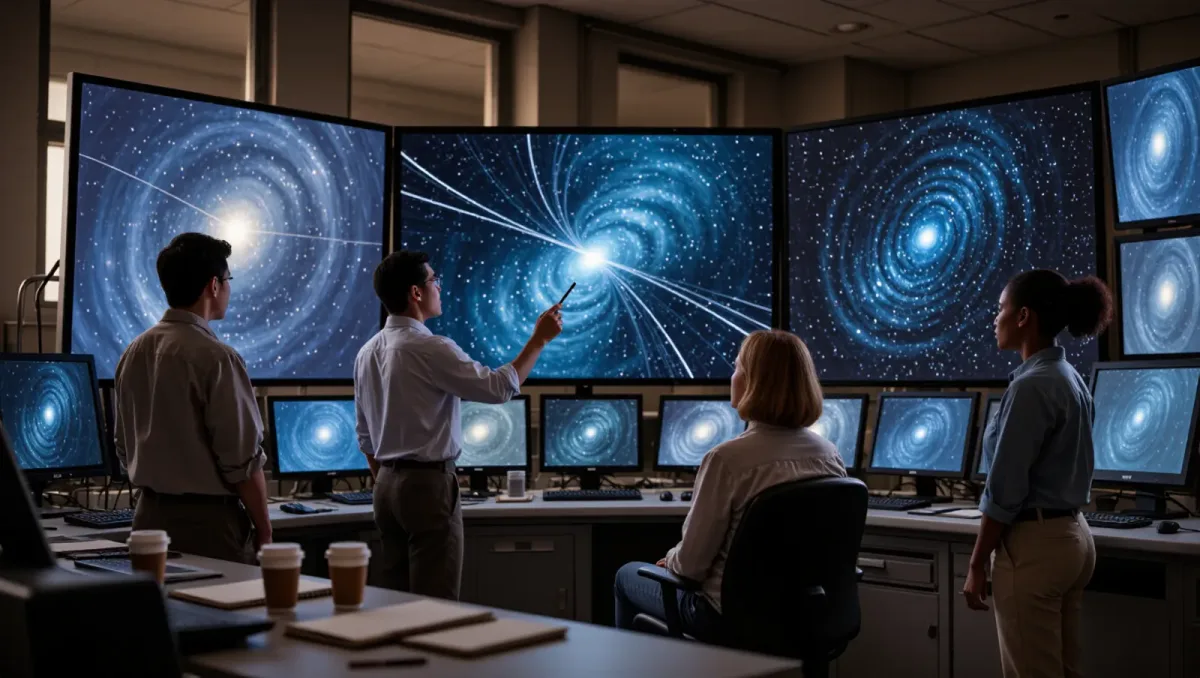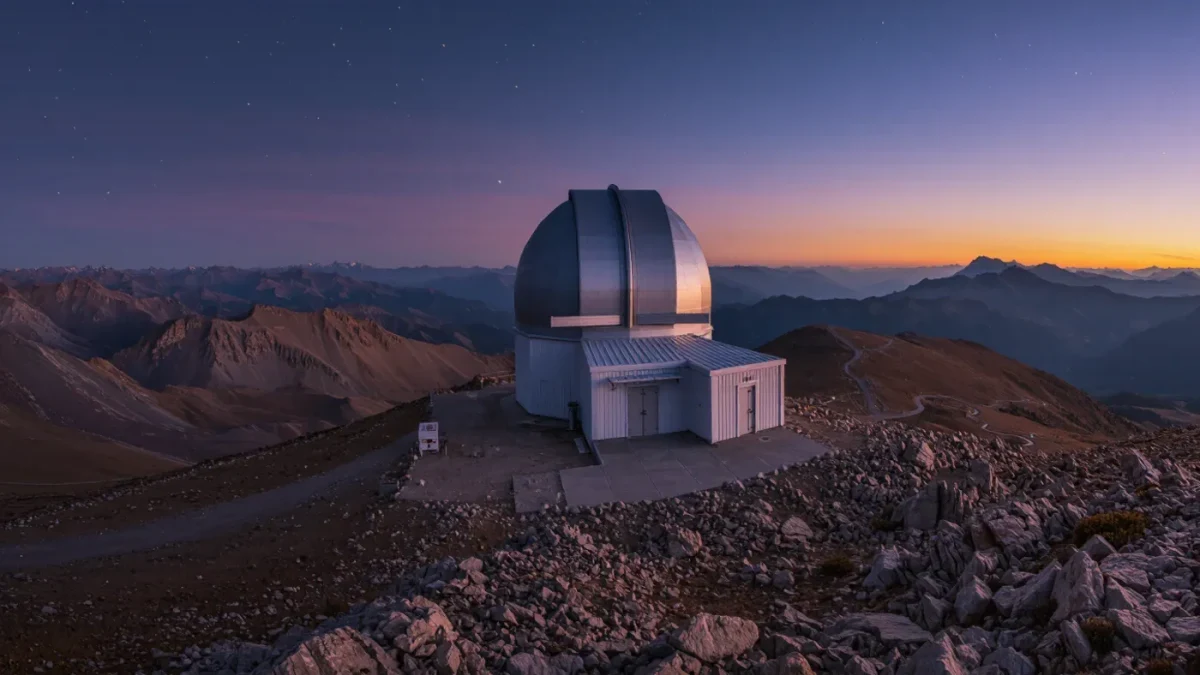
The Vera C. Rubin Observatory, located on Cerro Pachón in Chile, released its first images in June 2025 after more than a decade of construction. Its ten-year project, the Legacy Survey of Space and Time (LSST), will photograph the entire southern sky every few nights with a 3.2-gigapixel camera — the largest ever built for astronomy — generating on the order of 20 terabytes per night and roughly 60 petabytes over the survey. The design goal is not deep single portraits but repetition: seeing everything that changes, again and again, for a decade.
What makes the telescope unusual?
Rubin's mirror is unusually fast and wide. Its primary mirror measures 8.4 meters across, but the optical design — a three-mirror arrangement matched to a correcting lens nearly a meter and a half wide — gives the telescope a field of view of about 9.6 square degrees, dozens of times the area of the full Moon in a single exposure. Most large telescopes trade field of view for light-gathering power; Rubin refuses the trade, gathering light from a wide patch at once.
The camera at the focus is a machine of superlatives stated plainly: 3.2 billion pixels, cooled cryogenically, with filters spanning ultraviolet to near-infrared. A single exposure records an area that would take larger telescopes many pointings to cover. That combination — big mirror, wide field, giant detector — is what makes an all-sky movie possible rather than a decades-long fantasy.
How does the survey actually run?
Night after night, the telescope swings across the sky in a preplanned pattern, taking two exposures of each field in succession — a 30-second pair that lets software immediately tell a moving object from an electronic artifact. Each day, an automated pipeline compares the new images with the reference sky and issues alerts, typically within a minute, on everything that changed: a new supernova, an asteroid that shifted position, a star that flared.
The plan calls for millions of alerts per night, which forces its own science: teams build brokers — filtering software — that classify the flood and forward selected streams to astronomers. Final calibrated images and object catalogs accumulate into yearly data releases, the reference library future researchers will mine.
What is the survey expected to find?
The projected counts come from the collaboration's own simulations, and they are estimates, not promises. Over ten years, LSST is expected to catalog on the order of 20 billion galaxies and a similar number of stars, discover several million supernovae and other variable objects, and log millions of solar-system bodies — likely including tens of thousands of near-Earth asteroids and a population of distant objects that trace the structure of the outer solar system.
One headline target is dark energy and dark matter. By measuring the shapes of billions of galaxies — weak gravitational lensing, the slight distortion of galaxy forms by intervening mass — and mapping how galaxies cluster across cosmic time, LSST aims to constrain cosmological models with a statistical power no single previous survey approached. The evidence will be indirect; neither dark matter nor dark energy is seen directly, only inferred from gravitational effects on visible structure.
How do we know the machine works as advertised?
The commissioning data released since mid-2025 offers direct checks. In its first hours of test observations, the telescope returned images containing millions of stars and galaxies and detected thousands of new asteroids in short order — numbers the collaboration published as verification of both the optics and the alert pipeline. Earlier milestones included the camera's construction and testing at SLAC National Accelerator Laboratory, completed in the early 2020s, and the mirror's fabrication history, which survived a casting incident during the original melting.
Known limits are acknowledged in project documents. Weather on Cerro Pachón bounds the usable nights; the survey watches the southern sky deeply and the northern sky barely at all; and the alert system's speed depends on calibration data that matures as the survey ages. The first year's operations have also been sized conservatively while pipelines stabilize.
What problems come with 20 terabytes a night?
Data volume is a physics problem translated into a computing one. Each night's raw images must be calibrated, matched against reference catalogs, differenced, and turned into alerts before the next sunset. The project's data facility handles this with pipelines that automate what earlier surveys did by hand, and the annual public data releases — stacked images and measured object catalogs — will be products of automated processing at a scale no individual astronomer could reproduce.
A subtler challenge is calibration stability. Photometry good to a few percent, sustained for a decade across repeated filter changes and instrument maintenance, is what makes decade-long variability studies possible at all; the project devotes entire working groups to it, and its commissioning publications describe the strategies — repeated standards fields and cross-checks against stable stellar populations — in detail.
Who gets the data?
Rubin is funded by the U.S. National Science Foundation and the Department of Energy, with large contributions from private foundations and international partners. Science access follows a defined policy: full calibrated data go to collaboration members and participating institutions on release schedules, with a substantial share of images and catalogs made public after proprietary periods, and the alert stream open in real time to community brokers.
The name carries its own story. The observatory was renamed in 2019 for Vera Rubin, the astronomer whose measurements of galaxy rotation in the 1960s and 1970s helped establish that visible matter is outweighed by something unseen — the finding her namesake telescope is now positioned to test at survey scale.