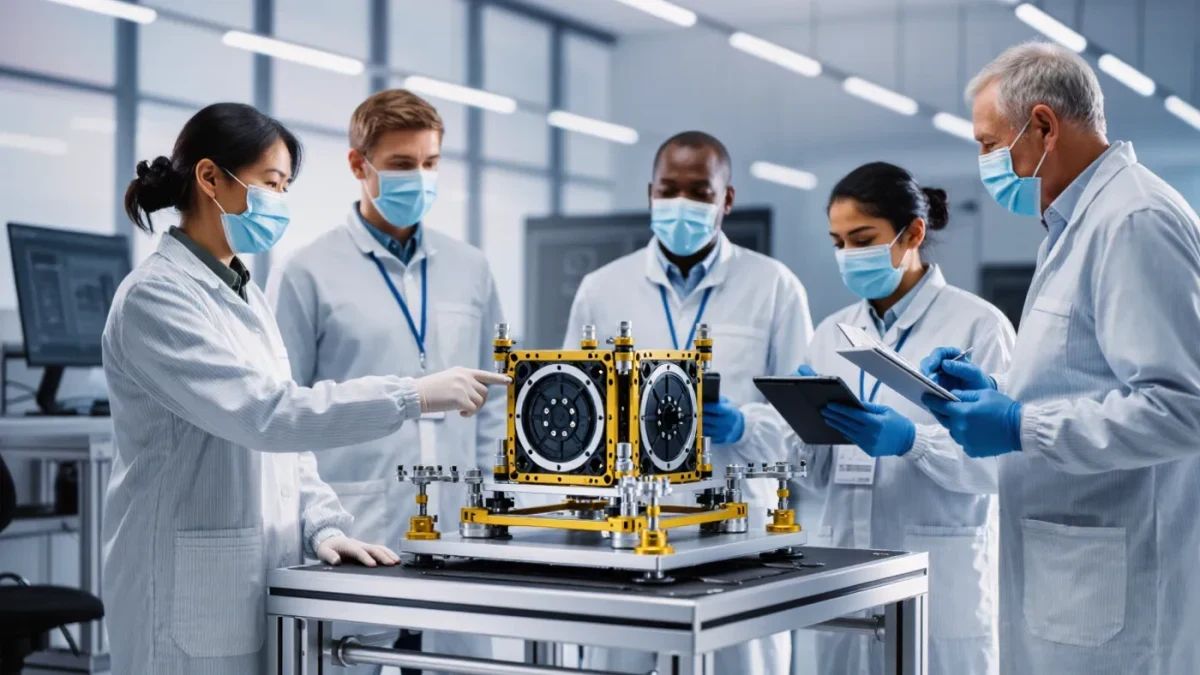
Ariel, the Atmospheric Remote-sensing Infrared Exoplanet Large-survey, is a European Space Agency mission designed to study the atmospheres of roughly a thousand known exoplanets. Chosen by ESA in 2018 and formally adopted in November 2020, the spacecraft is planned to launch in 2029 toward an observing post some 1.5 million kilometers from Earth. Its purpose is not to find new planets but to take a chemical census of existing ones, using a technique called transit spectroscopy.
How does transit spectroscopy read an atmosphere?
The method exploits a simple geometry. When a planet passes in front of its star — a transit — a sliver of starlight skims through the planet's atmosphere on the way to the telescope. Molecules in that sliver absorb specific wavelengths, leaving narrow fingerprints in the spectrum. By comparing starlight during transit with starlight outside transit, astronomers subtract one from the other and isolate the planet's atmospheric signature.
The fingerprints are unmistakable but tiny. The dimming caused by atmospheric absorption is typically measured in dozens to hundreds of parts per million, which is why Ariel needs to observe each target repeatedly — dozens of transits for the faintest signals — and why the mission dedicates itself to this one measurement rather than to general astronomy.
One limitation is built in: the method works best on planets whose atmospheres are puffy relative to their size, close to bright stars. Short-period planets, some heated to more than a thousand degrees, dominate any transit-spectroscopy survey. Ariel's chemical inventory will therefore describe the hot and warm worlds, with cooler planets appearing at the margins.
What chemicals is Ariel looking for?
Ariel carries two main instruments that together cover visible and infrared wavelengths from roughly 0.5 to 7.8 micrometers. That range captures absorption bands of water vapor, carbon monoxide, carbon dioxide, methane, ammonia, hydrogen cyanide, and clouds' signatures, along with metallic oxides such as titanium oxide in the hottest atmospheres.
The ratios among these carry the scientific payoff. The carbon-to-oxygen ratio, inferred from which molecules dominate, bears on how and where a planet formed in its disk of gas and dust. Water abundance, compared with the star's own composition, gives a proxy for overall metallicity — a term astronomers use for the proportion of elements heavier than helium. A planet that is enriched in heavy elements relative to its star likely accreted more solid material during assembly.
Why survey a thousand planets instead of studying a few?
Because single-planet results have limited meaning. One measured water abundance could be typical or could be an outlier; a cloud deck can mimic a low water signal in one atmosphere and hide nothing in another. A large, uniformly processed sample lets statisticians separate real population trends from instrument artifacts and weather.
That uniformity is Ariel's design choice. The mission plans to observe every target with the same instrument setup and a common data pipeline, producing comparable measurements across planets that range from Neptune-like to super-Earth in character. Population statistics of this kind, mission scientists argue, are what turn individual detections into tests of planet-formation theory.
How do we know the method works at all?
Transit spectroscopy has a two-decade track record. The first detection of an exoplanet atmosphere — sodium on the hot Jupiter HD 209458 b — was published in 2002 using the Hubble Space Telescope. Since then, Hubble and, since 2022, the James Webb Space Telescope have reported water vapor, carbon dioxide, methane, and sulfur dioxide on various exoplanets, each requiring multiple transits and careful correction for stellar variability.
The known weaknesses are equally documented. High-altitude clouds and hazes flatten the spectral features and can make a wet atmosphere look dry. Stellar activity — spots and flares on the host star — imprints signals that can be mistaken for planetary chemistry, a problem addressed by monitoring the star itself. Ariel's repeated visits to each target are partly a defense against exactly these confounders, and mission publications acknowledge that some fraction of targets will yield only upper limits rather than detections.
Where does the mission stand?
ESA adopted Ariel in November 2020, committing it to launch on an Ariane 6 from Kourou around 2029. NASA contributes to the mission as a partner, and member states across Europe supply the instruments; the infrared spectrometer hardware, for example, has been assembled and tested at national labs in the United Kingdom, Italy, and France during 2024 and 2025. As of late 2025, the mission reports its payload progressing through integration, with telescope assembly and cryogenic testing scheduled ahead of the planned launch.
The observing list itself remains open by design. Targets will be drawn from catalogs of transiting planets assembled largely by NASA's TESS satellite and ground-based surveys, finalized closer to launch so the sample reflects the best-characterized host stars.
What will count as success?
The deliverable is a comparative archive: a uniform set of atmospheric spectra, processed the same way, for about a thousand worlds. Scientists will treat it the way they treat large sky surveys — as a foundation on which others test models of formation, migration, and atmospheric escape.
It is worth stating what Ariel will not do. It will not image planet surfaces, detect life directly, or return weather maps. The chemical ratios it measures constrain formation history; they do not by themselves indicate habitability, and the hottest planets in the survey are uninhabitable by any known biochemistry. The mission's contribution is breadth — the first statistically meaningful answer to the question of what exoplanet atmospheres, as a class, are made of.