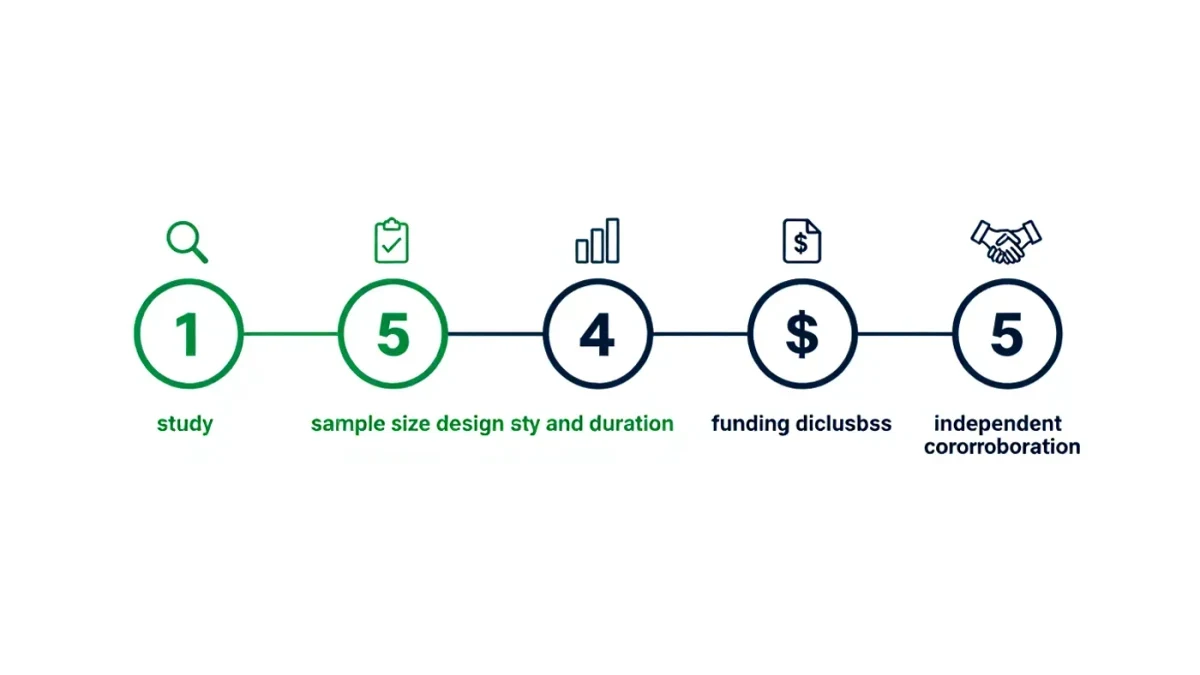
A health claim can be checked in five minutes by working a fixed sequence: find the named study behind it, confirm the design matches the claim's verb, check the sample and duration, look at the funding, and see whether independent coverage agrees. The U.S. Food and Drug Administration regulates health claims on product labels precisely because unverified statements travel faster than evidence — and the same skepticism the agency applies to labels is available to any reader with a search box and five minutes.
This checklist is a reader's tool for evaluating claims; health decisions belong with clinicians, who can weigh individual circumstances this article never sees.
What does step one — find the study — actually involve?
The first filter is provenance: a checkable claim names its study, journal, or institution, with a year. "Scientists have discovered that coffee prevents disease" is uncheckable; "a 2026 cohort study in a named journal followed 200,000 adults" is checkable. Searching the claim's exact phrase plus the word "study" usually surfaces the underlying paper within a minute, and PubMed, the National Library of Medicine's free index covering more than 35 million records, carries the abstract. If no study exists — only testimonials, a brand's page, or content farms repeating each other — the five minutes are over, and the claim has failed its first and most decisive test.
How does the design check work?
The design check asks whether the study's method can support the claim's verb. A claim of "prevents", "treats", or "causes" requires a design that can isolate effects: almost always a randomized controlled trial, where people are assigned to conditions by chance. Observational studies — cohorts that follow people, surveys that ask them — can show association, and their findings are often valuable, but their headlines deserve the softer verb "is linked to". Animal and cell studies rank lower still: a result in mice is a hypothesis about humans, as the long path of failed oncology drugs that cured mice attests. Reading the abstract's methods sentence, which nearly always states the design, settles the verb question in seconds.
What do size and duration tell a reader?
Size and duration bound what a study could have seen. A two-week study of 30 people cannot rule out harms that emerge over years, cannot detect small effects, and produces estimates that bounce with chance. Large samples narrow uncertainty, and long follow-up catches delayed outcomes — the reason hormone-therapy findings from the Women's Health Initiative in 2002, drawn from years of randomized follow-up in tens of thousands of women, carried weight that short trials could not. The abstract states enrollment and follow-up. As a rule of thumb: the smaller and shorter the study, the larger the hedge its claim requires, whatever the headline says.
Why does funding deserve its own step?
Because funding predicts framing, and occasionally findings. Industry-funded trials are often well-run — pharmaceutical company trials dominate the randomized evidence base — but a sizable methodological literature, including widely cited reviews of pharmaceutical-study outcomes, finds industry-sponsored trials more likely to report results favorable to the sponsor. Disclosures appear in the paper's conflicts section and, for U.S. physicians, in the public Open Payments database run by the Centers for Medicare and Medicaid Services, which publishes industry payments to clinicians. Funding does not falsify a study. It sets the prior for how carefully the claim's framing should be checked.
How do we know this checklist catches bad claims?
Each step encodes a documented failure mode. Claims without traceable studies are the raw material of supplement marketing, which the FDA and Federal Trade Commission police through warning letters published on the agencies' websites. Design-verb mismatches were quantified in the 2014 BMJ study of university press releases, which found causal claims attached to observational studies in a substantial share of releases. Selective reporting of favorable outcomes was documented in the 2009 JAMA comparison of registered and published trials. Small-sample overstatement is the core of Ioannidis's 2005 argument about why some published findings are false. The checklist is not a set of heuristics; it is the compressed findings of research about research.
What if the source is selling something?
The checklist tightens whenever the claim's source profits from belief. A seller's own page, an influencer's storefront link, or a clinic promoting its signature treatment all share an economic interest that no disclosure statement fully neutralizes, and regulators treat their statements as advertising rather than science — the Federal Trade Commission's enforcement actions against supplement marketers run exactly on this line. The workable adjustment is to raise the evidential bar: a commercial claim deserves a named, independent, preferably randomized study before it earns any weight, and a study funded by the seller deserves a published protocol and independent replication. None of this means commercial products never work; some of the strongest evidence in medicine comes from industry trials. It means the five-minute checklist has a sixth, unstated step that runs throughout — ask who benefits from the reader believing this, and weight the claim accordingly.
What does the full checklist look like?
Five minutes, five steps, in order.
| Step | Question | Red flag |
|---|---|---|
| 1. Source | Is a named study, journal, and year given? | Testimonials only; no traceable origin |
| 2. Design | Can the design support the claim's verb? | "Prevents" from a survey; human claims from mice |
| 3. Size and duration | How many people, followed how long? | Weeks, dozens of participants |
| 4. Funding | Who paid, and are conflicts disclosed? | Undisclosed sponsor; promoter sells the product |
| 5. Corroboration | Do independent outlets and reviews agree? | Only the seller's channels repeat it |
A claim that survives all five steps may still be wrong — single studies always may be — but it has earned a cautious hearing. A claim that fails the first two has not earned anything, including five more minutes.