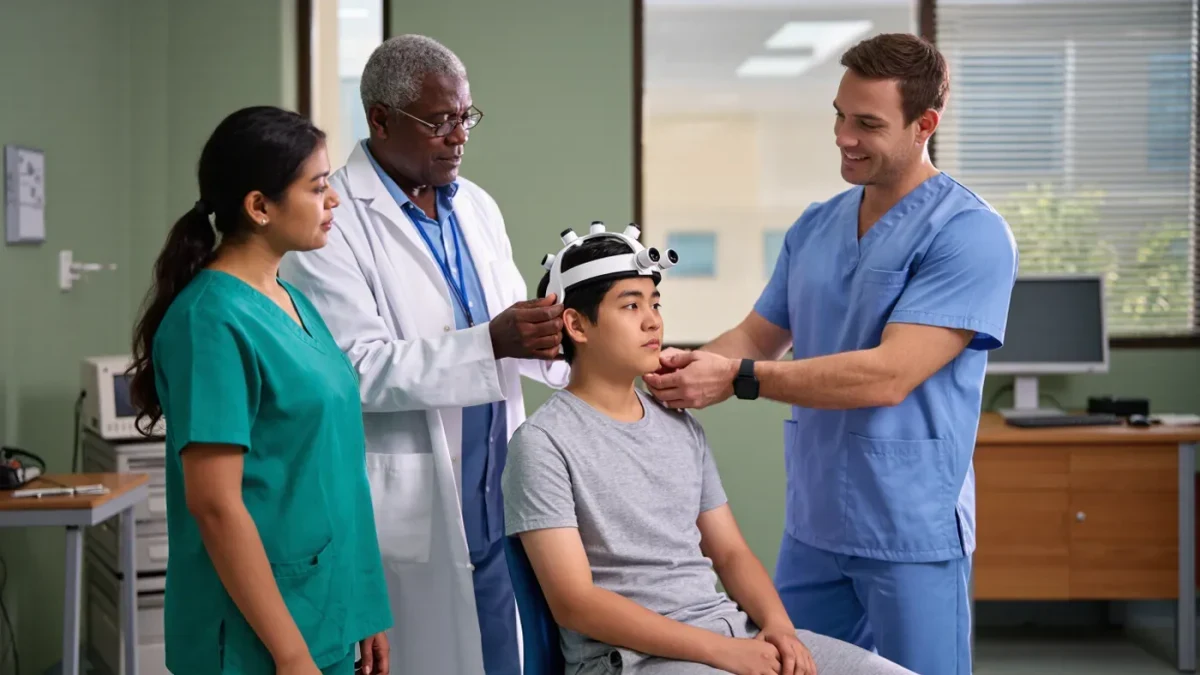
Quantum sensors reach the clinic by measuring magnetic fields produced by the body itself — the heart, the brain, even nerves — using clouds of atoms tuned by laser light. Devices built on this principle, called optically pumped magnetometers, have in the 2020s shrunk room-sized diagnostics into helmet-scale systems now being tested in hospitals. Clinical adoption, however, remains early: most applications are still in research studies rather than routine care.
Readers with health questions should raise them with a qualified clinician.
What does the body's magnetism actually look like?
Every electric current produces a magnetic field, and the body runs on currents. The beating heart generates rhythmic electrical signals that propagate through tissue; neurons firing in the brain produce their own faint pulses. The resulting magnetic fields are extraordinarily small — on the order of tens to hundreds of femtotesla, roughly a billion times weaker than Earth's ambient field. Detect them cleanly, and electrical activity can be read without touching the body at all.
That promise is not new. Magnetoencephalography, or MEG, has existed since the 1970s, and magnetocardiography, which records the heart's field, has been studied nearly as long. The obstacle was always the same: the signals were buried under magnetic noise from the planet, the power grid, and the machine itself.
How do quantum sensors see fields that weak?
The workhorse of the new devices is the optically pumped magnetometer. Inside each matchbox-sized sensor sits a small glass cell containing vapor of an alkali metal, usually rubidium or cesium. A laser aligns the spin of the atoms — a quantum property — and that alignment precesses at a rate proportional to the surrounding magnetic field. A second light measurement reads out the precession, giving the field strength with exquisite sensitivity.
The trick is that no cryogenic cooling is required. The atoms do the sensing, and lasers do the reading. A useful, if imperfect, analogy: traditional sensors listened to the orchestra through a wall of static, while quantum sensors tune each atom like a tiny radio antenna to one exact station. The analogy breaks down because antennas collect waves from afar, whereas the atomic vapor reacts to the field passing directly through the cell.
Why does losing the liquid helium matter so much?
Conventional MEG systems rely on superconducting quantum interference devices — SQUIDs — which need bathes of liquid helium at four degrees above absolute zero. Helium has grown scarce and expensive, and the cooling hardware forces sensors into a rigid, one-size-fits-all helmet fixed in a heavy dewar. Patients must sit still inside a shielded room; newborns and toddlers, whose brains are arguably the most interesting to study, are the hardest to scan.
Optically pumped magnetometers work at room temperature. Groups at the University of Nottingham and elsewhere showed from around 2017 onward that arrays of these sensors could record MEG while a child moved, because the sensors can sit lightly on the scalp and follow the head. A 2022 review in The Neuroscientist catalogued a fast-growing list of such demonstrations. The result was a practical change, not just a technical one: experiments that were once physically impossible became merely difficult.
Where might these machines enter medicine first?
Cardiology is an early candidate. Magnetocardiography does not require gel electrodes, works through clothing, and can capture fetal heart signals in ways that standard electrocardiography struggles to match. Research groups in Japan and Europe have published studies since the late 2010s using room-temperature systems to map abnormal heart rhythms, though most remain single-center investigations with modest sample sizes.
Neurology is the larger prize. Beyond brain mapping, researchers have explored magnetic sensors for detecting epileptic foci, monitoring stroke recovery, and — outside the body entirely — measuring nerve conduction in conditions such as diabetic neuropathy. A number of small companies and university consortia, particularly in the United Kingdom, Germany, and the United States, have built prototype systems; a 2023 report from the UK Quantum Sensors Network noted several hospital-based trials then under way. Progress is real but incremental.
How do we know the measurements are trustworthy?
The honest answer is that the evidence base is still maturing. Most clinical findings come from studies of tens of patients, not thousands, and comparisons are usually made against established SQUID systems rather than against long-term health outcomes. Sensor arrays also pick up magnetic contamination from cardiac pacemakers, dental implants, and nearby elevators, so shielding and software correction remain active engineering problems. Reviewers have repeatedly flagged the absence of large, multicenter validation trials as the field's central weakness. What the studies do show is that the signals match gold-standard recordings in controlled settings — a necessary first step, not a final verdict.
What still stands between the lab and the clinic?
Three barriers recur in the literature. First, regulation: a diagnostic device must demonstrate clinical validity to agencies such as the U.S. Food and Drug Administration, and few quantum-sensor systems have completed that pathway. Second, data: doctors need reference ranges and reproducible abnormalities, which only large studies can supply. Third, cost and infrastructure: even helium-free systems need magnetic shielding, which currently means a purpose-built room.
Researchers in the field tend to describe the technology's trajectory in years, not months. The sensors work. What remains is the slower work of proving, in trial after trial, that what they see changes what a doctor does — and helps the patient as a result.