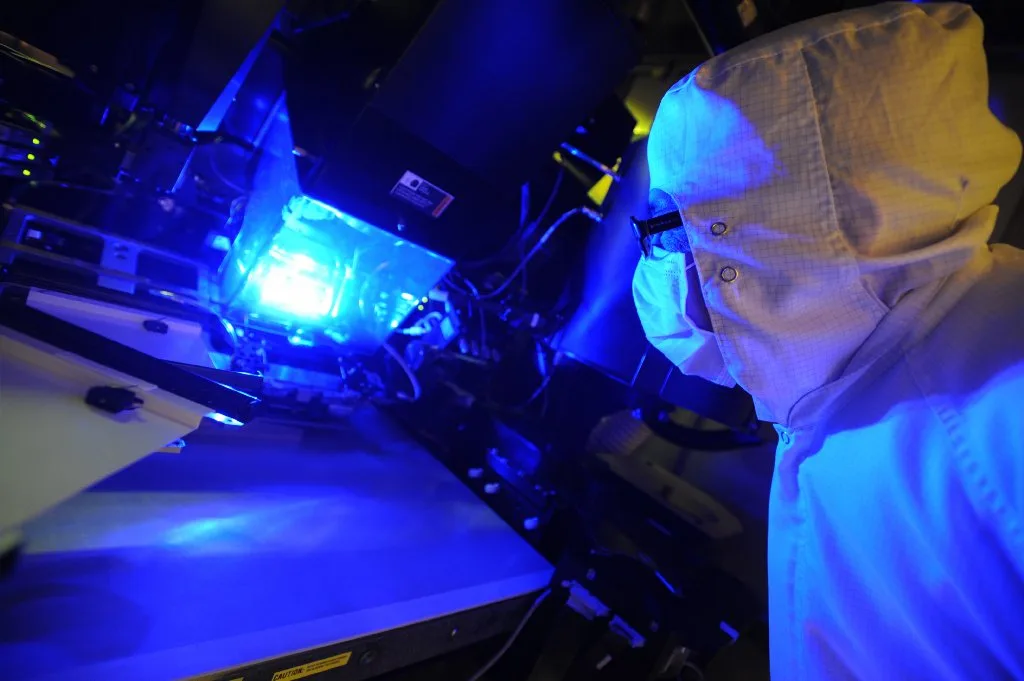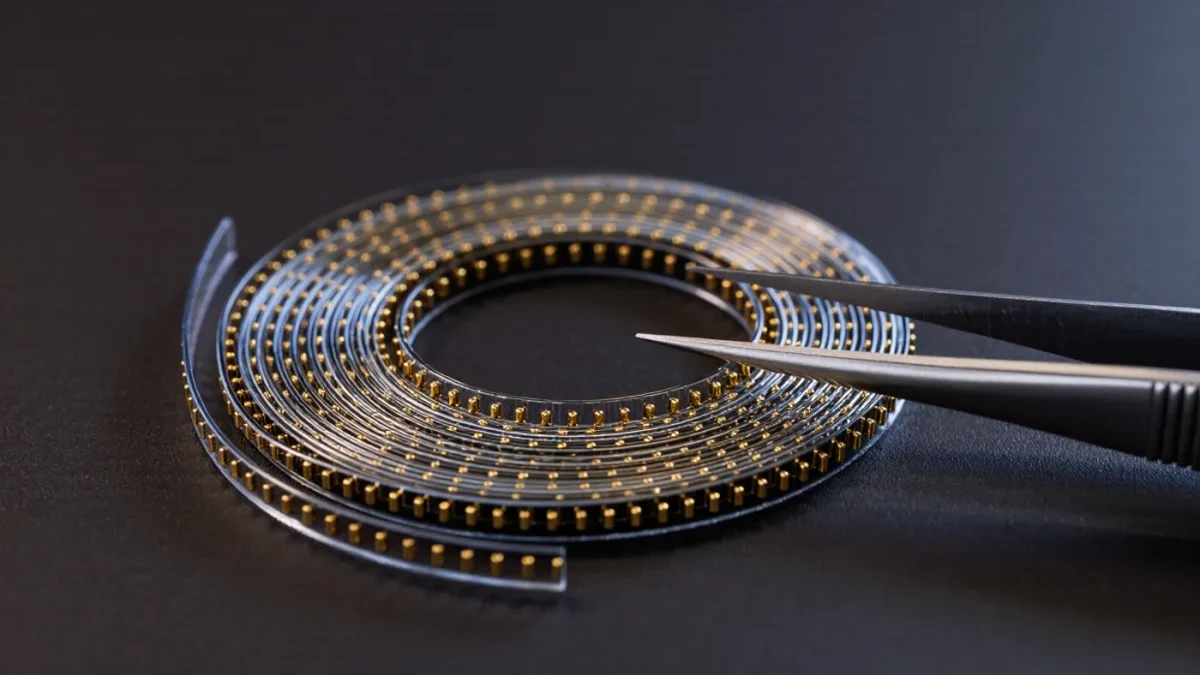
Brain-computer interfaces are tested for safety through a staged pipeline: laboratory bench testing of materials and electronics, animal studies lasting months to years, then small human trials under an investigational device exemption from the U.S. Food and Drug Administration. The first such implant in a person received FDA clearance for human testing in 2023, and the first participants were enrolled the following year. The safety record so far is encouraging — and, with only a few dozen people implanted worldwide, short.
Eligibility for any trial is a question for the study teams and a clinician.
What is a brain-computer interface, physically?
A BCI is a system that records electrical activity directly from the brain and translates it, in real time, into commands for a cursor, a keyboard, or a robotic arm. The implanted part is typically a flexible electrode array, threaded with conductive contacts finer than a human hair, placed in or on the cortex. A small electronics package amplifies and digitizes the signals; software decodes the firing patterns into intended movement.
The concept is decades old — arrays of implanted electrodes were first tested in people in the late 1990s in pioneering work at Brown University's BrainGate program. What changed in the 2020s was engineering: flexible threads, robotic insertion, wireless transmission, and commercial investment, most visibly by the company Neuralink, which the FDA cleared to test its implant in humans in May 2023.
What can go wrong, and how is it tested beforehand?
The risks fall into familiar categories, and each has a corresponding bench test. Infection and bleeding at the surgical site are surgical risks, evaluated in animal implants before any human surgery. Material failure — a thread snapping, insulation degrading, metal corroding in salty tissue — is tested by aging devices in accelerated conditions that simulate years in the body. Electrode performance is measured over months in animals, because scar tissue tends to encapsulate implants and mute signals; how much signal survives, and for how long, is the central durability question. Heat from the electronics, electrical safety, and the wireless charging link each carry their own standards, drawn largely from established rules for pacemakers and cochlear implants, adapted by regulators for devices that sit in the brain.
How does the FDA process actually work for these devices?
For a novel implantable device, the pathway begins with an investigational device exemption, which the FDA grants after reviewing preclinical evidence — laboratory and animal data supporting the safety rationale. Human trials under an exemption typically start small: a few participants, close monitoring, frequent imaging. Only after accumulating safety and performance data does a manufacturer seek wider approval, often through the FDA's breakthrough-device program, which several BCI sponsors have been granted.
BrainGate, the academic predecessor, ran its first implants under the same framework years earlier, publishing results such as a 2012 study in Nature in which participants with paralysis controlled a robotic arm, and a 2021 study in which two participants with loss of speech produced words via decoded signals at rates near speech itself. Those demonstrations came from tiny cohorts — two or three participants each — a limitation the authors state plainly in the papers.
What happened in the first commercial trials?
The first Neuralink participant received an implant in January 2024, in a procedure the company live-streamed and described in updates. In 2024, the company and independent researchers reported that some threads had retracted from the first participant's brain in the weeks after surgery, reducing the number of working electrodes; engineers compensated in software, and the participant retained cursor control. Additional participants were implanted later in 2024 and in 2025, and at least one report described a thread retraction in a second participant as well, again managed with engineering adjustments. The episodes, which the company discussed publicly, illustrate how safety and function are intertwined — and how early the learning curve remains.
Academic teams have implanted comparable research devices in a small number of other volunteers, with published results through 2024 on speech decoding and arm control. No severe adverse events have been reported publicly in these trials to date, though reporting is largely in the hands of the sponsors, and independent verification is limited while studies are ongoing.
How do we know the long-term risks?
Strictly speaking, we do not yet. No person has lived with a modern high-channel BCI for a decade; the longest human experience comes from older arrays with far fewer electrodes, and from adjacent fields — cochlear implants, deep-brain stimulators — whose decades of use support the biocompatibility of implanted electronics in general, but not the durability of flexible cortical threads specifically. Regulators require multi-year follow-up, and the current trials are, in effect, building that dataset in real time. Unknowns include how threads behave as brains age, whether removal or replacement surgery is safe, and what happens if a company sponsoring a trial fails — a scenario bioethicists writing in journals such as Neuron have urged planners to address.
What safeguards exist beyond the trials?
Several layers. Independent review boards approve protocols and consent documents at each site. The FDA inspects manufacturers and can halt trials. Journals and preprint servers make results — including adverse events — publicly scrutinizable, and conference presentations invite criticism from competitors and academics alike. The system is imperfect, but for BCI it has functioned visibly so far: a design change in 2024, publicly disclosed thread issues, and published corrections all became part of the record rather than disappearing.
Who might benefit first?
The trials enroll people with paralysis from spinal cord injury or amyotrophic lateral sclerosis, for whom the balance of risk and potential benefit is most favorable. Restoring communication and movement for people with locked-in syndrome is the near-term aim; speculative uses in healthy people remain far outside any approved trial.