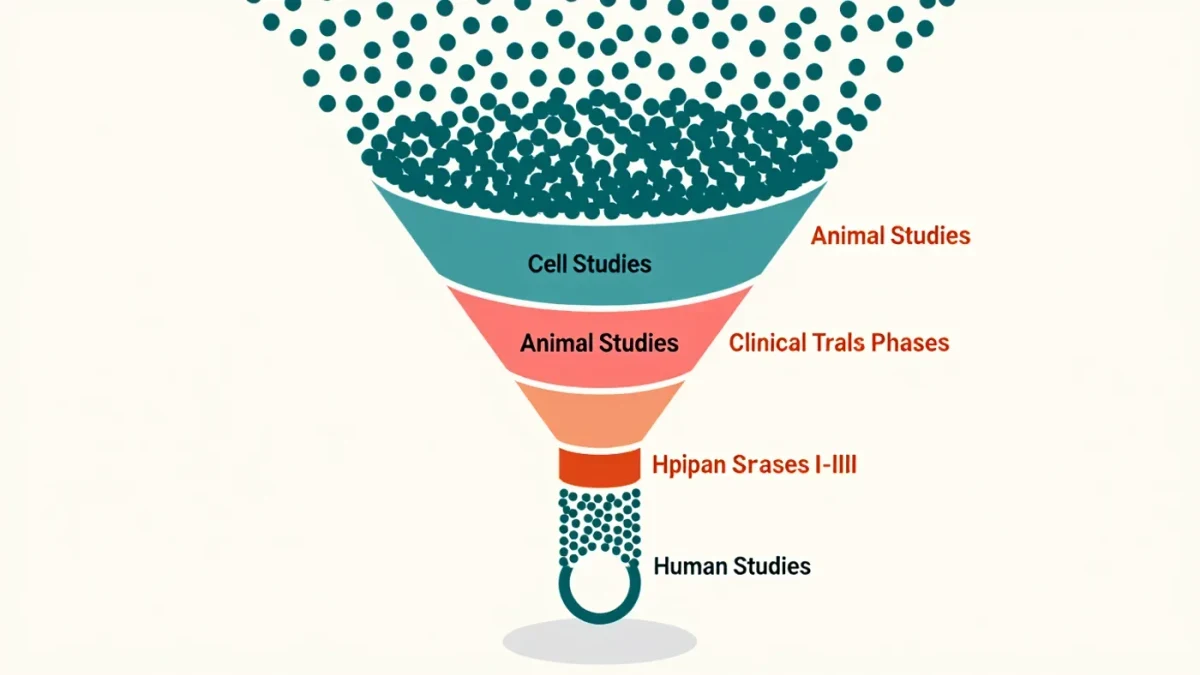
Animal studies fail to translate most of the time: attrition analyses of drug development commonly estimate that around nine in ten candidates that enter human trials fail there, most often for efficacy or safety problems that preclinical work did not predict. The 2006 first-in-human trial of the antibody TGN1412 at a London hospital, in which six previously healthy volunteers suffered severe inflammatory reactions despite doses far below those safely tolerated in monkeys, remains the standing lesson that animal safety does not guarantee human safety. Translation is real, but it is the exception that must be earned.
This article describes how preclinical evidence is generated and judged.
Why are animals used before humans at all?
Because whole living systems answer questions that cells and computers cannot. A molecule must be absorbed, distributed, metabolized and excreted; it must not poison the liver, the heart or a developing fetus at doses well above the intended one; and its effect on a disease process must be observed in something that has a circulation, an immune response and a metabolism. Regulators, including the United States Food and Drug Administration in its public descriptions of the drug development process, generally require animal testing before experimental drugs are given to people.
Whole-animal work also tests disease mechanisms: how a tumor evades immunity, how a nerve degenerates, how a diet alters metabolism over months. For questions like these, an organism is the smallest adequate instrument, and mice, rats, zebrafish and other species carry enough shared biology to make the results informative, never definitive.
Why do so many animal findings fail in humans?
The reasons stack, from biology to practice. Species differences come first: a drug target, a metabolic pathway or an immune receptor can differ enough between mouse and human that a compound's fate diverges at the first step. Model limitations come second, because laboratory animals usually carry one induced gene change or one implanted tumor, an approximation of a disease, not the disease as it occurs in a varied human population.
Practice problems come third, and they are the ones researchers can fix. Reviews of preclinical literature have documented small sample groups, absence of randomization and blinding, selective outcome reporting, and publication that favors positive results, the same failure modes that damaged credibility in other laboratory fields. Commentaries in the early 2010s, including work by collaborators of John Ioannidis, whose widely cited 2005 essay argued that most published research findings are false, extended the same argument to animal experiments, suggesting that small biased groups and selective reporting could render much of the preclinical record unreliable. The claim was a provocation, but the direction was documented.
- Species biology: receptors, metabolism and immune pathways differ between animals and humans.
- Model fidelity: induced conditions approximate disease rather than reproduce it.
- Method rigor: small groups, no randomization or blinding, selective reporting.
- Publication bias: positive animal results reach print far more often than null ones.
What was the TGN1412 case about?
About a hidden species difference amplified by dose logic. TGN1412 targeted a T-cell receptor, and cynomolgus monkeys, the species used in preclinical testing, did not show the catastrophic cytokine release that the antibody produced in humans, because of subtle differences in the receptor's behavior and the cells carrying it. The six volunteers, treated in March 2006 at Northwick Park Hospital in London, survived but suffered lasting injury, and the episode rewrote first-in-human trial rules in the United Kingdom, including dose escalation and staffing requirements. The lesson is not that animal testing is useless; monkeys did catch many other toxicities. It is that a clean animal result marks the start of human caution, not its end.
How do we know which animal findings will translate?
Imperfectly, but readers and reviewers can weigh odds by checklist. Strong preclinical evidence reproduces the effect in more than one species and more than one model, shows a dose-response relationship, uses randomized, blinded experiments with adequate group sizes, reports all measured outcomes, and is published with data. It tests the intervention in a model that resembles the human disease's mechanism, not merely its appearance, and, where possible, it confirms the mechanism in human cells or tissues. Findings from a single small unblinded mouse study should be labeled exactly that, in mice, one species, one laboratory.
Coverage discipline follows. An animal result described as a breakthrough cure has been misdescribed; the honest formulation is that a treatment did something measurable in an animal model, with human relevance untested, and the odds of translation, judged by attrition estimates, are long.
| Evidence stage | What it establishes | What it cannot establish |
|---|---|---|
| Cell and tissue studies | Mechanism plausibility in isolated systems | Whole-body behavior, safety |
| Animal studies | Effects in a living organism, preliminary safety | Human efficacy, human-specific toxicity |
| First-in-human trials | Safety and dosing in small groups | Effectiveness in patients |
| Large clinical trials | Efficacy and adverse effects in patients | Rare harms, long-term outcomes |
Are alternatives replacing animal testing?
Partially, and directionally downward. Organ-on-chip systems, engineered tissues and human cell lines increasingly answer questions that once required animals, and regulators in the United States and Europe have moved toward accepting certain non-animal evidence, including a 2025 United States provision aimed at reducing mandatory animal testing for drug applications. None of these systems yet reproduces a whole organism's integrated response, so the realistic trajectory is fewer animals used more precisely, not their immediate replacement.
How should a reader hold animal findings in mind?
As mechanism with potential, priced honestly. The examples that did translate, from statins, whose early work ran through animal models, to modern immunotherapies built on mouse experiments, show the pipeline can work. The attrition numbers show how selective its successes are. The practical reading rule never changes: note the species, the sample size, whether the experiment was blinded, and whether the result has been reproduced, and treat any single animal study as the first sentence of a story that human trials have not yet begun to write.