Lab-on-a-chip devices matter because they move chemical testing out of centralized laboratories and into the clinic, the pharmacy, or the home. By carving pumps, valves, and reaction chambers into a chip smaller than a credit card, they can run a diagnostic test — flu, strep, coronavirus — from a single sample in minutes. The chemistry works; the open challenge is making such tests cheap, accurate, and available where they are needed most.
Decisions about testing belong with a clinician.
What does a lab on a chip actually do?
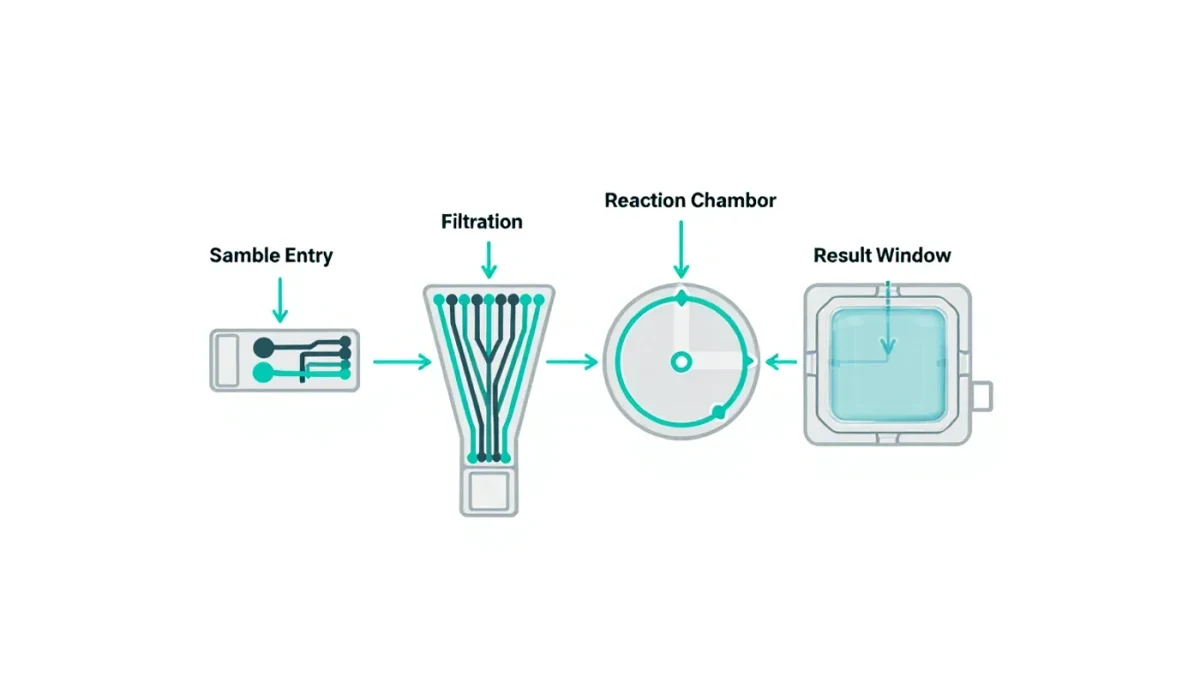
A conventional diagnostic laboratory follows a script: take a sample, purify it, mix it with reagents, incubate, and read a signal. Microfluidics performs the same script on a chip. Channels thinner than a human hair move droplets by capillary force, tiny pumps, or precisely controlled air pockets, while on-chip chambers hold dried reagents that dissolve when the sample arrives. The whole sequence is prearranged in the chip's plumbing, so the user adds a sample and reads an answer.
The physics helps in quiet ways. At small scales, fluids behave in an orderly fashion — they flow smoothly rather than turbulently, and diffusion mixes reagents in seconds. Heat spreads and dissipates quickly, which matters for tests that need warming and cooling cycles, such as those that amplify DNA. A simple comparison: a pipette-wielding technician and a microfluidic chip do the same job, but the chip's workspace is a million times smaller, so every step takes less time and less sample.
Where have these devices already proved themselves?
Pregnancy tests and lateral-flow antigen tests are microfluidics' humble cousins, and their success during the COVID-19 pandemic showed the power of putting testing in the hands of the user. Rapid antigen tests for SARS-CoV-2, authorized by the U.S. Food and Drug Administration from 2020 onward, relied on wicking a sample along a paper strip — not a chip, but the same philosophy of self-contained chemistry.
Chip-based molecular testing followed. Instruments the size of a coffee cup now perform nucleic-acid amplification at the point of care, and in 2023 the FDA granted marketing authorization for a combination home test that reports influenza and coronavirus results from one swab. Meanwhile, CRISPR-based diagnostics — in which a gene-editing enzyme is repurposed as a programmable detector — moved from a 2018 demonstration in the journal Science toward authorized tests, with the first FDA-authorized over-the-counter CRISPR test cleared in 2025 for use at home.
Why is sample preparation the hard part?
The laboratory is clean; the world is not. A nasal swab carries mucus, bacteria, and debris that can foul a chip's channels or block a reaction. A sample prepared for a lab machine by a trained technician is manageable; a sample added by a hurried parent at a kitchen table is not. Chip designers answer with filters, membranes, and chemistry that tolerates mess, but every added feature raises cost and creates new ways to fail.
This is why the field's hardest engineering is invisible. The visible result — a line on a strip, a glow in a well — is the easy part. The hard part is guaranteeing the result is right when the input is unpredictable.
How do we know these tests can be trusted?
Because regulators check them against laboratory benchmarks, with published numbers. Any test authorized by the FDA or the European authorities carries sensitivity and specificity figures: how often it correctly detects an infected person, and how often it correctly clears an uninfected one. Rapid antigen tests, for example, were authorized only after clinical studies comparing them against laboratory PCR — studies that showed they detect infection reliably when viral loads are high, and less reliably early in illness. That limitation, printed in the instructions, is a feature of honest engineering, not a failure of it. Independent evaluators, including the Cochrane Collaboration, have reviewed these performance figures across brands.
What has prevented lab-on-a-chip from dominating diagnostics?
Three bottlenecks recur in reviews of the field. First, cost: precision-molded chips with pumps and detectors are expensive to manufacture at scale, and healthcare systems pay only for tests that beat cheaper alternatives. Second, the last mile: a chip needs an instrument or a reader, plus distribution, refrigeration where required, and user instructions that survive real-world use. Third, the accuracy gap: for many diseases, a fast answer is still less reliable than a slow laboratory one, so chips complement rather than replace central labs.
| Approach | Typical time to result | Typical setting | Main trade-off |
|---|---|---|---|
| Lateral-flow strip | 10–20 minutes | Home, pharmacy | Lower sensitivity than lab tests |
| Microfluidic chip with reader | 30–90 minutes | Clinic, emergency room | Instrument cost per site |
| Central laboratory PCR | Hours to days | Hospital, reference lab | Speed and access |
Where do chips make the biggest difference?
Settings where sending a sample to a laboratory is impractical. Rural clinics without a courier service, emergency rooms deciding on isolation within the hour, outbreaks in crowded camps — in each, a result that arrives in minutes changes the decision, while a result that arrives in three days does not. Maternal and newborn care is another documented frontier: microfluidic prototypes for measuring infection markers and blood chemistry from a finger prick have been reported in clinical studies across African and South Asian hospitals since the late 2010s, typically by university consortia working with local clinicians. These studies are small and the devices remain investigational, but they show the pattern the field is chasing: move the decision to where the patient already is.
What comes next for the field?
Research groups are chasing tests that need no instrument at all — chips where the answer appears as a visible color change — and multiplexed designs that screen for a dozen pathogens from one sample. The direction is clear even if the timeline is not. Testing keeps moving toward the patient, one miniaturized valve at a time.