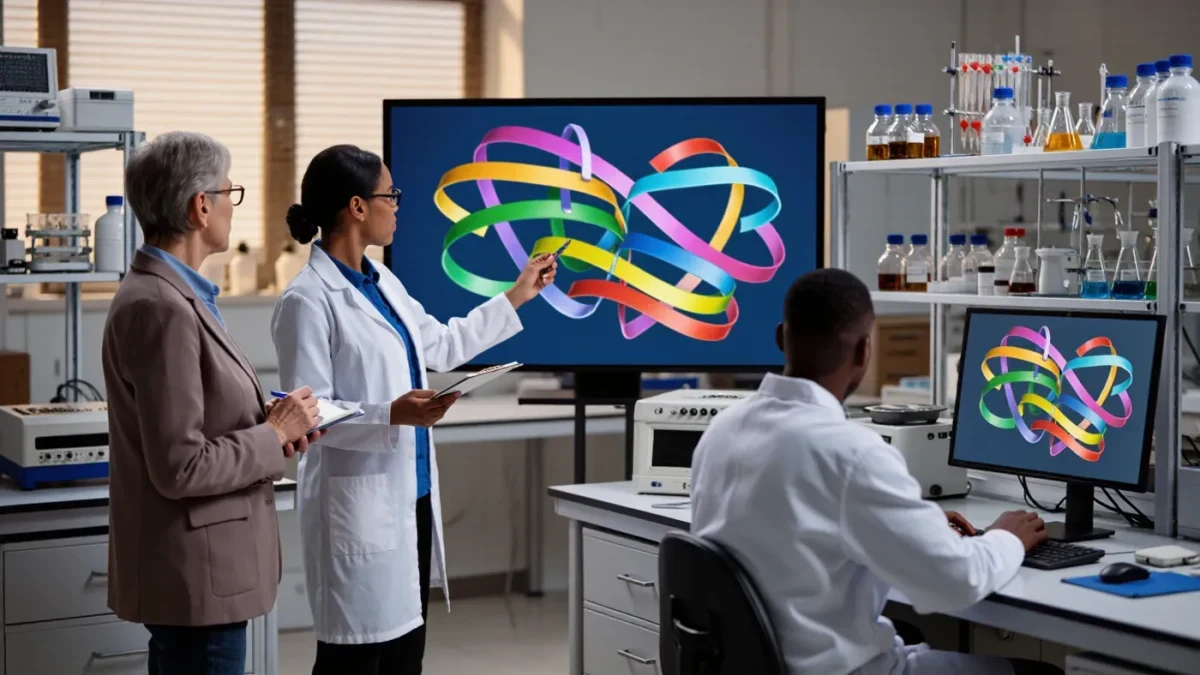
AI protein structure prediction changed biology by solving, in practice, a problem that had stood open for half a century: guessing a protein's three-dimensional shape from the linear sequence of its amino acids. DeepMind's AlphaFold, first announced at a benchmark contest in 2020 and published in Nature in 2021, now supplies predicted structures for essentially every cataloged protein — more than 200 million of them, released free by the company in 2022. The change is real, and so are its limits.
A protein's sequence — the order of its chemical building blocks — determines how the chain folds into a compact shape, and the shape determines what the protein does. For decades, deducing the fold from the sequence was one of biology's grand unsolved problems. The standard method, X-ray crystallography, costs months of laboratory work per protein; cryo-electron microscopy is faster for some targets but still slow and expensive. Biologists' structure knowledge grew at a trickle.
What did AlphaFold actually demonstrate?
The public proof came at CASP14, a community benchmark contest held every two years where predictors are scored against unpublished laboratory structures. In November 2020, AlphaFold 2 achieved median accuracy comparable to experimental methods across most targets — a result the contest organizer John Moult called a once-in-a-generation change in what was computable. The paper describing the method appeared in Nature in July 2021, and a companion paper from the European Bioinformatics Institute applied it across whole genomes.
In July 2022, DeepMind and the European Bioinformatics Institute released a database of over 200 million predicted structures — nearly every protein known to science, from established model organisms to obscure bacteria. The resource is free to all, and the Nobel Assembly at Sweden's Karolinska Institutet recognized the upheaval by awarding the 2024 Nobel Prize in Chemistry to DeepMind's Demis Hassabis and John Jumper, alongside David Baker of the University of Washington, whose laboratory developed an independent design method.
How does the model work, in plain terms?
AlphaFold is not a physics simulation. It is a deep neural network trained on the roughly 200,000 structures that laboratories had already solved, learning statistical patterns linking sequences to shapes. Given a new sequence, it also mines evolutionary history: proteins with shared ancestry across species carry telltale co-varying positions that hint at which amino acids touch inside the folded molecule. The network combines these clues and, critically, estimates its own confidence for every region of its prediction — so users can see which parts to trust.
One qualified analogy: it resembles an apprentice who has memorized every blueprint in the archive and can sketch a plausible new building instantly, but has never stood in a building. The comparison fails where buildings obey static rules; proteins wiggle, and the archive holds mostly frozen snapshots.
What do biologists actually use it for?
Thousands of published papers have used AlphaFold structures since 2021. The uses cluster around interpretation: mapping a mutation seen in patients onto a protein to see where it lands, finding candidate drug-binding pockets, constructing models to fit ambiguous experimental data. Neglected-disease research benefited early, because proteins of parasites and crops had few laboratory structures. The method also accelerated a malaria vaccine program and enzyme engineering projects reported by academic and industry groups through 2023 and 2024.
The 2024 Nobel citation reflected that diffusion: the committee credited structure prediction and protein design, not disease cures, as the achievement. A finding is never larger in the citation than in the papers.
How do we know the predictions can be trusted?
Because the confidence estimates are unusually honest. Independent evaluations have shown that when AlphaFold reports high confidence, its prediction usually matches experiment closely — often within the width of an atom; where it reports low confidence, users are warned and are right to be. The documented limits matter just as much. The model typically predicts one static structure, while real proteins flex, breathe, and change shape as they work. It does not, by itself, reveal how two proteins bind each other — later tools such as AlphaFold-Multimer, released in 2022, extended predictions to complexes with mixed success. It can be wrong on the floppy regions that drug designers care about, and it cannot say anything about a sequence unlike anything ever measured — a general property of learned systems. The laboratories, in short, remain essential; predictions guide experiments rather than replacing them.
Did experimental structural biology become obsolete?
No — the demand shifted. AlphaFold narrowed the questions worth taking to the bench. Crystallographers now routinely use predicted models to solve structures that once resisted analysis, a workflow embraced by structural genomics centers. Meanwhile the frontier moved to what prediction cannot yet deliver: the dance of proteins over time, their interactions in crowded cells, and the design of entirely new molecules that have never existed. David Baker's laboratory specializes in exactly that design problem, and it was recognized together with prediction in 2024.
| Era | Method | Typical scale |
|---|---|---|
| Before 2020 | Crystallography, cryo-EM | Tens of thousands of structures, decades of work |
| 2020–2021 | AlphaFold 2 at CASP14 and in Nature | Experimental-grade accuracy on most single proteins |
| 2022 onward | Public database of 200 million structures | Nearly every known protein, free to all |
What problem comes after the folding problem?
The community's own answer, stated in reviews and roadmaps since 2022, is that the static picture was the easier half. Proteins in living cells are concerts, not sculptures. Predicting — and eventually simulating — motion, binding, and regulation inside cells is the next fifty-year problem, and it has barely begun.