University research offices exist because federal rules make them necessary: a 1980 law called the Bayh-Dole Act allowed universities to keep ownership of inventions made with federal research money, and managing that ownership, along with administering the grants themselves, requires permanent professional staff. Before 1980, the federal government owned most such inventions and licensed only a small fraction of them, so universities had little to manage.
This site publishes information about how research institutions operate, not legal advice on patents or licensing.
What did the Bayh-Dole Act of 1980 change?
Before the law, when a federally funded researcher invented something, title sat with whichever agency had paid for the work. By 1980 the government held roughly 28,000 patents but had licensed only a small share, commonly cited as under five percent, according to figures reported at the time. Bayh-Dole let universities elect to keep title to inventions from federally funded work, on conditions: they must patent when worthwhile, seek practical application, give the government certain rights, and share income with inventors.
The result was a new profession. Institutions set up technology transfer offices, and the association now tracking the field, AUTM, grew from a small gathering into a national membership organization. Supporters credit the law with helping launch biotechnology regions such as Boston and the San Francisco Bay Area; critics, including some economists, argue it raised costs and that many blockbuster drugs owed little to it. Both readings coexist in the literature.
What do the different research offices actually do?
Research administration splits into at least three distinct functions, often housed in separate offices. The Sponsored Programs office, sometimes called pre-award, prepares and submits grant proposals, negotiates terms with agencies and monitors compliance. The Post-Award office manages spending once a grant lands, from effort reporting to audit responses. The Technology Transfer office, often called TTO or the Office of Technology Licensing, handles inventions: filing patents, marketing licenses to companies and sometimes spinning out startups.
- Sponsored Programs: proposal budgeting, submission, agency negotiation, compliance training.
- Post-Award financial administration: spending oversight, effort certification, audits.
- Technology Transfer: invention disclosures, patents, licensing, startups, Bayh-Dole reporting.
- Research Compliance, often a fourth office: human subjects, animal care, export controls and conflict-of-interest rules.
How does an invention travel from lab to license?
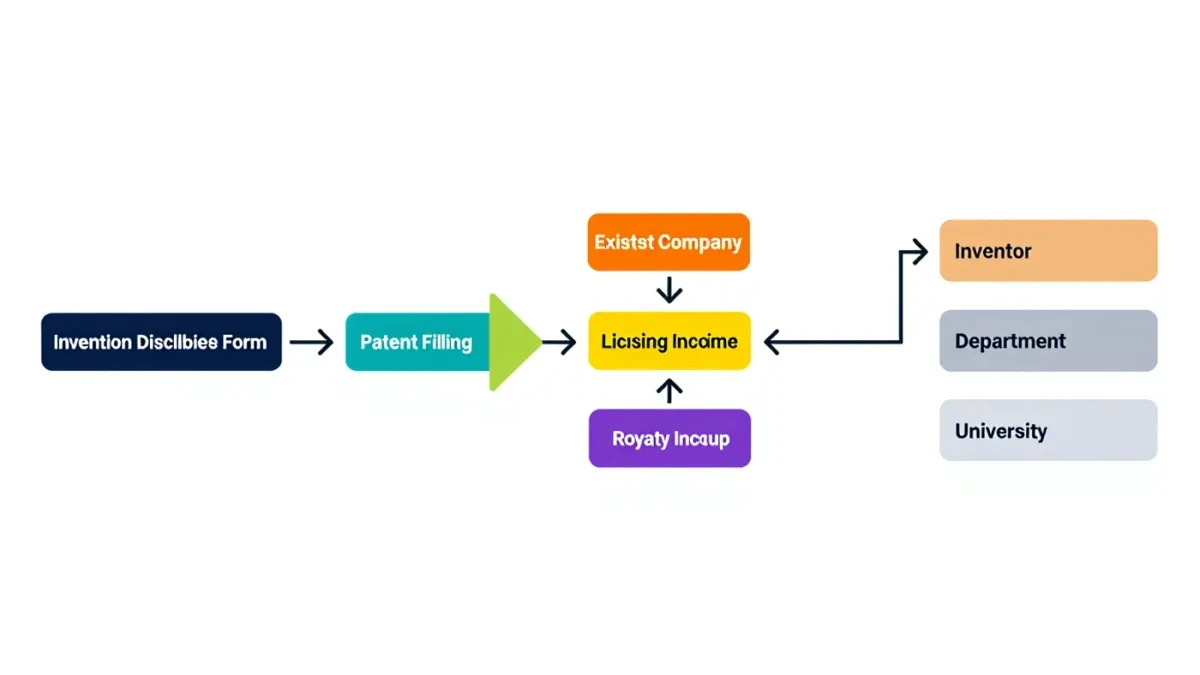
The typical path is standardized across large U.S. research universities. A researcher submits an invention disclosure, a form describing the finding. The TTO evaluates patentability and market interest, decides whether to file, and then seeks licensees, which may be existing companies or a new startup founded around the patent, often by the inventor. When licensing income arrives, it is split among the inventor, the department and the university, under formulas set by policy; the Bayh-Dole framework requires that inventors receive a share.
Most disclosures never become products. AUTM's annual surveys have consistently shown that licensing income is highly concentrated: a small number of lucrative patents, in fields such as pharmaceuticals and engineering, fund the system, while most inventions generate little or nothing. The famous examples, such as the Cohen-Boyer recombinant DNA patents at Stanford, which brought in roughly a quarter of a billion dollars, are outliers by definition.
Do these offices pay for themselves?
For most universities, technology transfer rarely turns a large profit once patent costs are counted. Studies of AUTM data over the years have found that a minority of institutions net positive licensing income in a given year; the offices' defenders argue the mission is societal impact and regional development rather than revenue. Sponsored Programs, by contrast, is a cost center by design: its work exists to bring federal money in, and overhead payments on grants, the facilities and administrative costs universities add to awards, cover far more of campus infrastructure than licensing ever will.
How do we know how the system performs?
The main evidence base is AUTM's annual licensing survey, to which hundreds of U.S. institutions report disclosures, patents, licenses, startups and income, alongside federal Bayh-Dole reporting requirements and studies by economists and policy researchers. The survey has well-known limitations: reporting is voluntary, definitions vary across institutions and the data say nothing about whether a licensed product actually reached users. Peer-reviewed analyses, including work questioning how much credit Bayh-Dole deserves for specific drug launches, temper the anniversary-party narrative. A 2026 reader should treat the field's headline numbers as institutional self-reports, informative but not audited like financial statements.
Why should a student or taxpayer care?
Because these offices shape daily academic life. A graduate student's stipend may be paid from a grant that Sponsored Programs negotiated; a professor's startup may exist because a TTO attorney filed the right patent; a department's new building may be funded partly by overhead from federal awards. The invisible bureaucracy around research is not decoration. It is the legal machinery that connects a federal appropriation to a specific experiment on a specific bench, and since 1980 that machinery also decides who owns what the experiment produces.
How much activity do these offices handle?
The scale surprises outsiders. AUTM's annual surveys have reported on the order of several thousand invention disclosures, thousands of new U.S. patent applications and roughly a thousand startup formations per year across reporting U.S. institutions, with activity concentrated in a few dozen large research universities. A major medical-center technology transfer office may employ thirty or more staff, including patent liaisons, licensing associates with doctorates in the sciences and contract specialists, while a small college may assign the function to a single part-time administrator. Staffing tracks research volume, not university size, which is why the most sophisticated operations sit atop the largest academic medical and engineering portfolios rather than at the most famous liberal arts institutions.