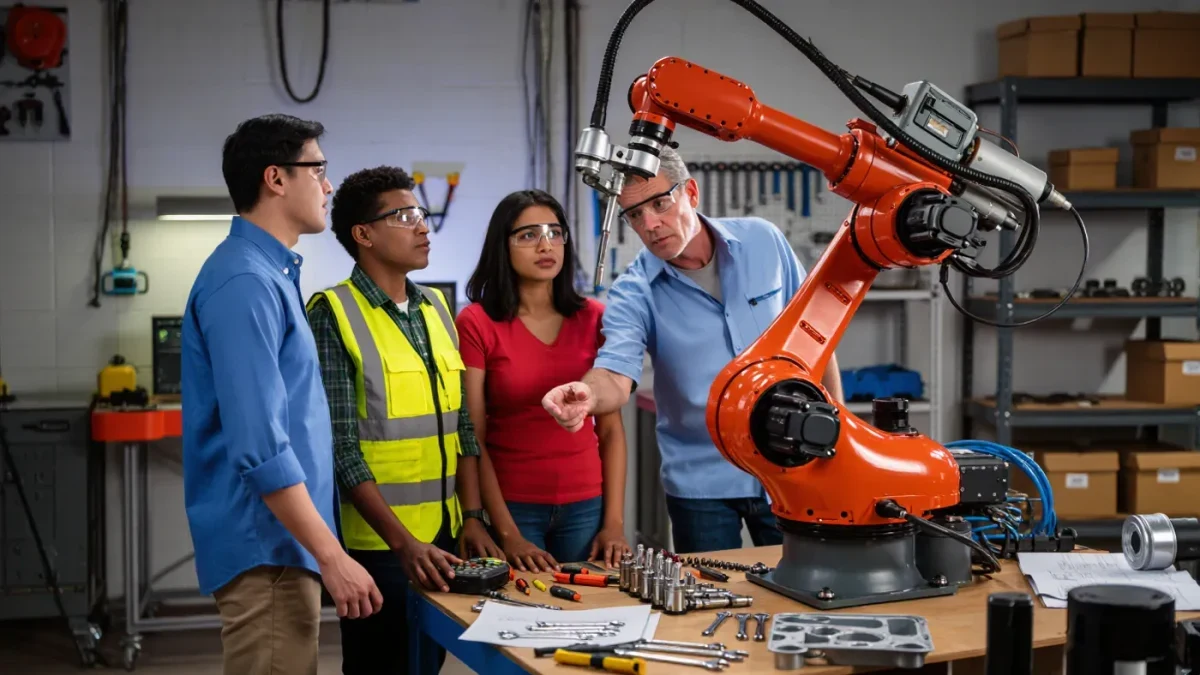
Community colleges feed the U.S. STEM workforce from two ends at once: they award a large share of the technician credentials, in fields like engineering technology and health sciences, that industry consumes directly, and they serve as the entry ramp for transfer students, with NSF's Science and Engineering Indicators reporting that a substantial fraction of science and engineering bachelor's recipients, and about one in five doctorate holders, attended a community college at some point. The two-year sector, about a thousand institutions enrolling several million undergraduates, is where much of the STEM pipeline's volume actually flows.
This site publishes information about education and workforce research, not advice on choosing an institution.
What does the federal data actually show?
The National Center for Science and Engineering Statistics, NSF's data arm, publishes the biennial Science and Engineering Indicators, whose education chapters draw on national degree and survey data. Its reports through the 2020s show community colleges producing the majority of associate degrees in technician-intensive fields, including large shares of nursing and allied health credentials, and supplying roughly half or more of new nurses in many states. On the transfer side, the Indicators and NCES analyses report that a meaningful share of science and engineering bachelor's recipients, concentrated among first-generation and lower-income students, started at or attended two-year institutions, and that about a fifth of S&E doctorate recipients report community college attendance. The precise percentages shift by field and year; the pattern does not.
Why do STEM students start at two-year colleges?
Cost and geography. Community college tuition runs a fraction of four-year rates, and about half of U.S. undergraduates live within commuting distance of one, though this figure is an often-cited industry estimate rather than a precise census statistic. Federal data consistently show two-year students are older on average, more likely to work while enrolled, more likely to be first-generation and more likely to be from groups underrepresented in STEM. For these students, the community college is not a detour but the front door, which is why NSF funds the sector directly through its Advanced Technological Education program, running since 1994, which supports technician education in partnership with industry.
What happens at the transfer boundary?
Loss. Transfer research published through the 2010s and 2020s, notably from the Community College Research Center and the Aspen Institute, found that of students aiming to transfer to four-year institutions, a minority earn a bachelor's degree within six years, and credit loss at transfer is a documented cause: institutions disagree about which courses count, and students lose a quarter or more of their credits in many cases. States that adopted structured transfer pathways, guaranteed course articulation and associate degrees designed as transfer blocks, have shown measurable improvements, findings that fed a wave of state legislation in the early 2020s. The engineering pathway is a particular concern, because sequenced math and physics courses mean a lost semester compounds.
| Pathway | Typical outcome | Main risk |
|---|---|---|
| Technician A.A.S. directly to industry | Employment in lab, manufacturing or health tech roles | Wage ceiling without further credential |
| Transfer-oriented associate degree | Bachelor's in STEM after two more years | Credit loss and sequencing delays |
| Reverse transfer, university to community college | Associate degree en route or after leaving university | Stigma and advising gaps |
How do we know the sector's contribution?
The evidence base has genuine weaknesses, which researchers at NCSES and in the transfer literature acknowledge plainly. Federal datasets count degrees by institution, so a bachelor's earned at a university erases the two-year origin unless surveys specifically ask, and the Indicators' community-college-attendance figures come from self-reports in the National Survey of College Graduates and doctorate surveys. Follow-up tracking differs across states, making national transfer rates approximate. Industry technician counts undercount community college output because occupational data lump credential levels together. The convergent picture, multiple imperfect datasets agreeing on direction if not decimals, is the standard the field accepts, and it consistently shows the sector's role is larger than its four-year reputation suggests.
What are the current pressures?
Enrollment and finance. Community college enrollment fell more steeply than any sector during the pandemic, dropping by double digits from 2019 to 2021, with the steepest losses among adult learners; partial recovery followed, driven substantially by dual enrollment, per national enrollment reports through 2024. At the same time, federal investment in semiconductor and clean-energy manufacturing, including the 2022 CHIPS and Science Act's workforce provisions, directed attention, and some funding, toward technician training, an area community colleges are structurally best placed to provide. Faculty shortages in technical fields, where industry pays far more than adjunct wages, remain a chronic constraint on expanding capacity.
Does the pipeline story hold up?
With qualifications, yes. The causal evidence on transfer pathways is weaker than the descriptive data: students who successfully transfer differ from those who do not in ways studies struggle to fully adjust for, and technician wage outcomes vary sharply by field. But the descriptive case is solid enough that NSF, the Department of Labor and state systems have all treated community colleges as necessary infrastructure for the technical workforce. The pipeline metaphor may understate the point: for a large share of the people currently working in American laboratories, hospitals and advanced manufacturing floors, the community college was not a feeder into the system. It was the system.
What reforms have improved transfer outcomes?
The strongest documented answer is structure. Guided pathways reforms, now adopted in some form by a majority of states, replace cafeteria-style course menus with mapped semester-by-semester plans and default course sequences, and evaluations through the 2020s have associated them with more credits earned and better transfer rates. Statewide common-course numbering and guaranteed transfer of entire associate degrees, as in Florida and Washington, cut credit loss substantially in transfer studies. Dedicated transfer partnerships between specific community colleges and universities, including engineering programs that place advisors on two-year campuses, show promising outcomes in case studies, though these are typically evaluated without comparison groups. The common thread is removing the navigation burden from the student, who is least equipped to carry it.