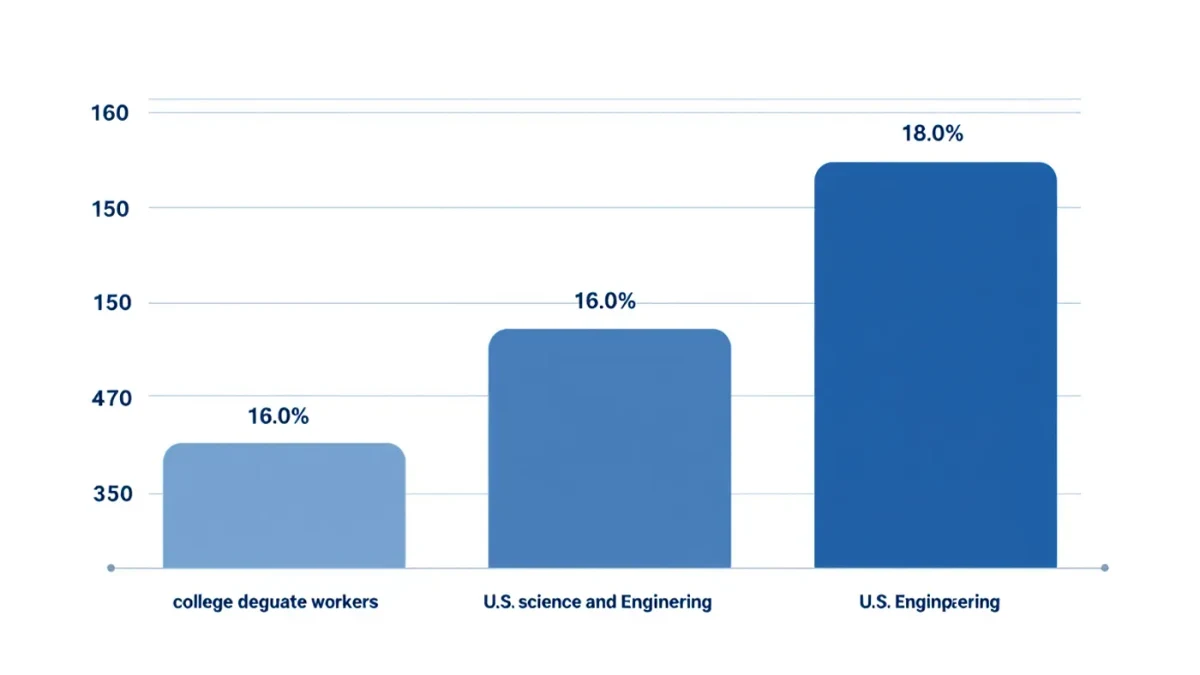
Foreign-born scientists matter to U.S. research partly because of arithmetic: NSF's Science and Engineering Indicators reports that roughly a third or more of the U.S. science and engineering workforce with college degrees was born elsewhere, with the share rising well above half at the doctoral level in fields like engineering and computer sciences, and temporary visa holders have accounted for a substantial fraction of U.S. doctorates awarded in those fields for decades. The American research system, in other words, is staffed in large part by people who arrived in it from abroad.
This site publishes information about science-workforce research, not immigration advice.
What do the federal statistics show?
The clearest data come from two NSF systems. The Survey of Earned Doctorates, a census-like survey of new PhD recipients, has recorded for decades that temporary visa holders receive a large share of U.S. doctorates in engineering and computer science, with the national figure for all fields running near a third in recent years and much higher in those two, though India and China dominate the origin countries. The Indicators workforce analyses, drawing on census-type surveys, put the foreign-born share of scientists and engineers in the U.S. at roughly a third overall, and higher among doctoral holders, concentrated in academia, pharmaceutical research and information technology.
Patent and publication analyses, including peer-reviewed studies published from the 2000s onward, have repeatedly found immigrants overrepresented among highly productive researchers. A 2017 study found immigrants made up a disproportionate share of authors of exceptionally highly cited papers and of founders of fast-growing firms. Such findings are correlational, reflecting selection in who manages to migrate, but the pattern itself is consistent.
How did the system get this way?
By design, in part. Postwar policy built channels aimed at talent: the Immigration and Nationality Act of 1965 removed national-origin quotas, and later policy created paths such as the H-1B visa in 1990 and, for advanced-degree holders, mechanisms like the national interest waiver and the employment-based permanent residence categories. Universities also became employers of international talent through the exchange-visitor J-1 program, widely used for postdoctoral researchers. Doctoral funding played a role too, since U.S. research grants can fund any student admitted to a program, regardless of nationality.
What happened during the visa disruptions of recent years?
The system showed its sensitivity. Policy changes and pandemic-era consular closures in 2020 sharply cut new international student enrollment for a period, and processing backlogs persisted afterward. The Justice Department's China Initiative, launched in 2018 and ended in February 2022 after criticisms and failed prosecutions, was associated in analyses by policy groups with a measurable drop in Chinese scientists choosing to work in or return to the United States. Reports published in the early 2020s, including surveys of researchers of Chinese descent, documented increased caution about U.S. careers. None of these events stopped the pipeline; together they narrowed intake at the margins, which is precisely where workforce statistics register change.
How do we know the contributions, not just the counts?
Beyond headcounts, three strands of evidence are typically cited. First, Nobel and early-career prize data: analyses of U.S. Nobel laureates in the sciences have long shown a substantial immigrant share, for instance of the U.S. laureates in chemistry, medicine and physics since 2000, a considerable fraction were born abroad. Second, economic studies of invention, including work linking visa lotteries to patenting, which found random variation in visa access translated into measurable differences in innovation output. Third, institutional dependency: fields like computer science faculty hiring, examined in studies of doctoral training, show international PhDs feeding entire subfields. Each strand has limits, selection effects above all, since migrants are not a random sample of their home countries or their fields. The convergence of counts, prizes, patents and field-level dependency is what carries the argument.
Could the composition change quickly?
Workforce analysts note the system has feedback loops in both directions. A strong research system attracts talent; talent sustains the system's output. Competition matters: the OECD's international student data through the early 2020s showed other countries, and increasingly strong domestic systems in China and India, absorbing researchers who once had few alternatives. Long-run Indicators series show China's own doctoral production overtaking the U.S. in STEM fields, which changes the calculus for mobile researchers. The honest position is that U.S. dependence on foreign-born talent is a maintained condition, not a fixed law, and it responds to policy and opportunity with a lag of a few years.
Why does this matter beyond academia?
Because research capacity has economic consequences. Studies of regional innovation, including work on immigrant founders in technology clusters, associate talent inflows with firm formation and job growth, and the pharmaceutical and semiconductor industries explicitly cite talent availability in workforce planning. The reverse experiment, talent outflow, has been run elsewhere and is not encouraging for the losing side. For a reader weighing confidence in U.S. science, the Indicators' message is double-edged: the system's openness is among its measurable strengths, and its dependence on that openness is equally measurable.
What have studies estimated about reduced inflows?
Directly measuring a counterfactual is impossible, so researchers rely on natural experiments. Studies of the 2020 visa restrictions found sharp drops in new petitions and enrollment in affected categories, and a 2017 study of the H-1B lottery used its randomization to show that firms denied visas reduced employment and innovation output rather than seamlessly substituting native workers, evidence that talent constraints bind. Econometric work on the post-1965 immigration waves associated immigrant inflows with measurable patenting increases in receiving regions. None of these pins down the future, but together they support a direction: restricting the inflow of skilled researchers tends to reduce research activity here, with the loss distributed across firms, universities and the graduate programs that depend on international applicants to fill positions domestic students do not.