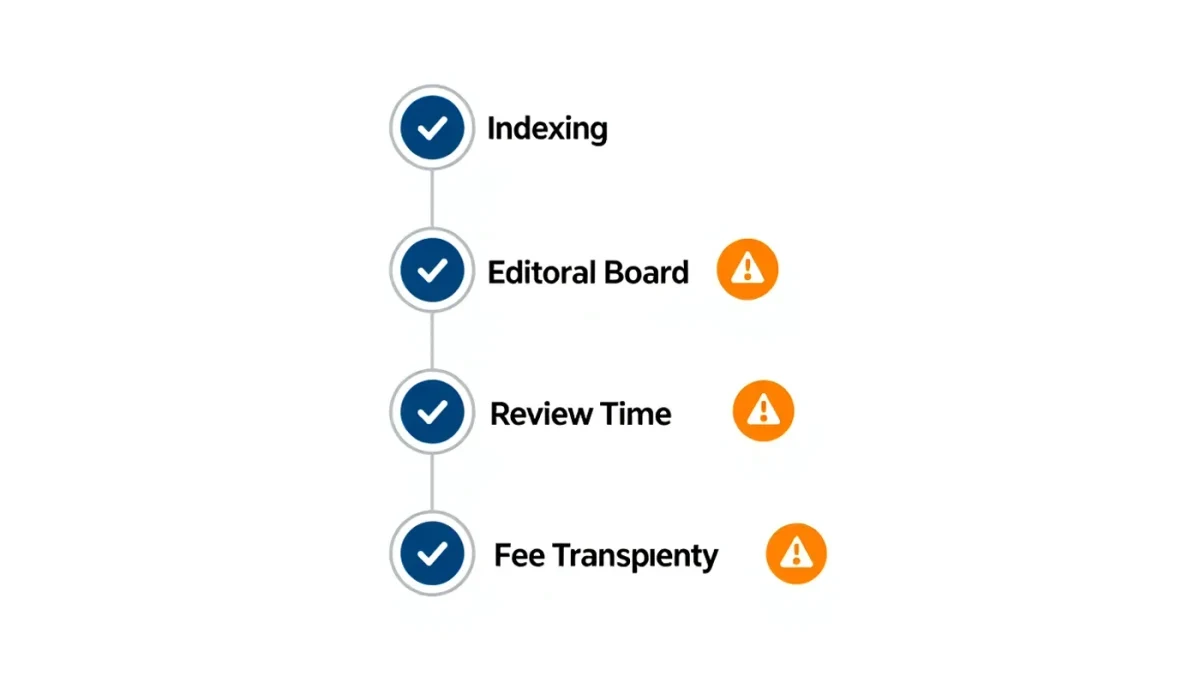
A predatory journal can be spotted by a cluster of signals rather than any single flag: review completed within days, editorial boards whose members do not know they are listed, article-processing fees disclosed only after acceptance, and a title mimicking a respected journal. Librarians built a public response to this problem — the Think. Check. Submit. campaign, launched in 2015 by a coalition of library and publisher organizations, which walks authors and readers through exactly these checks. The signals are visible to readers, not just to authors.
Engevity News publishes information, not professional advice. This piece explains how questionable journals reveal themselves; institutional publishing decisions belong to authors and their institutions.
What makes a journal predatory?
The term, popularized by librarian Jeffrey Beall's lists in the early 2010s, describes publishers that collect fees while providing little or no real peer review, editing, or archiving — the services the fee is supposed to buy. The label covers a spectrum, and researchers debate where profiteering ends and merely sloppy publishing begins; a 2019 Nature survey of thousands of researchers found deep disagreement about the term itself. But the core pattern is not controversial: the publisher's revenue depends on accepting manuscripts, and the quality controls that should reject manuscripts are absent or decorative. For a reader, the practical question is narrower — did anything resembling genuine peer review happen before this paper appeared?
Which clues matter most?
Several checks separate credible journals from imitators, and all of them can be done in minutes from the journal's own website.
- Review speed promised in days, or a manuscript accepted within a week — genuine peer review typically takes weeks to months.
- Editorial board members who are listed without their knowledge, uncontactable, or duplicated across unrelated journals.
- Fees that appear only after acceptance, or aggressive solicitation emails inviting submissions to wildly mismatched topics.
- A journal name nearly identical to an established journal, or a claimed impact metric that is not one of the standard citation indexes.
- Published articles riddled with formatting errors, missing affiliations, or identical template text.
How do we know these signals work?
Because they have been tested in the field. In the most famous probe, Science correspondent John Bohannon submitted a deliberately flawed study about a molecule from lichen — 304 versions, each with grievous errors that any competent reviewer would catch — to a sample of open-access journals in 2013; more than half accepted it. Sting operations have limits as evidence, and the sample did not include subscription journals for comparison, but the result demonstrated that the acceptance-for-fee pathway exists at scale. Follow-up analyses by scholarly-communication researchers have continued to map the market, and coordinated efforts — including a 2022 international coalition statement that cross-publisher watchlists could be sustained without a single centralized list — keep the detection criteria public. The signals persist because the underlying business model does.
Why should readers care, not just authors?
Because a paper's provenance is part of its evidence. A reader who cites a predatory article inherits its unreviewed claims, and questionable papers do not stay confined to obscure corners: investigations by journalists, including the Retraction Watch project founded in 2010, have documented flawed papers from fake-review journals propagating into citation databases, clinical-literature reviews, and policy documents. Hundreds of papers have been retracted after editors discovered the peer review was fabricated — reviews submitted through phony reviewer email addresses. The cost compounds: every uncritical citation launders the paper one step further into respectability.
Is open access the problem?
No, and confusing the two is the most common error. Legitimate open-access publishers — PLOS, eLife at launch, and the open-access arms of Nature, Science, and Elsevier — charge fees and provide rigorous review; the model itself is sound and widely used. Predatory publishers exploit the same fee structure without the review. The 2013 Bohannon sting targeted open-access journals because the fee model creates the incentive, but subscription-based journals have their own quality scandals. The reader's question is never "does this journal charge?" but "what does the charge buy, and who verified it?".
What should a reader do with a paper already published in one?
Discovering that a cited paper sits in a questionable journal does not, by itself, prove the paper wrong — a handful of sound studies have appeared in weak venues, sometimes because authors were deceived rather than careless. But it does shift the burden of proof. The reader should check whether the same finding appears in independently reviewed work, whether the paper's data and methods are public enough to audit, and whether any authoritative reviews cite it. In citation databases, a paper whose references are mostly older and unrelated, or whose authors cannot be traced to real institutions, deepens the concern. If nothing else corroborates the claim, the honest move is to set the paper aside as unverified — annoying when it is the only study on a question, but far better than letting an unaudited claim enter a bibliography wearing the costume of peer review.
How can a reader verify a journal quickly?
Two minutes and three lookups settle most cases.
- Check whether the journal is indexed in PubMed or a standard citation index — absence is not proof of predation, but it removes a layer of screening.
- Verify one editorial board member on a university website; a real editor knows they serve.
- Look up the journal and its publisher in the archive of Retraction Watch coverage.
A journal that fails all three has not earned the trust its formatting imitates.