Laboratory safety training in U.S. universities is required mainly through a federal regulation, OSHA's Laboratory Standard of 1990, which obliges every institution that uses hazardous chemicals to maintain a written chemical hygiene plan and train each worker on the specific hazards of their work. What that training covers in practice is shaped by professional guidelines and by lessons drawn from fatal incidents, including the 2008 death of a young research assistant at the University of California, Los Angeles.
This site publishes information about laboratory safety practice, not site-specific safety advice; readers with hazards in their own labs should consult their institution's safety office.
What does the OSHA Laboratory Standard demand?
The standard, formally the Occupational Exposure to Hazardous Chemicals in Laboratories rule, took effect in 1990. It requires a chemical hygiene plan: standard operating procedures for handling hazardous substances, criteria for exposure control, measures such as fume hoods and personal protective equipment, and provisions for training. Training must happen at assignment, before work with new hazard classes, and when conditions change. The rule is performance-based, meaning OSHA sets goals rather than a national curriculum, so depth varies across institutions.
Underneath sit additional layers. Hazard communication rules govern labeling and safety data sheets, and institutional review requirements govern biological and radiation hazards separately. A student handling pyrophoric chemicals, infectious agents and radioactive tracers may be enrolled in three distinct training tracks.
What does training typically include?
A standard university curriculum now covers a predictable set of elements, increasingly delivered as online modules followed by in-person, hands-on sessions for high-hazard work.
- Reading safety data sheets and chemical labels before first use.
- Correct use of fume hoods, including sash positioning and what never goes in one.
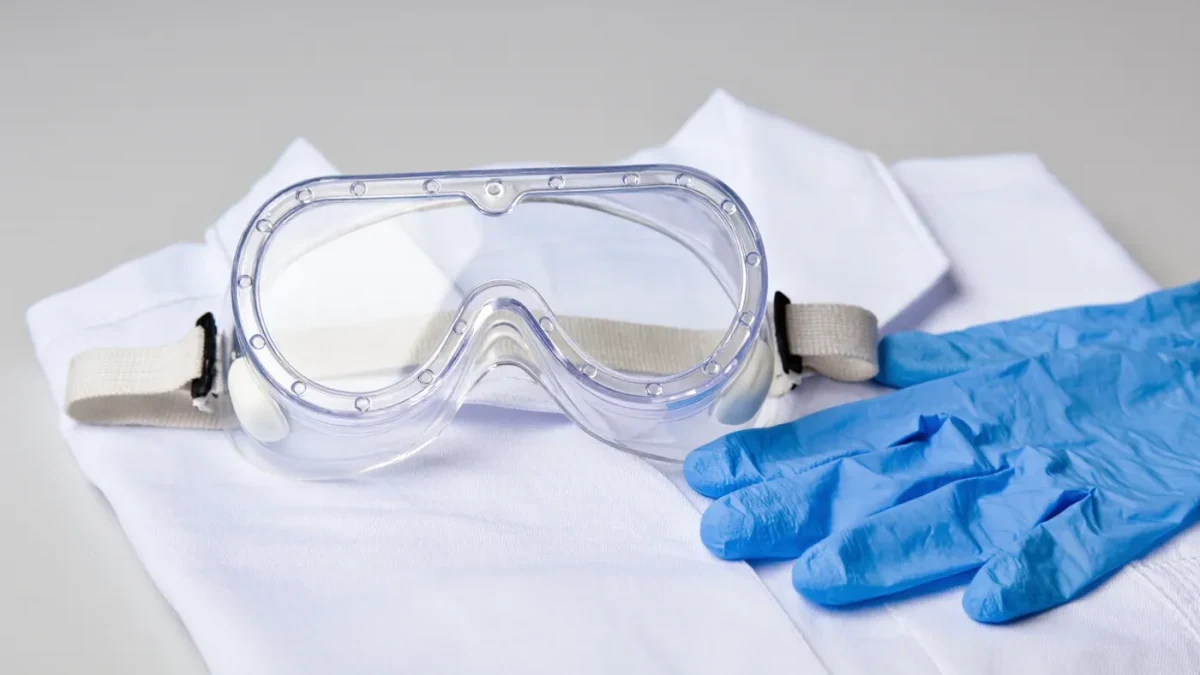
- Personal protective equipment selection: goggles versus safety glasses, gloves matched to the chemical, lab coats that stay in the lab.
- Emergency response: eyewash and shower use, spill kits, and reporting near misses.
- Chemical inventory, incompatible storage and waste segregation and disposal.
- Specialized modules for pyrophorics, compressed gases, controlled substances and biological agents.
What happened at UCLA in 2008?
In December 2008, Sheharbano Sangji, a 23-year-old research assistant, suffered severe burns when a syringe of tert-butylithium, a chemical that ignites on contact with air, caught fire as she transferred it; she died eighteen days later. Cal/OSHA investigated, citations followed against the university, and in 2012 the chemistry professor supervising the lab reached a settlement agreement in a rare criminal case. The incident became a national reference point because the subsequent reviews found the assistant had not received documented training for the procedure and was not wearing a lab coat.
The case helped shift expectations from an apprenticeship model, in which students learned safety informally from senior lab members, toward documented, auditable training records, a shift accelerated by the University of California system's post-2008 reforms.
What did the Chemical Safety Board find in academic labs?
The U.S. Chemical Safety Board, the federal agency that investigates chemical accidents, examined academic laboratory safety after a 2010 explosion at Texas Tech University injured a graduate student working with energetic nickel hydrazine compounds. Its 2011 report described a culture in which graduate students sometimes scaled up reactions without systematic hazard analysis, and it noted that academic labs were governed by guidance rather than the stricter process-safety management rules applied to industry. The board recommended that universities adopt stronger incident reporting and that federal funding agencies consider safety culture in grant oversight, a suggestion that remains contested.
Professional bodies responded. The American Chemical Society issued guidelines for chemical safety in academic institutions, first published in 2012, and the hazard-analysis framework known as RAMP, recognize hazards, assess risks, minimize risks and prepare for emergencies, promoted by safety educators Robert Hill and David Finster, has spread through curricula.
How do we know what makes training effective?
Evidence in this field is thinner than the rulebooks imply. Systematic studies of academic safety training are scarce; most support for specific practices comes from regulatory findings, case investigations such as the Texas Tech report, and surveys by groups like the ACS Committee on Chemical Safety, which have repeatedly found that students underreport incidents and often skip protective equipment when unsupervised. A 2012-13 survey of university labs by the ACS and others documented uneven training requirements across departments. Because accidents are rare events, no randomized trial of training regimes exists; institutions instead rely on leading indicators, such as near-miss reports and inspection results, which measure culture rather than outcomes directly.
Who checks that any of this happens?
Internally, environmental health and safety offices audit labs, often annually, and principal investigators bear formal responsibility for their groups. Externally, OSHA inspections of academic labs are complaint-driven and relatively infrequent, and federal agencies do not routinely audit safety as a condition of grants, a gap the National Academies and the CSB have both flagged. In practice, enforcement pressure after serious incidents, fines, settlements and reputational cost, has done more to standardize training than routine oversight. The trajectory across two decades is visible: from unwritten apprenticeship to mandatory modules, and, slowly, toward treating a lab the way industry treats a chemical plant, as a system designed not to rely on memory or luck.
Do teaching labs face the same expectations as research labs?
In principle the rules follow the person and the chemical, not the purpose, so an undergraduate course laboratory using hazardous substances falls under the same chemical hygiene plan as a research laboratory. In practice the two settings differ. Teaching labs use curated experiments with pre-measured reagents, fixed procedures and instructors circulating, which narrows the hazard envelope, and incidents there are correspondingly less frequent and less severe. Research labs put novices next to open-ended work with unfamiliar combinations, higher-energy materials and pressure to produce results, which is precisely the setting the Texas Tech investigation flagged. That asymmetry explains a consistent theme in safety literature: formal training tends to be strongest in teaching contexts, while the greatest risk sits in the research spaces where supervision thins just as autonomy rises.