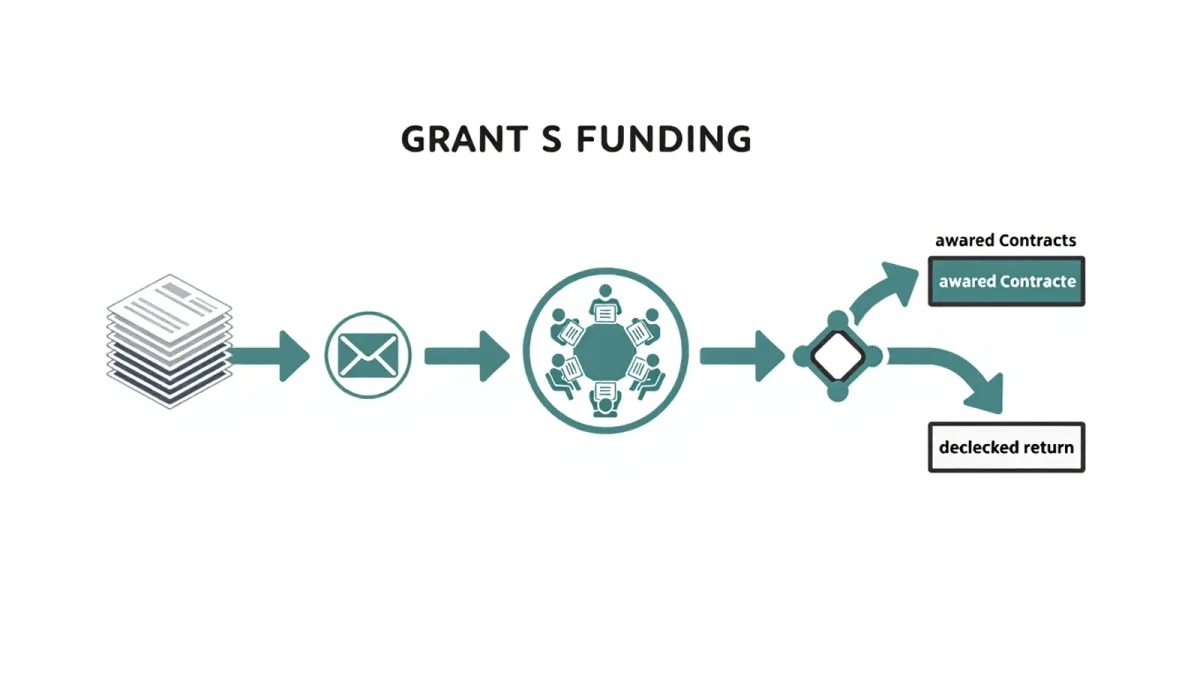
Most U.S. federal research grants are awarded through a two-layer system of expert review: working scientists score each proposal in writing and in panel meetings, and a second advisory body checks that the agency's final rankings follow the rules. At the National Science Foundation and the National Institutes of Health, the two largest basic-research funders, this structure has remained broadly stable since the middle of the twentieth century.
This site publishes information about how research institutions work, not advice on applying for grants.
Who actually decides which proposals are funded?
No single person chooses. At the NSF, proposals are typically read by a handful of external reviewers with relevant expertise, then discussed by a panel of roughly ten to twenty scientists convened by a program officer, a career staff scientist who manages a portfolio. At the NIH, most applications go to a standing review committee, known as a study section, run through the agency's Center for Scientific Review. Roughly a quarter of a million applications move through NIH review each cycle cycle across the agency's institutes.
Reviewers donate this time. Panel service at both agencies is unpaid apart from travel reimbursement, and much of it is performed by academic researchers between teaching and their own lab work. The system presumes that active researchers are the people best placed to judge whether a proposed study is technically sound and scientifically important.
What criteria do reviewers apply?
Since 1997, the NSF has used two formal criteria: Intellectual Merit, which covers the quality of the science, the qualifications of the team and the potential to advance knowledge, and Broader Impacts, which covers the work's wider benefits to society, such as education, workforce development or public engagement. Reviewers must address both in writing.
The NIH, by contrast, scores five core criteria: significance, investigator(s), innovation, approach and environment. Each is scored from 1 to 9, with 1 the best, and the scores combine into an overall impact score. In practice, reviewers have long observed that the approach section, the actual experimental plan, tends to carry the most weight.
What happens after the panel meets?
At the NIH, the study section produces a priority score and a percentile, which ranks an application against others reviewed by the same committee in recent cycles. The percentile matters because each NIH institute sets a funding threshold, known as a payline. Applications that fall within the payline are very likely to be funded; those near it may be discussed again by the institute's advisory council, the second layer of the NIH's dual-review system.
At the NSF, the process is more discretionary. The program officer writes an analysis, called a review analysis in agency materials, and can recommend funding proposals that ranked below others, provided the rationale is documented. The division director makes the final award decision, and the National Science Board, the agency's presidentially appointed oversight body, sets broad policy. This means an NSF program officer holds real, if constrained, influence over which science gets done.
How tight are the funding odds?
Tight, and getting tighter. NIH success rates for research project grants have generally run between roughly 15 and 20 percent through the 2010s and early 2020s, down from around 30 percent in the early 2000s, according to the agency's own statistics. NSF success rates have typically hovered near 20 to 25 percent in recent years. The numbers vary sharply by institute, by directorate and by year.
| Agency | Review body | Core criteria | Typical recent success rate |
|---|---|---|---|
| NIH | Study sections (Center for Scientific Review) | Significance, investigators, innovation, approach, environment | ~15-20% |
| NSF | Ad hoc reviewers plus panels | Intellectual Merit and Broader Impacts (since 1997) | ~20-25% |
How does the money reach a scientist's bench?
An award is not a check to a person. Grants go to institutions, mainly universities, which administer the funds, charge overhead costs, often roughly half again on top of direct costs, and pass the rules down to the researcher. A typical NIH research project grant, the R01, supports salaries for trainees, supplies, equipment and travel for three to five years, after which the lab must compete again.
This cycle shapes careers. Because renewal depends on productive prior awards, the system favors researchers who can sustain a continuous funding record, a pressure that studies of academic careers have linked to risk-averse proposal writing.
How do we know this is how the process works?
The account above rests on the agencies' own published documentation: the NSF's Proposal and Award Policies and Procedures Guide, which spells out the two review criteria and the program officer's role, and the NIH's peer-review pages and data books, which publish success rates, percentile calculations and study-section rosters. Reviewer names and panel rosters are public at both agencies after the fact. Critics, including reports from the Government Accountability Office and the National Academies over the years, have documented biases in the system, among them documented advantages for established applicants and persistent disparities in award rates, which is why reviewers receive conflict-of-interest rules and bias training. The published statistics make the system unusually auditable for a federal program.
Are there alternatives to panel review?
Yes, though they remain small. The NSF has experimented with mechanisms such as the Creative Research Awards, and some funders, including the Howard Hughes Medical Institute, fund people rather than projects. Some European agencies use lottery selection for proposals ranked near the funding line, a practice studied by the Italian funding body FORLILVEI-affiliated researchers and others. The panel system persists largely because it distributes judgment across many experts and leaves a documented rationale, features the alternatives struggle to match at scale.
What does this mean for the science that gets done?
Review shapes the research agenda as much as any discovery does. When success rates fall, reviewers favor safe, incremental proposals; when particular fields are prioritized in agency budgets, panel sizes and proposal volumes shift accordingly. Understanding the mechanics helps explain why certain research exists at all, and why scientists spend a striking share of their working lives writing and reviewing grants.
Who serves on panels, and can the public see it?
Panelists are active researchers nominated by agencies, colleagues or themselves, and the NSF expects roughly a third of reviewers each year to be first-time panelists, a rule intended to widen the pool beyond the usual gatekeepers. Study section rosters are published on the NIH's public RePORT system after each meeting, and the NSF discloses reviewer names upon request under its policies, which makes the system more inspectable than most federal decision processes. Service is unevenly distributed: analyses by the NSF's own evaluation staff have found reviewers skew toward senior, well-funded investigators, which critics argue builds a conservative tilt into the system. Efforts to recruit earlier-career reviewers, including graduate students onto certain NSF panels, exist but remain small relative to the volume of proposals reviewed each cycle.