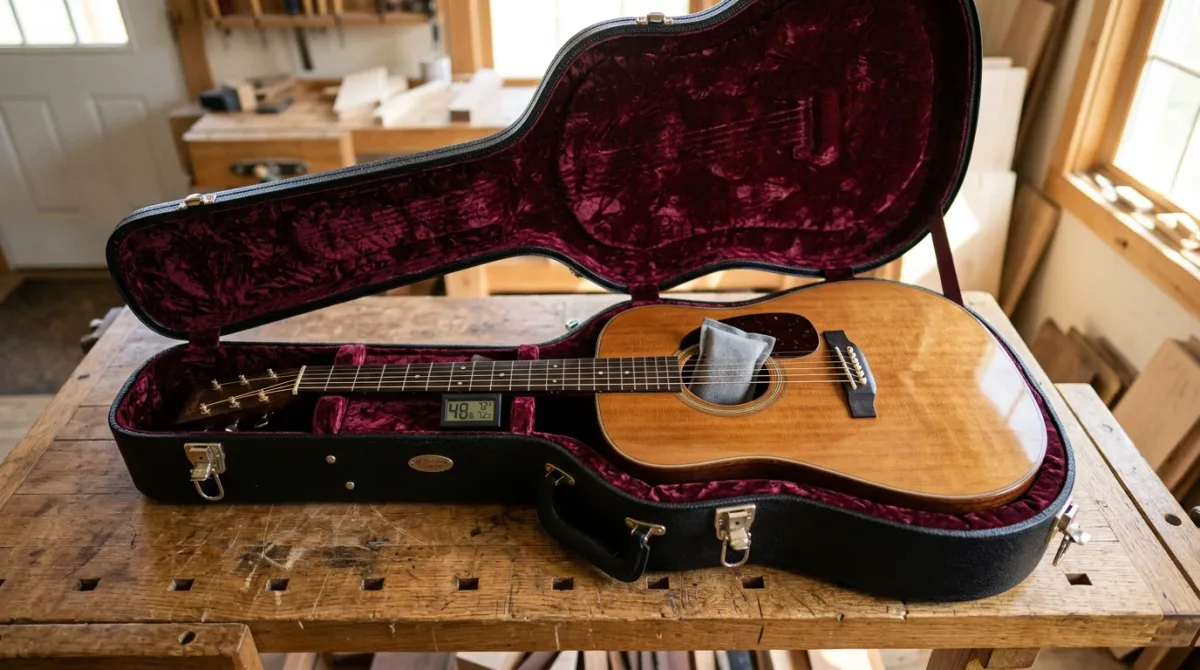
On the supplied evidence — Taylor's, Martin's and D'Addario's own care documentation, plus federal wood-moisture data — a sealed two-way case system is the pick for most acoustic owners, with D'Addario's Humidipak Maintain at $25.99 as of the maker's listing on August 20, 2026. The qualification: none of it works unless the guitar actually lives in a closed case.
Every load-bearing number below traces to a named document. The 45–55% relative humidity target and the symptom lists are Taylor's published maintenance guidance. The 45–50% band for two-way packets, the three-packet count and the $25.99 price come from D'Addario's Humidipak Maintain listing, checked August 20, 2026. The $15.00 price and the resin-tube description are from Martin's listing for item 18AHG, checked the same day. Wood-moisture figures come from the USDA Forest Products Laboratory; the stability numbers come from the National Park Service; hygrometer calibration rests on a 1977 National Bureau of Standards paper. A maker is the source of its own specifications and claims, not independent verification: no independent laboratory test of either product was supplied.
Strengths of the two-way packet system
- Holds a stated 45–50% RH with no refilling, per D'Addario's listing.
- Three packets and a soft mesh pouch in the box, per the same listing.
- Sealed packets, so no open water sits inside the body.
- Removes moisture as well as adds it, which the maker describes as automatic in both directions.
Trade-offs
- Consumable: D'Addario states packets last two to six months, then need replacing.
- $25.99 against $15.00 for Martin's refillable tube, per each maker's listing on August 20, 2026.
- Inert with the case open — D'Addario specifies a sealed case.
- No supplied independent measurement confirms in-case RH against the claimed band.
| Field | Detail |
|---|---|
| Gear category | Acoustic guitar case humidification |
| Makers and models | D'Addario Humidipak Maintain (three packets plus mesh pouch); Martin Guitar Humidifier, item 18AHG |
| Street price | $25.99 and $15.00 respectively, as of each maker's own listing on August 20, 2026 |
| Release year | Not stated in the supplied manufacturer listings |
| Basis of coverage | Manufacturer documentation from Taylor, Martin and D'Addario, plus published federal data from the USDA Forest Products Laboratory, the National Park Service and the National Bureau of Standards. No hands-on testing. |
Why does humidity matter to a wooden guitar?
Because wood takes on and gives up moisture until it matches the air around it, and it changes size as it does. The Forest Products Laboratory's Wood Handbook chapter by Samuel V. Glass and Samuel L. Zelinka puts wood's equilibrium moisture content near 9.2% at 50% relative humidity and 70 °F, but only 6.2% at 30%.
That same chapter states that wood "changes dimension as it gains moisture (swells) or loses moisture (shrinks) because the volume of the cell wall depends on the amount of bound water," and that shrinkage "continues in a fairly linear manner until the wood is completely dry."
A guitar top is a thin, braced, glued panel under roughly a hundred pounds of string tension. Taylor's published maintenance page translates the wood science into an instrument-scale figure: at 30 percent humidity, it states, spruce shrinks approximately 1/8 inch in width. That is the maker's own figure, and no independent measurement of it was supplied.
What relative humidity should you actually target?
Taylor's guidance names 45–55% RH as the safe band, and the company says it builds in a controlled environment at 46 to 47 percent, at 74 degrees Fahrenheit. If you want one number to aim at, that is it. Stability matters as much as the set point.
For comparison, the National Park Service's preventive conservation recommendations (Conserve O Gram 1/3, July 1993) specify an RH range of 40% to 55% for museum objects, with "less than 5% fluctuation about the set point per 24-hour period, with a seasonal change of less than 15%." That guidance covers organic museum collections broadly, not guitars specifically, but the bands overlap closely with Taylor's.
The practical read: chasing a perfect number matters less than avoiding swings. A case is the cheapest stabilizer you own, and the NPS document makes that point in conservation terms, calling an appropriate enclosure "of major importance in minimizing relative humidity (RH) fluctuation."
How do the two main designs differ?
One design adds water and only adds water; the other adds or removes moisture until the case settles in a fixed band. Martin's soundhole humidifier is the first kind, D'Addario's packet system the second. Both are documented by their makers; neither has a supplied independent test behind it.
| Spec | Martin Guitar Humidifier (18AHG) | D'Addario Humidipak Maintain |
|---|---|---|
| Type | Refillable soundhole tube | Sealed two-way packets |
| Mechanism, per the maker | "A water-absorbing stem holds up to ten times its weight in water and slowly releases moisture through the outer holes" | Boveda-based packets that "automatically maintain the optimal 45-50% relative humidity level within your instrument case by adding or depleting moisture as necessary" |
| Stated RH result | Not specified as a numeric band on the maker's listing | 45–50% RH |
| Contents | Non-vinyl, non-allergenic resin tubes, per Martin | Three packets plus soft mesh pouch, per D'Addario |
| Service interval | Refill with water; interval not stated on the listing | Two to six months, then replace, per D'Addario |
| Price as of Aug. 20, 2026 | $15.00, per Martin's listing | $25.99, per D'Addario's listing |
Note what the price gap buys and what it does not. Martin's tube is cheaper and refills indefinitely; D'Addario's system is a subscription in disguise, and its advantage is that it also pulls moisture out. If your problem is a damp summer rather than a dry winter, only the two-way design addresses it, per the makers' own descriptions.
Where do you put it, and how do you monitor it?
Taylor's humidification guidance gives a placement sequence for packet systems, and it is worth following literally rather than improvising:
- Drape the soundhole pouch over the strings so two packets descend into the soundhole, or place it in the case cutaway area if space allows.
- Position a headstock pouch beneath the headstock, which Taylor says maintains moisture in the neck and fretboard.
- Keep a digital hygrometer, not an analog one, inside the case; Taylor specifically recommends digital for accurate 45–55% readings.
- Replace packets when the contents turn solid — two to six months depending on climate, per both Taylor and D'Addario.
A hygrometer you have not checked is a guess with a display. The standard reference for calibration is the saturated-salt fixed point: Lewis Greenspan's 1977 paper in the Journal of Research of the National Bureau of Standards puts the equilibrium relative humidity over saturated sodium chloride at 75.47 ± 0.14% at 25 °C, and over magnesium chloride at 32.78 ± 0.16%. That paper documents the fixed points; it does not evaluate consumer hygrometers, and no supplied source measured how far typical case hygrometers drift.
What goes wrong at each extreme?
Taylor publishes symptom lists for both directions, which are the most useful diagnostic you can read before spending money. Dry-side signs, per Taylor: low action with strings very close to the fretboard; a hump where the neck joins the body; a sunken top between bridge and fingerboard; a back that looks unusually flat; sharp fret ends past the fretboard edge.
Wet-side signs, per the same maker: unusually high action, a sound Taylor describes as "dull and lifeless," swelling at the tail block that leaves a low spot in the middle of the back, and frets that sight below the top of the bridge. Taylor attributes over-humidification to roughly 80–90% RH over several weeks, or 60–70% over several months.
Both lists are the maker's published account, not independent findings. Neither list, and none of the supplied documents, quantifies how quickly a given case and humidifier combination corrects a guitar already out of band.
So what should you buy?
If this is your first acoustic and you live somewhere with dry winters, Martin's $15.00 tube plus a digital hygrometer covers the failure mode you are most likely to hit, per Martin's and Taylor's documentation. Spend the difference on the hygrometer, not the humidifier.
If you are stepping up to an instrument you intend to keep, or your climate swings damp and dry across the year, the two-way system is the better structural argument: it is the only one of the two whose maker states a numeric RH band and a two-direction mechanism. That is the whole trade-off — a consumable you replace, in exchange for a claimed band you do not have to manage.
Be clear about the gaps. None of the supplied sources independently measured in-case humidity for either product, compared them head to head, or established a release year for either. The NPS figures describe museum objects rather than guitars. And no supplied evidence connects any humidifier to a sound outcome — the makers' documentation addresses wood movement and structure, which is a different claim than tone.
For a related business news perspective, read NAMM Pushes Back on Tariffs Threatening Guitar Prices.
For more context, read How Long Should You Wash Film Negatives After Fixing?.
For more context, read How chain of custody works, and what happens when it breaks.
For more context, read Nobody has been in charge of your dress size since 1983.