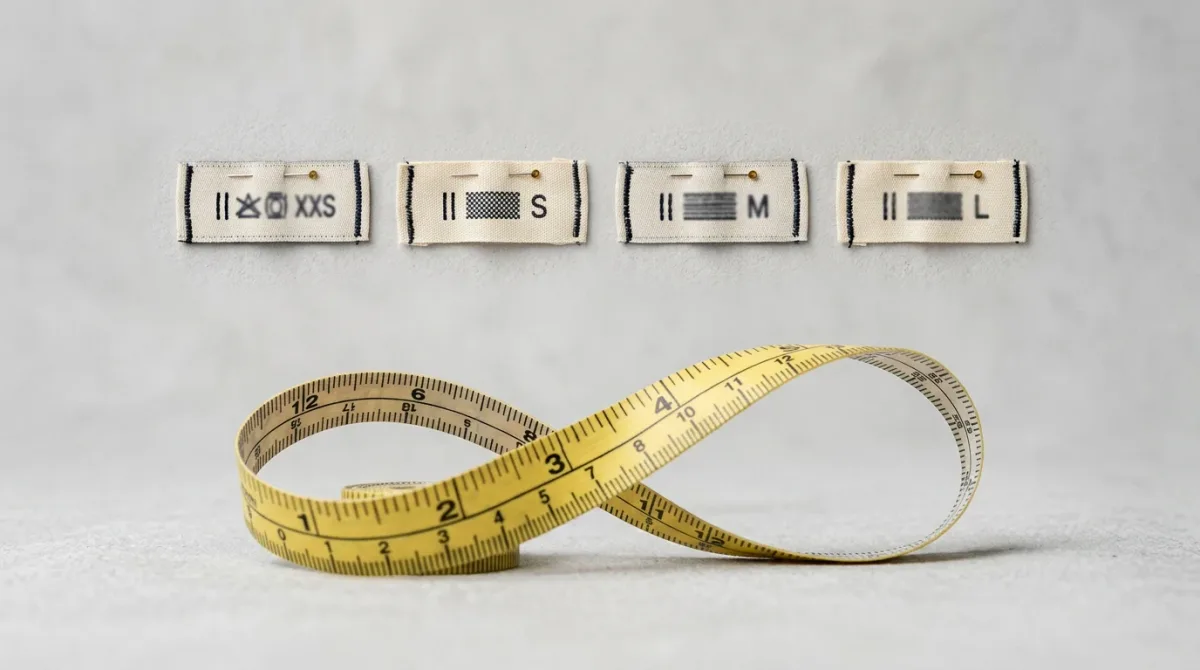
Nobody has been in charge of American women's clothing sizes since 1983. The number on your label is a brand's own decision, descended from a 1941 U.S. Department of Agriculture study by Ruth O'Brien and William C. Shelton — and from the fact that the federal standard built on that research was withdrawn decades ago.
Which means the fitting-room experience you already suspected was rigged is documented history. Not paranoia. Not a bad day. Just a vacuum where a rule used to be.
The 1941 study everyone is still quoting
Before O'Brien and Shelton, sizing had "grown up in the industry, apparently chiefly by trial and error." That phrasing is not a modern dunk — it comes from the National Agricultural Library's exhibit page on the pair's report, Miscellaneous Publication 454, produced for the USDA's Bureau of Human Nutrition and Home Economics. The stated goal was measurements that could improve the fit of women's garments and patterns.
Their central finding is the one that still explains your closet. The exhibit records their conclusion that girth measurements of the body have little relation to vertical measurements — how wide you are around tells you almost nothing about how tall you are — and their recommendation that a stature-weight combination would be the best basis for classifying women's body types.
The industry did not take that advice. It kept sorting bodies by bust.
The sample had limits, and they matter. In Time's account of the survey, roughly 15,000 women were measured at 59 points on the body, participation was voluntary, and the group skewed toward lower-income white women. A national system built on a self-selected sample was always going to wobble.
The money motive is in the record too. Time reports the push toward standardization followed an estimate that inconsistent sizing was costing manufacturers roughly $10 million a year. Fit was never purely an aesthetic concern. It was a returns problem with a dollar figure attached, and the fix was supposed to be a system of sizes, in the USDA's framing, satisfactory to consumers and to all branches of the trade.
Then the federal government let go
A commercial standard arrived in 1958, developed with the Mail-Order Association of America and the National Bureau of Standards. Time reports it drew on measurements of women who had served in the air force, ran from size 8 to size 38, and layered on height and girth designations. There was no size zero. Nothing yet required one.
Then bodies changed, manufacturers drifted from the guidelines, and in 1983 the Department of Commerce withdrew the commercial women's clothing size standard, according to the same report. That is the load-bearing date. Everything after it is voluntary.
The vacuum has a paper trail. A 1994 NIST publication by Yung-Tsun T. Lee states that U.S. sizing standards then in use relied on body measurement data gathered by the Department of Agriculture during the late 1930s, and that apart from an ASTM study aimed at women over 55, no comprehensive anthropometric study of today's diverse population had been undertaken in the United States.
Half a century of data lag, written down by a federal lab. In an abstract. With no italics.
Lee's report was not a complaint, either. It was an inventory: a compilation of body dimensions drawn from five measurement reports, plus documentation of apparel sizing standards used nationally and internationally, assembled to support future body measurement surveys and improved sizing standards. The gap got identified, catalogued, and left open.
What actually governs a size tag now
ASTM International publishes voluntary measurement tables, and they are the closest thing the American market has to a shared reference. ASTM D5585-21 covers the adult female misses figure type, size range 00 through 20; its scope states that the listed body measurements "can be used as a baseline in designing apparel" once a designer accounts for fabric type, ease for body movement, styling and fit.
Those tables filled a hole rather than closing it. Time dates ASTM's independent sizing tables to 1995, twelve years after the federal standard came down — an industry body stepping into a space the government had vacated, with no authority to make anyone comply.
Baseline. Not rule. A brand can start from that table and then choose its own ease allowance, its own fit model, its own grading — the increments it adds between one size and the next. Two labels can consult the identical document and hand you two garments that fit nothing alike.
Which is why "vanity sizing" is doing less explanatory work than the internet thinks. Vanity sizing implies a standard being gamed. There is no standard. There is a withdrawn one, a research report from the Roosevelt administration, and a set of tables a company may or may not open.
Time notes the version of this that circulates as scandal: a 12 on Marilyn Monroe in the sixties would read as roughly a 6 today. Told as gossip, it sounds like a conspiracy about shrinking numbers. Read against the timeline, it is arithmetic on a scale nobody has anchored since the Reagan administration.
None of this makes shopping easier, but it does relocate the problem. The tag is not a verdict on your body. It is a brand's estimate of a hypothetical body, produced under no obligation to match the estimate next door.
So: keep a soft tape measure in the drawer. Read the brand's own size chart before the label, because the chart is the only number the brand actually stands behind. Treat the digit on the tag as packaging copy, which is what it has legally been for the whole of your life.
The number was never neutral. It was a 1941 research project, a 1958 committee, and a 1983 shrug — and then everyone kept printing it anyway.
For a related fashion news perspective, read Ben Affleck and Matt Damon Make a Splash on Gossip Stone TV.
For more context, read How to Choose a Guitar Humidifier: Specs, Prices, Trade-Offs.
For more context, read FedRAMP: How a Cloud Service Gets Federal Authorization.
For more context, read How chain of custody works, and what happens when it breaks.