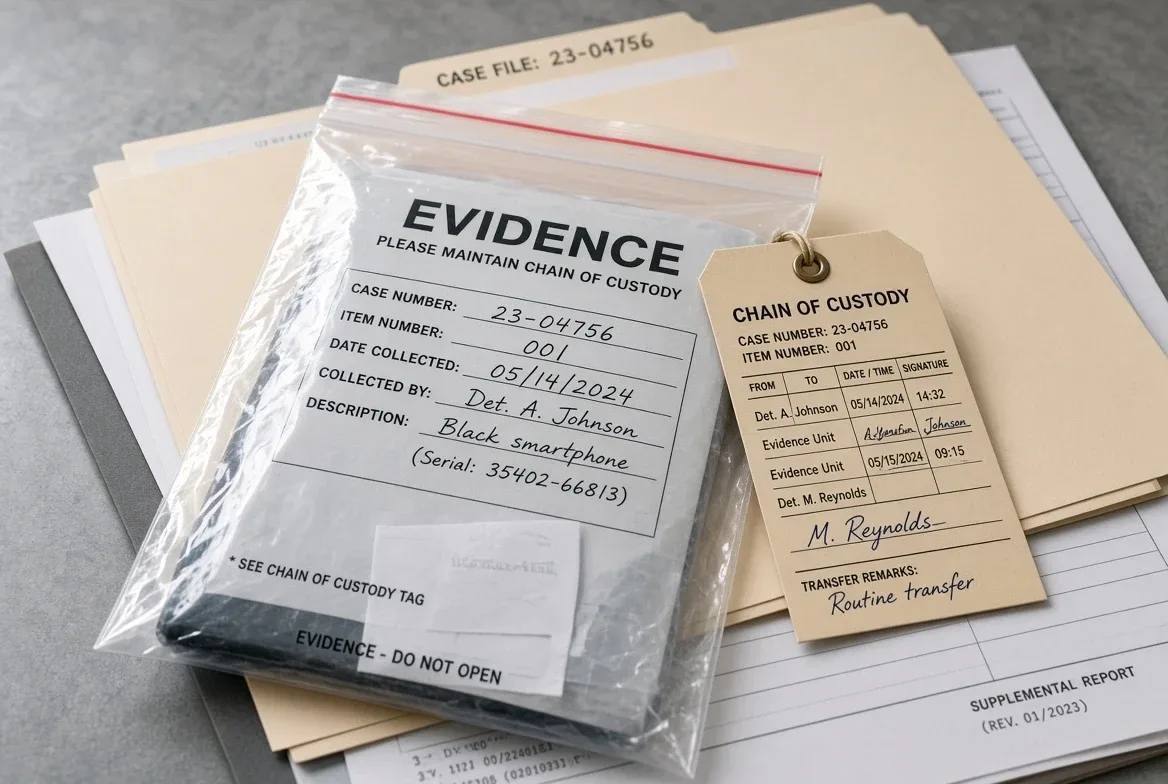
Chain of custody is the documented, unbroken record of who collected, handled, stored, and transferred a piece of physical evidence from a crime scene to a courtroom, according to the National Institute of Justice. Every person who touches that evidence signs for it, logs the transfer, and keeps it in a sealed, labeled container — and a gap in that record can lead a judge to keep the evidence away from a jury entirely.
The idea sounds like paperwork, and it is. But the paperwork decides real outcomes. A firearm, a bag of pills, or a DNA swab is only as useful to prosecutors or to a defense team as the trail proving nobody lost it, mixed it up with another case, or altered it between the scene and the witness stand. The National Institute of Justice's legal training materials for forensic experts describe chain of custody as, simply, "the ability to track tangible evidence items" from the moment they are found to the moment they are offered in court.
What exactly does chain of custody track?
Chain of custody tracks three things about a piece of evidence: where it was found, how it was preserved, and who has physically possessed it at every point since. The National Institute of Justice's guidance says investigators should record the "field location" where an item was discovered, with logs and photographs where appropriate, before it ever leaves the scene.
From there, the item has to be packaged in a way that protects it from contamination or degradation — what the guidance calls proper "preservation method." Every container is supposed to carry a complete identification tag and label so it can be matched back to a specific case, a specific item number, and a specific date of collection.
What has to be documented at each handoff?
The National Institute of Justice's checklist for maintaining chain of custody breaks the documentation into a sequence that is meant to repeat every time evidence changes hands, whether that hand belongs to a patrol officer, an evidence technician, a lab analyst, or a courier.
- Collection and sealing. "The same person or persons that recovered the evidence should initial, seal and send the evidence, or deliver it to an evidence locker," per the National Institute of Justice's guidance for maintaining a chain of custody.
- Secure storage. Agencies are directed to keep evidence "in a locked vault, cabinet or room" until it is needed for testing, discovery, or trial.
- Tracked transport. Any evidence that has to be shipped between agencies or labs requires, in the guidance's words, "a reliable shipping method that can accurately track items shipped."
- Signed transfer. "Each person who takes physical custody of an evidence item must sign for it," creating a receipt for every step the item takes.
One example of how a jurisdiction turns that general standard into a working policy is Massachusetts's Forensic Science Oversight Board, a state panel that publishes a standardized chain-of-custody protocol for evidence handled by crime laboratories and police departments statewide. The board's protocol document sets out definitions, collection procedures, and storage and training requirements that individual agencies are expected to apply, rather than leaving each department to write its own rules from scratch.
What happens when the chain breaks?
A missing signature, an unexplained gap in the log, or a container that was not properly sealed does not automatically mean evidence gets thrown out. But it gives the defense an opening to challenge whether the item in the courtroom is the same item collected at the scene, and whether it is in the same condition. The National Institute of Justice's materials frame the stakes plainly: documentation exists so that "no question should ever exist at trial or a hearing" about missing items, contamination, mislabeling, or breaks in custody that could "jeopardize evidence admissibility."
In practice, a judge weighs how serious the gap is and whether it plausibly affected the evidence's integrity. A short, explained delay in logging a transfer is not the same as an evidence bag that sat unsecured for days or was signed for by no one at all. Defense attorneys use these gaps to argue for exclusion or to undercut the reliability of the evidence in front of a jury; prosecutors carry the burden of showing the record is intact.
Why does the accuracy of the underlying test matter too?
A clean chain of custody proves an item was not tampered with — it does not by itself prove the forensic conclusion drawn from that item is correct. Those are separate questions, and the second one has its own body of research. A National Institute of Standards and Technology publication from May 2024 addresses how forensic laboratories should treat "inconclusive" results when they calculate how reliable a method is.
The NIST authors, led by researchers including Swofford, Lund, Iyer, and Butler, argue that reliability has to be assessed along two separate tracks: whether an analyst followed the established procedure correctly, and whether the method itself can actually "discriminate between different propositions of interest," such as whether two samples came from the same source. The paper does not hand down a single error-rate number for any forensic discipline; instead it proposes a framework for how labs and courts should weigh conformance to procedure against a method's real discriminating power when they report how much confidence a result deserves.
Put together with the custody rules, the two standards point at the same idea from different directions: a courtroom needs proof that evidence was not altered, and separately, proof that the method used to analyze it actually works as well as it claims to.
Frequently asked questions
Does a broken chain of custody mean a case gets dismissed?
Not by itself. A break can lead a judge to exclude a specific piece of evidence, but a case can often proceed on other evidence. Dismissal is a separate, more limited remedy tied to the overall strength of the prosecution's case.
Who is responsible for maintaining the chain of custody?
Every person who takes physical possession of an item, from the officer who collects it through the analyst who tests it, is responsible for logging and signing for that possession, per National Institute of Justice guidance for evidence handlers.
Is chain of custody the same everywhere?
The general principles are consistent, but the specific forms, software, and storage rules vary by agency and state. Massachusetts's Forensic Science Oversight Board protocol is one example of a state-level standard that individual departments apply locally.
Can a defense attorney challenge evidence even with a complete chain of custody?
Yes. A complete chain of custody addresses whether the item was tampered with, not whether the underlying test or analysis was performed correctly — those are argued separately.
For a related legal perspective, read How bail works, and what actually decides who goes free before trial.
For more context, read How to Choose a Guitar Humidifier: Specs, Prices, Trade-Offs.
For more context, read FedRAMP: How a Cloud Service Gets Federal Authorization.
For more context, read Nobody has been in charge of your dress size since 1983.