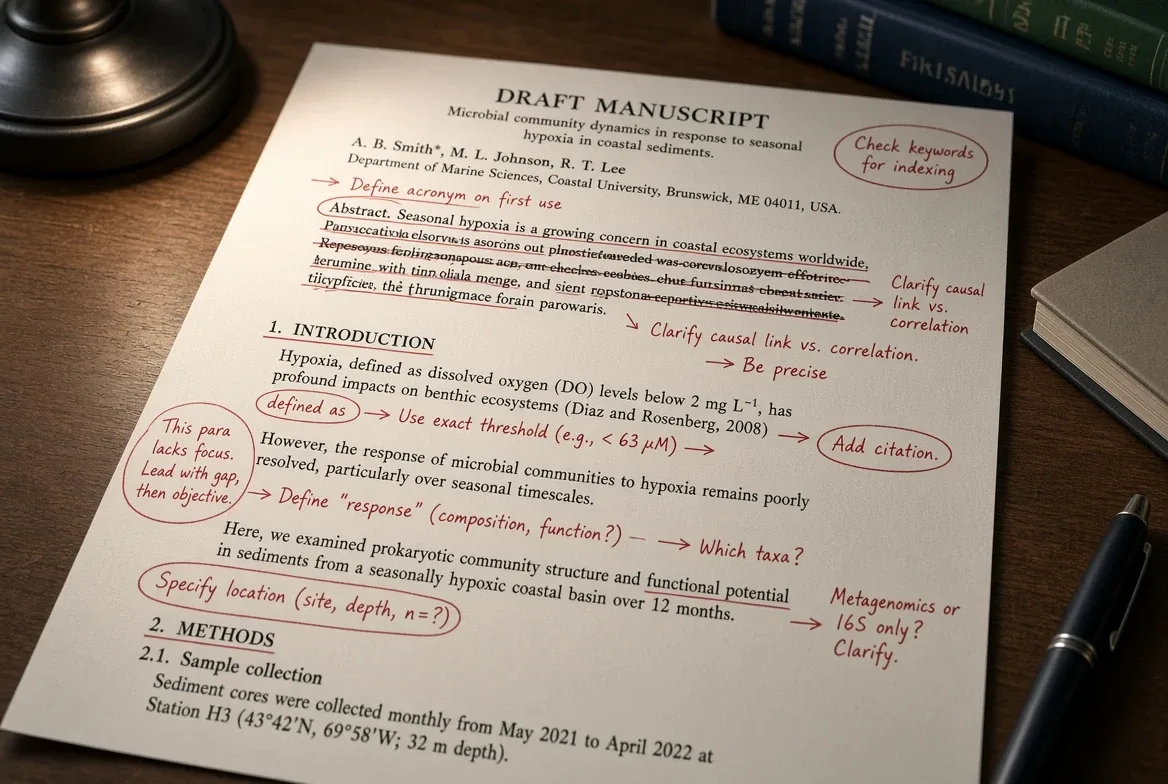
Papers that draw heavy criticism and extensive revision demands during peer review tend to earn more citations within three years than papers that sail through with light edits, a preprint posted in April 2026 by researchers at Beijing Normal University and the University of Chinese Academy of Sciences found. The analysis is correlational and has not yet been peer-reviewed itself.
What did the new analysis find?
The preprint, titled "Demanding peer review is associated with higher impact in published science," looked at what happens to a paper after reviewers push back hard on it. Among several signals of review toughness the team tracked, a paper's later citation record tracked most closely with revision cost — how much rewriting, new analysis, or additional data the authors were asked to produce. That association was statistically significant. Two other signals, how strongly reviewers voiced disagreement and how substantive their comments were, also tracked with more citations, though less strongly.
One signal did not follow the pattern: how polite or constructive reviewers were toward the authors showed almost no relationship to a paper's later impact. The toughest pushback tended to target a paper's central claims and its novelty rather than how the manuscript was written or formatted, and most of that pressure arrived in the first round of review, easing off in later rounds.
| Review signal | Association with citations within 3 years |
|---|---|
| Revision cost | Strongest positive association, statistically significant |
| Reviewer opinion strength | Positive association |
| Comment quality | Positive association |
| Reviewer constructiveness | Little to no association |
How did the researchers measure "demanding" review?
Nature Communications has published the correspondence between reviewers and authors alongside accepted papers since 2016, and made the practice mandatory for new submissions from 2022. The preprint's authors drew on that public archive, pulling 8,000 papers published between 2017 and 2024, balanced across those years, as Nature's news team reported in May 2026.
Because the reviewer comments and author responses exist as free-flowing text rather than structured scores, the team used a large language model to convert each exchange into a consistent set of measures: how strong an opinion a reviewer expressed, how constructive the comment was, how costly the requested revision would be, what kind of objection was raised, how authors responded, and whether a reviewer's demand appeared to have been met by the next round. To measure impact, they used each paper's citation count within three years of publication, drawn from the SciSciNet-V2 research database rather than a citation count the authors compiled themselves.
How do we know this, and what can't it show?
The design is observational: the researchers did not run an experiment in which some papers received tougher review and others did not. They looked backward at papers that had already been published and asked whether review toughness lined up with later citations. That structure carries real limits.
Because Nature Communications only publishes reviewer files for accepted papers, the dataset contains no rejected submissions, so the study cannot say whether demanding review predicts impact across everything sent in for review — only among the subset that eventually made it into print. It also cannot establish that tough review caused the extra citations. A paper that was already unusually ambitious or consequential might simply attract harder scrutiny and, independently, more citations later, without the review process itself doing anything to the outcome.
The measure of whether a reviewer's demand was actually satisfied was inferred from later rounds of correspondence rather than confirmed directly, and because citation counts need time to accumulate, the most recent papers in the sample had less opportunity to be cited than older ones. And the paper itself is a preprint: it has not gone through the same peer review it studies.
Why might tougher scrutiny track with more impact?
One reading the authors offer is that reviewers reserve their hardest pushback for a paper's core claims and its novelty, not its presentation, and that this pressure is concentrated early, when a paper's central argument is still being tested. The pattern has a familiar shape: in any workshop or seminar, the idea that draws the sharpest, most detailed criticism is often the one with the most riding on it, because reviewers only bother probing a claim's foundations when the claim looks like it might matter.
The comparison has a limit, though. It cuts both ways: a paper might draw harder scrutiny for the same underlying reason it later draws more citations — because it stakes out a bigger, more contestable claim — without the scrutiny itself changing anything about the science.
How does peer review actually work, in general?
Academic peer review has been used to vet submitted research for roughly three centuries, according to a 2012 explainer on the process published in the International Journal of Sports Physical Therapy. In its ordinary form, an editor first checks a submitted manuscript for fit and completeness, then either declines it without outside review or sends it to at least two independent experts in the field.
Those reviewers evaluate the study's methods, the soundness of its statistics, and whether its conclusions are supported by its results, typically working from a standardized checklist. The editor weighs that feedback and issues one of three outcomes: rejection, a request for revisions, or acceptance. When revisions are requested, authors rewrite and resubmit, sometimes through several rounds, before a paper is finally accepted and moves toward publication.
The new preprint's contribution is to show, across 8,000 cases, what tends to happen to a paper's later citation record depending on how demanding that back-and-forth turned out to be. The pattern does not tell an author, a reviewer, or an editor what to do differently. It describes what already happened to 8,000 published papers at one journal, using an automated reading of their review files, and it stops well short of showing that harsher review makes a paper better or more citable.
For a related literacy perspective, read Peer review may catch less bad science than readers assume.