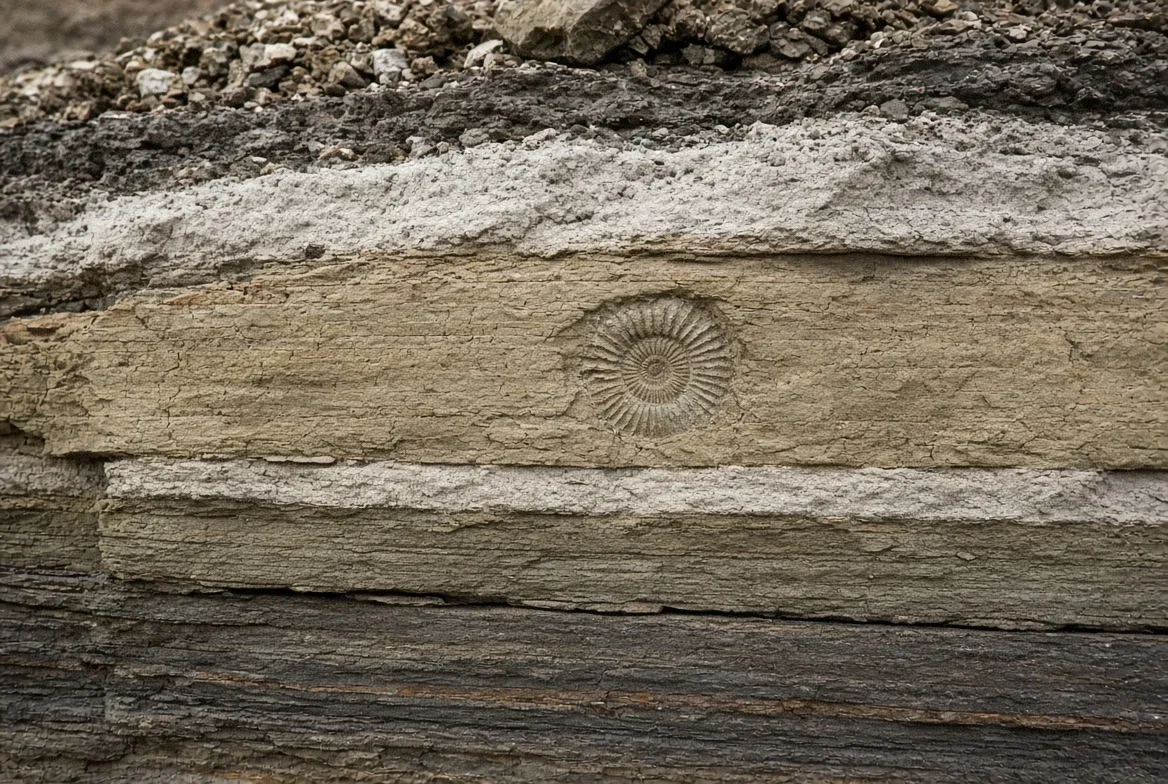
Scientists rarely date a fossil directly. Instead, they date the volcanic ash or lava layers above and below it using radiometric methods such as uranium-lead or argon-argon dating, then bracket the fossil's age between those two numbers, according to the National Park Service and the U.S. Geological Survey — a technique that works only where volcanic layers happen to be close by.
How does radiometric dating actually work?
Radiometric dating works by measuring how much of a radioactive isotope in a rock has decayed into a different, stable isotope since the rock formed. Each radioactive isotope decays at a fixed, well-known rate, described by its half-life — the time it takes for half of the original atoms to convert into the new one, according to a National Park Service explainer on radiometric dating.
Because that decay rate does not speed up, slow down, or depend on temperature or pressure, comparing the amount of remaining "parent" isotope to the accumulated "daughter" isotope in a mineral crystal gives a number: how long ago that crystal formed. Different isotope pairs suit different timescales. Carbon-14 decays into nitrogen-14 with a half-life of about 5,730 years, useful for material tens of thousands of years old at most. Uranium-238 decays into lead-206 over a half-life measured in billions of years, useful for the oldest rocks on Earth. Potassium-40 decaying into argon-40 sits in between, and is the workhorse for dating volcanic rock.
Why can't most fossils be dated directly?
The problem is what fossils are made of. A fossil is not the original bone or shell; over long stretches of time, groundwater typically replaces the original material with minerals, a process called mineralization. Those minerals did not crystallize when the animal died — they formed gradually afterward, at no single fixed moment, so a radiometric clock run on the fossil itself does not measure the age of the organism.
Radiometric dating instead works cleanly on igneous rock — rock that cooled from molten material, like a lava flow or a layer of volcanic ash — because the crystals inside it, such as zircon, do form at one identifiable moment: when the rock solidified. Sedimentary rock, the kind that actually contains most fossils, is built from grains eroded off older rocks of many different ages, so dating those grains directly would only reveal how old the source material was, not when the sediment was deposited.
How do scientists bracket a fossil's age using rock layers?
When a fossil-bearing sedimentary layer sits between two volcanic ash beds, geologists can date the ash above and the ash below using uranium-lead or argon-argon methods, then conclude the fossil in between is somewhere in that window. The Grand Canyon's rock record, mapped in detail by the National Park Service, illustrates the approach: one sedimentary unit, the Bass Formation, gets a precise age of about 1,255 million years — not from the sediment itself, but from a U-Pb radiometric measurement on a volcanic ash bed embedded within it.
Not every fossil-bearing layer has a nearby ash bed to date, however. Where no datable volcanic material exists, geologists fall back on relative dating: comparing the fossil assemblage in a layer to fossils of known age elsewhere, using an internationally agreed stratigraphic chart, and estimating an age range rather than a single number. The Grand Canyon's Redwall Limestone is one such case — its deposition is estimated to have occurred over a period of a few million years, with an approximate age of 340 million years pinned down mainly through fossil correlation rather than a direct isotope measurement.
What about carbon-14 — why doesn't it work for dinosaur bones?
Carbon-14 dating is the method most people have heard of, but it is the wrong tool for almost anything a museum calls a fossil. Its half-life of 5,730 years means that after roughly ten half-lives — about 50,000 to 60,000 years — there is too little carbon-14 left in a sample to measure reliably, according to a U.S. Geological Survey guide to dating rocks. Dinosaur fossils are tens to hundreds of millions of years old, far beyond that window, and are usually already mineralized rather than made of the original organic carbon the method requires.
Carbon-14 dating remains useful for younger organic material — wood, charcoal, shell, bone that has not fully mineralized — from roughly the last 50,000 years, which covers most of the archaeological and recent-Ice-Age record but almost none of the fossil record that gets illustrated in dinosaur books.
How much can these dates be trusted?
Radiometric ages are reported with a stated uncertainty, not as bare numbers. The Bass Formation's 1,255-million-year age, for instance, is expressed with a margin — plus or minus roughly two million years — reflecting measurement precision on that particular sample, not guesswork. Geologists also cross-check dates: an age derived from one isotope pair is considered more solid when a second, independent method or a second sample from the same layer gives a consistent result.
The main limitation is coverage, not accuracy. Where volcanic ash beds are absent, as in large stretches of sedimentary rock worldwide, fossil ages fall back on the coarser relative method, and the resulting range can span millions of years rather than the tight brackets a nearby ash layer would allow. Which method applies is a matter of what a given rock sequence happened to preserve, not a limitation of the physics involved.
Frequently asked questions
- Does this mean fossil ages are estimates rather than facts? The numeric age attached to a fossil is a bracketed range or a dated boundary, not a single measured instant — but it comes from physical decay rates that do not vary, so the range itself is well constrained where volcanic layers exist nearby.
- Can the fossil's own bone ever be dated? Only rarely, and only for younger, unmineralized organic remains within carbon-14's roughly 50,000-year range; most fossils are already partly replaced by minerals of no single formation age.
- Why do museums sometimes give a fossil's age as a single number instead of a range? A single number is often the midpoint of a bracketed range, or comes from an unusually well-dated layer, such as one sandwiched between two precisely dated ash beds.
- Is relative dating from fossils itself circular? No — the stratigraphic chart used for relative dating is built from thousands of radiometrically dated layers worldwide, so fossil-based estimates are calibrated against, not substituted for, the physical decay measurements.
For a related innovation perspective, read A brain implant let one ALS patient talk for two years at home.