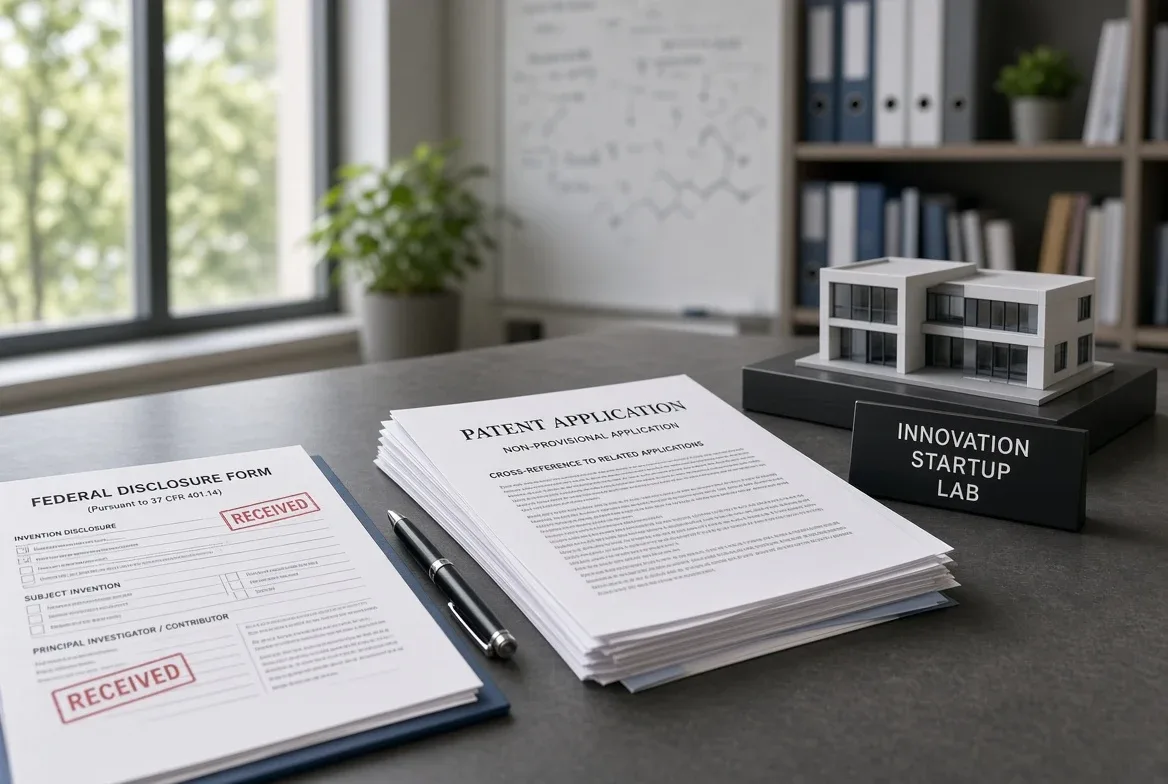
A discovery made with federal research money becomes a company through a legal pipeline built by the Bayh-Dole Act of 1980, which lets the funded university or small business keep the patent and license it to industry. The route is well documented in federal regulation. What the public record tracks well is paperwork, not outcomes.
That distinction matters for anyone reading a press release about a university spinout. The steps below are legally required and time-limited, and each one is written down in a federal rule or an agency policy. Whether the resulting company ever ships a product is a separate question, measured far less precisely.
What does the Bayh-Dole Act actually do?
It moves ownership. Under the University and Small Business Patent Procedures Act of 1980 — the formal name of Bayh-Dole — a university, nonprofit, or small business that invents something using federal funding may elect to keep title to the patent rather than hand it to the funding agency. The government retains a paid-up license for its own use.
The change was a reaction to a low number. In a 2009 review of federal invention policy, the U.S. Government Accountability Office reported that before Bayh-Dole passed, only about 5 percent of federally owned inventions were being used commercially. Congress concluded that inventions parked in a federal patent portfolio were not reaching anyone.
The implementing regulations live at 37 CFR 401 and 404, and the National Institute of Standards and Technology writes them through its Technology Partnerships Office. NIST's most recent comprehensive revision was published as a final rule on March 24, 2023, described by the agency as technical corrections, reorganization, and the removal of outdated sections — housekeeping rather than a change of direction.
What has to happen before a patent is even filed?
A sequence of deadlines, all set by the standard patent rights clause at 37 CFR 401.14. Missing one can cost the institution its right to keep the invention. The clock starts inside the university, not at the agency.
- Disclosure to the agency. The contractor must report each subject invention to the federal agency within two months after the inventor discloses it to the institution's own patent staff.
- Election of title. The contractor then has two years from that disclosure to state in writing that it intends to retain title. The window can be cut short if a statutory bar is approaching — to no fewer than 60 days before the bar takes effect.
- Initial filing. Once title is elected, the initial patent application must be filed within one year of election, or before any statutory bar expires, whichever comes first.
- Follow-on filings. A provisional application must be converted to a nonprovisional within ten months. Foreign filings generally follow within ten months of the first application.
The design is deliberate. Each step forces a decision the institution might otherwise defer indefinitely, and the shortened windows near a statutory bar exist because a public disclosure — a conference talk, a published paper — can extinguish patent rights that nobody has yet claimed.
How does a company actually get the rights?
By applying for a license, in one of several forms, with terms that vary by how much exclusivity the company wants. The National Institutes of Health publishes its own menu for inventions made in its intramural labs, and the categories are a reasonable model for how federal technology transfer works generally.
| License type | What it permits | Exclusivity |
|---|---|---|
| Commercial evaluation | Make and use the technology to assess its commercial potential; no sales or distribution | Nonexclusive |
| Internal commercial use | Make and use the invention internally, typically as a development tool; no commercial distribution | Nonexclusive |
| Patent license | Commercialize the patented invention | Exclusive or nonexclusive |
| Biological materials | Make, use, or sell commercially useful biological materials that are not patented | Usually nonexclusive |
The application itself asks for the applicant's background, the license type sought, proposed terms, and a commercialization plan. For an exclusive license, NIH publishes a notice in the Federal Register and weighs public comments over a 15-day period before deciding. Granting one company sole rights to a publicly funded invention is treated as a public act, not a private negotiation.
Three conditions travel with the license. Licensees report annually on patent utilization and development progress, with those reports kept confidential. Products sold in the United States must generally be manufactured domestically. And the license is revocable — for non-use, for non-compliance, or for failure to meet public health needs. The commercialization plan is converted into performance benchmarks written into the agreement, which is how a licensing office distinguishes a company that is developing a technology from one that is shelving it.
Where does the money come from before there is a product?
Often from a second federal program rather than from investors. The Small Business Innovation Research program, running since 1982 and coordinated by the Small Business Administration across 11 participating federal agencies, provides what the program describes as equity-free funding to American small businesses developing technology toward commercialization.
The awards are structured in phases with published ceilings. As of April 2026, SBIR lists Phase I awards at up to $323,090 and Phase II awards at up to $2,153,927, with amounts above those thresholds requiring a waiver approved by the SBA. Phase I buys a feasibility answer; Phase II buys development against that answer.
The word "equity-free" is the load-bearing one. A seed round costs a founder ownership; an SBIR award does not, which is why hardware and life-science companies with long development timelines lean on it hardest. It also means the award is not a market signal — a government reviewer's judgment that a project is worth trying is not the same as an investor's judgment that it is worth buying.
How do we know this route works, and what do the numbers miss?
The best available national picture comes from the National Science Board's February 2024 report on invention, knowledge transfer, and innovation, compiled by the National Center for Science and Engineering Statistics using survey data collected by the Association of University Technology Managers. It counts activity across U.S. academic institutions, and the counts are substantial.
For 2021, the report records almost 8,800 new licenses or options issued by U.S. universities, with 78 percent of them going to startups and small businesses of fewer than 500 employees — up from 69 percent in 2011. Universities reported 1,009 startup companies formed to develop licensed technology that year, and about 66 percent of those companies were located in the university's home state.
Here is the limitation, stated plainly. Those figures come from a voluntary survey of technology transfer offices, so they reflect institutions that chose to respond and report their own activity. A license executed is a contract signed, not a product sold; a startup formed is an incorporation, not a going concern. The data describes the front of the pipeline in detail and says very little about what emerges at the other end.
The geography finding is the one with the least ambiguity attached: two-thirds of these companies stay near the lab they came from, which is consistent with the long-standing observation that early-stage technology companies cluster around the people who understand the technology.
Can the government take the rights back?
In principle yes, through what the statute calls march-in rights, and in practice it has not happened. GAO's 2009 report to the congressional judiciary committees laid out the four grounds: a licensee failing to take effective steps toward practical application, unmet health or safety needs, unmet requirements for public use, and a breach of the domestic manufacturing preference.
The report examined the Department of Defense, the Department of Energy, NASA, and NIH, which together controlled 89 percent of federal research funding in 2006. None had ever exercised march-in authority, despite holding it for roughly two decades at that point. NIH had received three formal march-in petitions, in 1997 and 2004, and rejected all three. GAO noted the fact-finding procedure alone takes five to eight months, and that officials cited both process complexity and concern about chilling private investment.
That report is now more than fifteen years old, and march-in policy has remained an active area of federal rulemaking since — NIST has continued to work on an interagency framework for evaluating march-in requests alongside its handling of domestic manufacturing waivers. Anyone relying on march-in as a live check should confirm the current position with the agency rather than with a 2009 count.
What the pipeline is, in one line
Federal money produces an invention; a statute from 1980 lets the inventing institution own it; a regulation sets short deadlines for disclosing and patenting it; an agency licensing office sells rights under conditions that can be revoked; and a separate federal program often funds the first years of the company. Every step is documented. The success rate is not.
For a related briefings perspective, read How does an mRNA vaccine actually work?.